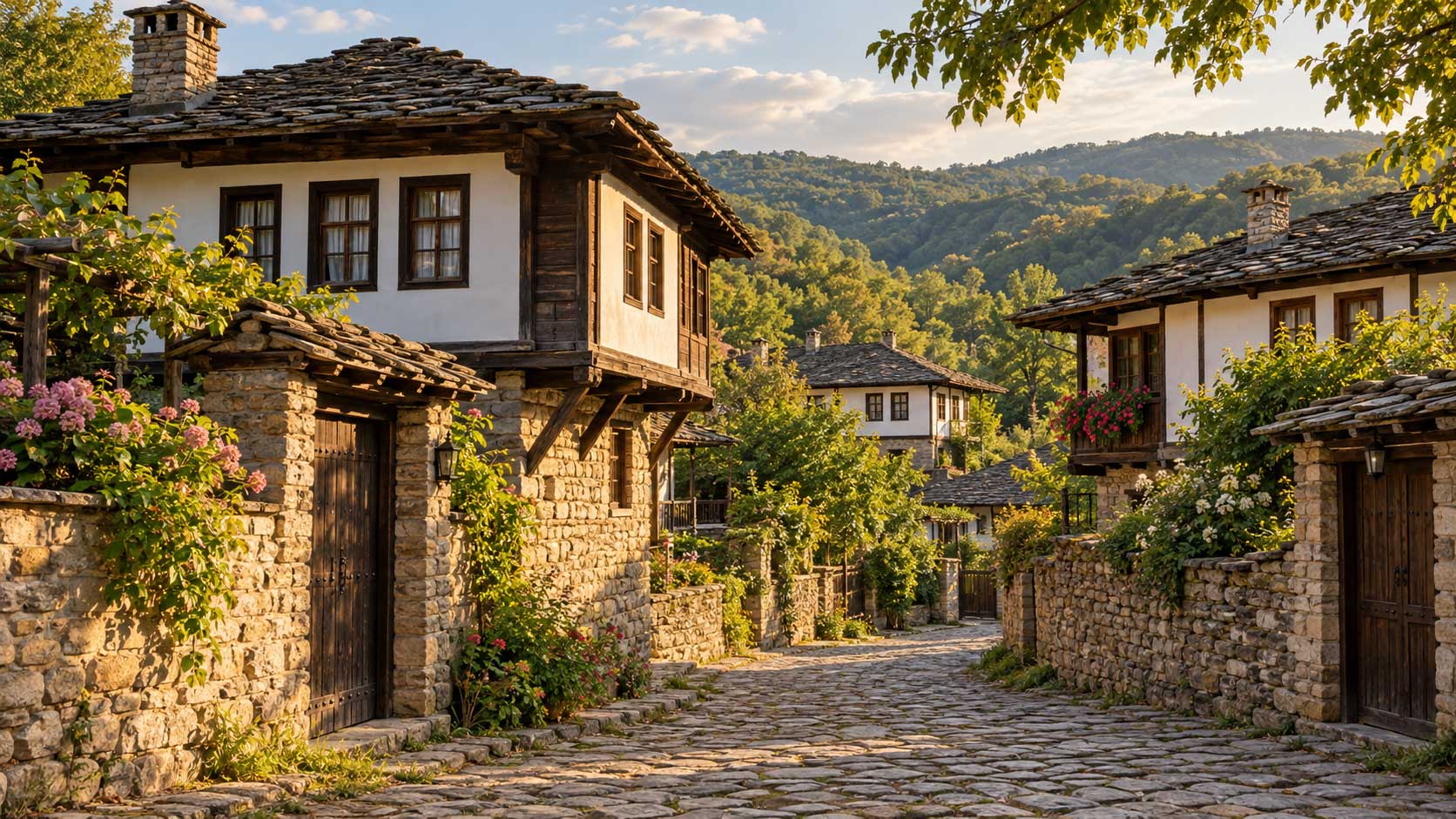
Mogilitsa – Rural Bulgaria Near the Arda River

- August 14, 2026
- 21
- Bulgarian Villages , Mountain Villages
Mogilitsa Bulgaria is a small mountain village tucked into the green folds of the Western Rhodope Mountains, where everyday life still feels closely connected to the surrounding landscape.
Located about 25 kilometers southwest of Smolyan, the village stretches along the upper reaches of the Arda River, surrounded by forested hills, winding mountain roads and traditional homes scattered across the slopes.
Mogilitsa feels very different from Bulgaria’s better-known mountain resorts. There are no large hotels or busy pedestrian streets here. Instead, you will find gardens, small farms, quiet roads and houses overlooking the river valley.
At the heart of the village stands its most remarkable landmark: the Agushevi Konatsi, an unusual 19th-century residential complex surrounded by stone walls and easily recognizable by its distinctive tower.
The countryside around Mogilitsa gives you even more reason to stay for a while. Caves, forest trails, mountain viewpoints and tiny settlements are scattered throughout the Upper Arda Valley, making the village a good base for exploring one of the quieter corners of the Rhodopes.
Mogilitsa is not somewhere you come for nightlife or a long checklist of attractions.
Mogilitsa suits travelers who want to spend time in a traditional mountain village, see unusual Rhodope architecture and explore a less-visited corner of southern Bulgaria.
Why Visit Mogilitsa?
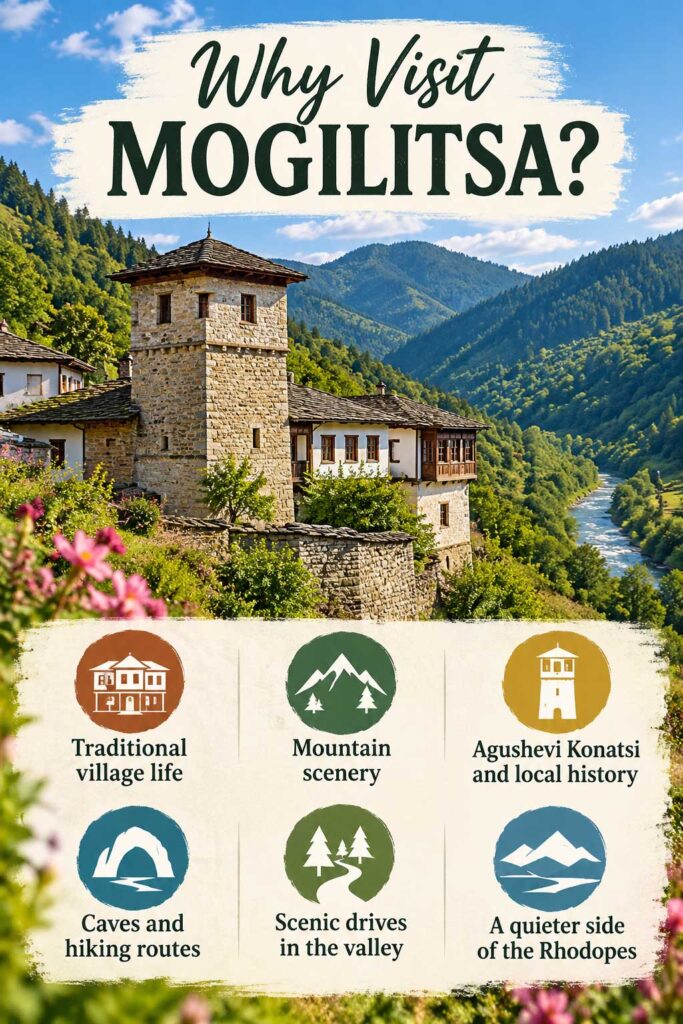
Mogilitsa brings together many of the things that make the Rhodope Mountains worth exploring: traditional village life, mountain scenery, local history and a peaceful atmosphere.
The village sits at around 950 meters above sea level, with many of its houses scattered along the slopes above the Arda River. Forested mountains rise around the settlement, giving Mogilitsa a secluded feel even though it is only about 25 kilometers from Smolyan.
Unlike places shaped heavily by tourism, Mogilitsa still feels like a working mountain village. As you walk through it, you will see older Rhodope houses alongside newer homes, small gardens and quiet streets following the contours of the hills.
The village also makes a good starting point for exploring the surrounding mountains.
Nearby attractions include Uhlovitsa Cave, old fortress remains and hiking routes through the Upper Arda Valley. Farther into the mountains, marked trails lead toward the source of the Arda River, Ardin Peak and several panoramic viewpoints.
Then there is Mogilitsa’s most important historical landmark: the Agushevi Konatsi.
Hidden behind high stone walls, this remarkable residential complex contains courtyards, living quarters, agricultural buildings and distinctive architectural details unlike anything else you are likely to see during a typical Rhodope road trip.
For travelers who enjoy discovering places beyond Bulgaria’s usual tourist routes, Mogilitsa is an easy village to appreciate.
Come for the history, but leave enough time to enjoy the quiet roads, forested hills and green landscapes of the Upper Arda Valley.
Agushevi Konatsi – Mogilitsa’s Most Famous Landmark
The main historical attraction in Mogilitsa is the Agushevi Konatsi, an unusual 19th-century residential complex that looks almost like a small fortress in the Rhodope Mountains.
Built between 1820 and 1840, the complex was created for a wealthy local landowning family. Rather than a single large house, it consists of residential and agricultural buildings arranged around three connected courtyards, all enclosed by high stone walls.
One of the most striking things about the complex is the contrast between its defensive-looking exterior and the traditional Rhodope architecture inside.
Stone walls, wooden details, projecting upper floors and the distinctive tower give the Agushevi Konatsi an appearance quite different from the Revival-era houses you might see in villages such as Kovachevitsa or Shiroka Laka.
The numbers alone give you an idea of its size.
The complex has 221 windows, 86 doors and 24 chimneys. Each courtyard once included living quarters for the family and servants, along with spaces for seasonal workers and agricultural buildings such as barns and storage areas. Each courtyard also had its own well.
A Glimpse Into Rhodope History
The Agushevi Konatsi tells a different story from many of Bulgaria’s better-known historic houses.
This was not simply a family home. It was a large rural estate where everyday life, farming and household activities all took place within the same enclosed complex.
That combination of residential and working spaces helps explain why the property is so extensive and why it remains one of the most unusual historic buildings in the Rhodopes.
The Agushevi Konatsi was declared a cultural monument of national importance in 1964. The property is privately owned today. Current opening hours are Tuesday through Saturday, from 9:30 AM to 1:00 PM and from 1:30 PM to 6:00 PM. Sunday and Monday visits may be possible by advance reservation.
Because schedules can change, check the official Agushevi Konatsi website before making a special trip.
Even if you come to Mogilitsa mainly for the mountain scenery, make time for the Agushevi Konatsi.
It is one of the landmarks that gives the village its distinctive character and offers a fascinating glimpse into the history of the Upper Arda region.
Exploring the Arda River and the Nature Around Mogilitsa
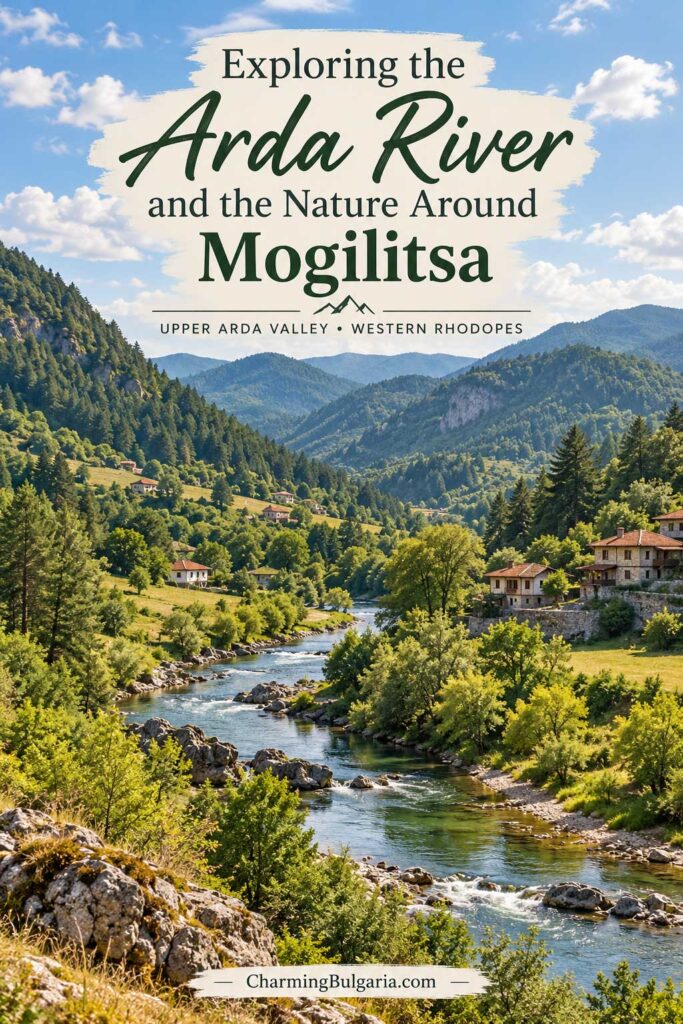
One of the best reasons to visit Mogilitsa is the countryside surrounding the village.
The Arda River begins high in the Western Rhodopes, near Ardin Peak and the Bulgarian-Greek border. Around Mogilitsa, the upper river valley is still narrow and mountainous, with wooded slopes rising on either side.
Small meadows, gardens and houses appear between the forests, while winding roads follow the contours of the valley.
Walking Through the Countryside
You do not need to plan a long hike to enjoy the landscape.
A walk along the quieter roads around Mogilitsa takes you past gardens, small farms, wooded hillsides and occasional views across the valley. Even a short stroll beyond the center of the village quickly feels rural.
Spring and early summer bring fresh greenery and wildflowers, while autumn adds yellow, orange and red to the surrounding forests.
For travelers who enjoy photography, countryside walks and exploring small villages, this is one of the nicest parts of visiting Mogilitsa.
Following the Upper Arda Valley
If you want to go farther, the Upper Arda region has several marked hiking routes.
One of the most interesting leads toward the source of the Arda River, which lies below Ardin Peak at around 1,460 meters above sea level. The marked trail passes through meadows and forest before reaching the spring beneath an old beech tree.
Other routes in the area lead toward mountain peaks, old fortifications and viewpoints overlooking the Western Rhodopes.
The farther you travel from Mogilitsa, the more remote the landscape becomes, with forests, open ridges and tiny settlements scattered through the mountains.
Enjoy the Landscape Around the Village
Not every visit needs to involve a full hiking route.
Spend some time walking through Mogilitsa, follow the river valley for a while or stop at one of the viewpoints along the surrounding roads.
There may not be a long list of conventional attractions here, but the forests, river valley and surrounding Rhodope Mountains are a large part of the reason to come.
Uhlovitsa Cave – A Natural Wonder Near Mogilitsa

One of the most interesting places to visit near Mogilitsa is Uhlovitsa Cave, one of the best-known developed caves in the Western Rhodopes.
Located high above the left bank of the Arda River, the cave is about 460 meters long, with roughly 330 meters developed for visitors. It is also included among Bulgaria’s 100 National Tourist Sites.
Inside Uhlovitsa Cave
Uhlovitsa is known for its unusual cave formations rather than its size.
Inside, you will see stalactites, stalagmites and delicate dendrite formations that resemble coral. Toward the end of the visitor route are several small sinter pools that fill with water in early spring, along with a larger pool fed by a small underground waterfall.
The temperature inside remains around 10–11°C throughout the year, so bringing a light jacket is a good idea even during summer.
The developed route also includes around 280 metal steps, making the visit more physical than a simple walk through a flat show cave.
Getting to the Entrance
Reaching Uhlovitsa requires some effort before you even enter the cave.
From the parking area between Koshnitsa and Mogilitsa, visitors follow a steep trail for about 800 meters, followed by approximately 190 metal steps leading to the entrance. The total elevation gain from the parking area is around 160 meters.
Comfortable shoes are essential, and it is worth allowing extra time for the climb rather than treating Uhlovitsa as a quick roadside stop.
Part of a Larger Cave Region
Uhlovitsa is only one of many caves in the Upper Arda region.
Nearby Nadarska Cave, about seven kilometers from Mogilitsa, offers a more adventurous experience. Visits there must be arranged in advance and are conducted with guides and appropriate equipment.
The wider area around Mogilitsa also contains other caves, marked hiking routes, waterfalls, old fortifications and trails leading toward the source of the Arda River.
For most visitors, however, Uhlovitsa is the easiest major cave experience to combine with a day in Mogilitsa.
Together with the Agushevi Konatsi and the Upper Arda Valley, it gives you a good mix of history, mountain scenery and something genuinely different to explore underground.
Panoramic Viewpoint “The Peak” Near Mogilitsa
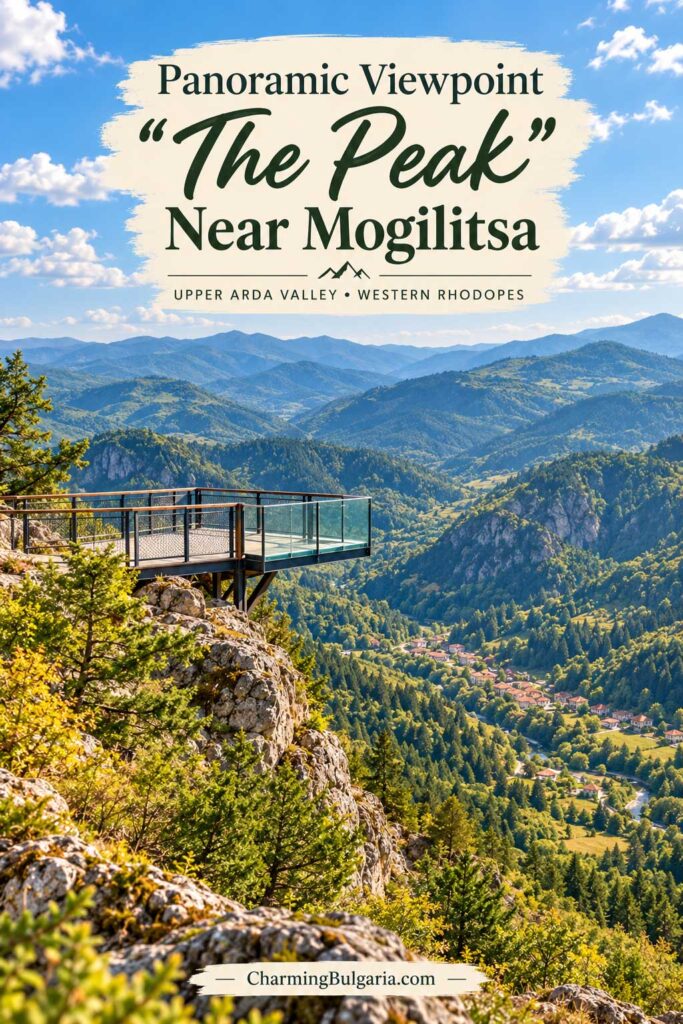
For one of the widest views over the valley, head to the panoramic platform known as “The Peak” (Varhat) above Mogilitsa.
The viewpoint sits about 9 kilometers from the center of the village at an elevation of 1,351 meters. Built on the edge of a rocky summit, it stands roughly 350 meters above the road winding through the valley below.
One feature makes the platform especially memorable: its final 1.5 meters are made of glass, allowing visitors to look almost straight down beneath their feet.
Views Across the Rhodopes
On a clear day, the platform opens onto a broad panorama of the Western Rhodopes.
To the south you can see Ardin Peak, while the northern view includes Karlak Peak, the Snezhanka Tower and Momchil Peak. Borikovo and several smaller settlements can be seen to the west, while Kom Peak rises to the east.
From the valley, the mountains around Mogilitsa can feel surprisingly enclosed. Up here, you get a much better sense of the scale of the Upper Arda region, with wooded ridges, scattered villages and mountain peaks stretching in several directions.
How to Reach the Viewpoint
The marked walking route begins in Mogilitsa and continues through Borikovo and the Potoka area. Directional signs are placed along the route.
According to the official Smolyan tourism guide, the hike takes about 2 to 2.5 hours each way, so this is better treated as a half-day outing rather than a quick detour.
Another option is to arrange an off-road jeep trip from the center of Mogilitsa, which takes roughly 40–50 minutes each way.
A Good Place for Photography
The elevation and open views make the platform one of the better photography locations around Mogilitsa.
Morning mist can settle in the valleys below, while later in the day the changing light brings out the layers of forested ridges and distant peaks.
If you have enough time, the viewpoint combines well with Agushevi Konatsi and Uhlovitsa Cave, but trying to fit all three into a short visit could feel rushed.
Give the viewpoint a few hours of its own and you will see a very different side of the landscape surrounding Mogilitsa.
Traditional Life and Local Culture in Mogilitsa
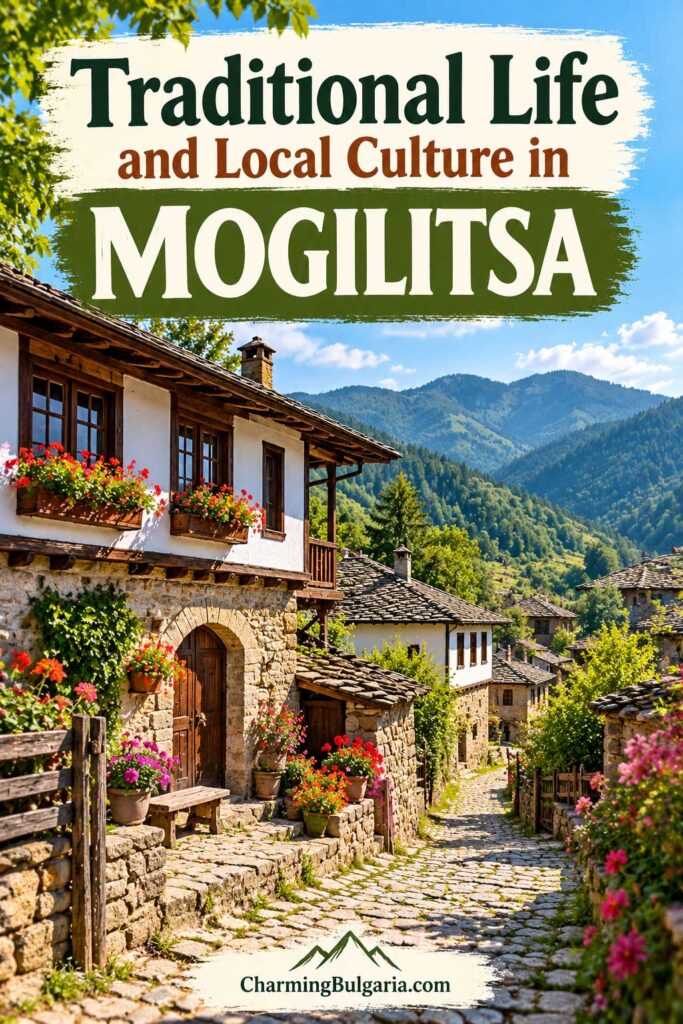
Mogilitsa is more than its caves and historic buildings. It is still a working Rhodope village, shaped by the land and by traditions that developed over generations.
For much of its history, local families relied on livestock breeding, agriculture and forestry. These activities influenced everything from the layout of the village to the surrounding pastures, gardens and forested slopes.
You can still see traces of that rural way of life today.
Homes are scattered across the hillsides, gardens sit beside village streets, and grazing land stretches into the surrounding countryside. Mogilitsa may attract visitors, but it has never stopped being a place where people live and work.
Rhodope Crafts and Traditions
Traditional crafts also remain part of Mogilitsa’s story.
The official Smolyan tourism guide describes rooms inside the Agushevi Konatsi furnished with regional handmade objects, including woven cloths, rugs, livestock bells and decorative pieces. These everyday items offer a glimpse into the skills and household traditions once common across the Rhodopes.
The wider Upper Arda region is also known for traditions connected with herbs, wildflowers, food and folklore.
Since 2013, Mogilitsa has participated in the Rhodope Wild Flower Festival, held around Enyovden in late June. Events across villages in the region have included botanical and photography walks, herbal workshops, hiking, cycling, natural-dye crafts and folklore performances.
Mogilitsa’s Village Festival
Mogilitsa also holds a local celebration traditionally scheduled for the penultimate Saturday of June.
The festival brings together folk music, traditional crafts and local producers. Rhodope artisans are invited to demonstrate their work, while producers offer regional and environmentally focused products.
If your visit happens to fall in late June, these events offer a chance to see another side of village life.
But Mogilitsa does not need a festival to feel traditional. Walk through the village, look at the gardens and older houses, listen to the Arda below, and you still get a sense of how closely life here remains connected to the mountains and countryside of the Upper Arda Valley.
Best Things to Do in Mogilitsa
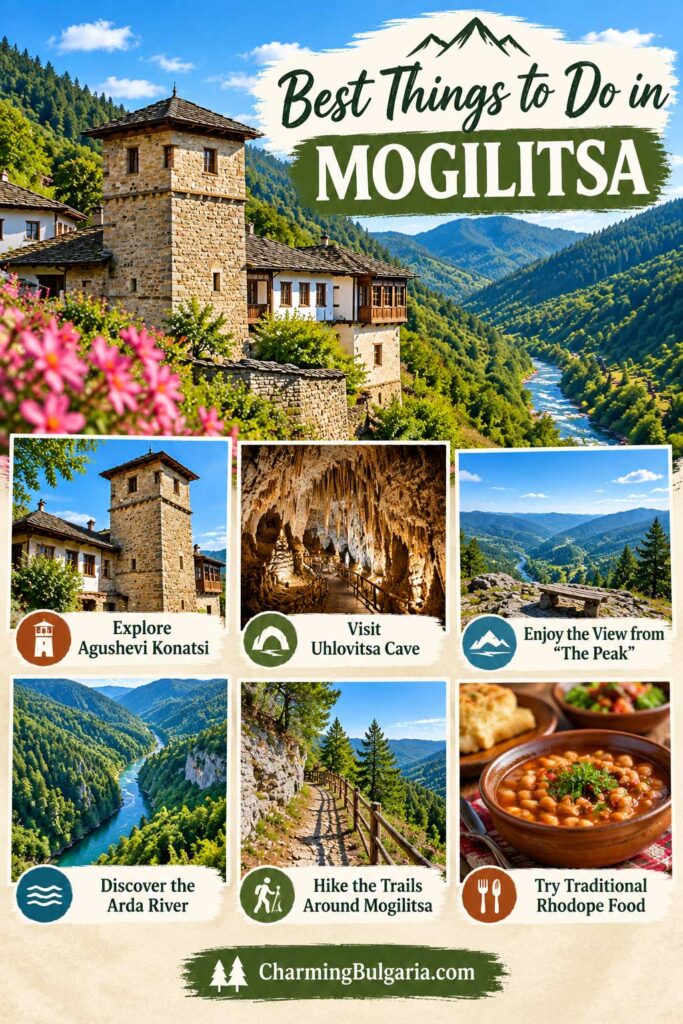
Mogilitsa does not have a long list of conventional attractions, but there is plenty to fill a day if you combine the village with the surrounding mountains.
1. Visit the Agushevi Konatsi
Start with Mogilitsa’s most important historical landmark.
The Agushevi Konatsi stands out for its high stone walls, three courtyards, traditional Rhodope architecture and fortress-like appearance.
Rather than stopping only for a photograph from outside, allow time to explore the complex if it is open during your visit.
2. Explore Uhlovitsa Cave
Nearby Uhlovitsa Cave is one of the highlights of the Upper Arda region.
The visit involves a steep approach to the entrance as well as numerous steps inside, so it requires a little more effort than a typical roadside attraction.
Once underground, you can see stalactites, stalagmites, sinter pools and other limestone formations.
3. Walk Through Mogilitsa
Leave some time simply to explore the village itself.
Quiet roads wind between houses, gardens and wooded slopes, while different parts of Mogilitsa offer views across the Arda Valley.
Early morning and late afternoon are particularly pleasant for walking and photography.
4. Explore the Upper Arda Valley
Mogilitsa sits in one of the quieter sections of the Upper Arda Valley, making the surrounding countryside an attraction in its own right.
Follow the roads through the valley, stop at safe viewpoints and look for short walks through the surrounding forests and meadows.
If you have more time, marked hiking routes lead deeper into the mountains toward the source of the Arda River and other natural sites.
5. Hike to the Panoramic Viewpoint
For broader mountain views, head toward the panoramic platform known as The Peak (Varhat).
At 1,351 meters above sea level, the viewpoint looks across several peaks and settlements in the Western Rhodopes.
The walking route takes around two to two and a half hours each way, so give this outing a substantial part of the day rather than treating it as a quick stop.
6. Discover Nearby Villages and Mountain Roads
The wider area around Mogilitsa is worth exploring slowly.
Small villages, forest roads, meadows, caves and old fortifications are scattered throughout the Upper Arda region. Nearby places such as Smilyan and Koshnitsa can easily be combined with Mogilitsa on a longer drive.
Stick to established roads and marked routes, especially if you are unfamiliar with the area.
7. Make Time for the Village Atmosphere
Not every hour in Mogilitsa needs to be planned around a specific attraction.
Sit beside the river, have coffee or a simple meal, photograph the surrounding hills or walk through a quieter part of the village.
Those slower moments are often what make Mogilitsa memorable.
The village is best enjoyed as a combination of history, nature and everyday Rhodope life, rather than as a place where you rush from one sight to the next.
Best Time to Visit Mogilitsa
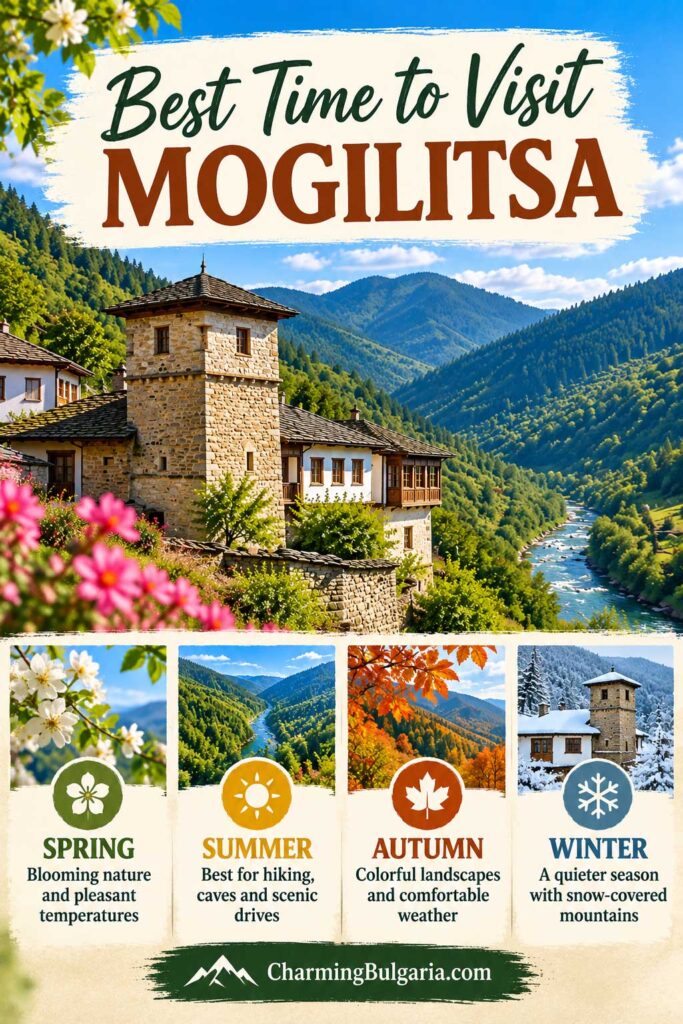
Mogilitsa can be visited throughout the year, but late spring through early autumn is the easiest period for exploring the village, caves and surrounding mountain trails.
At around 950 meters above sea level, Mogilitsa has a noticeably cooler climate than Bulgaria’s lowlands. Summers in the Smolyan region are generally mild, while winters bring colder temperatures and regular mountain conditions.
Spring
Spring gradually brings the Upper Arda Valley back to life.
Forests and meadows turn green, wildflowers begin appearing along the roads and trails, and streams carry more water from rain and melting snow. By May and June, conditions are usually much better for walking and exploring the countryside.
Late June is particularly interesting because Mogilitsa participates in the Rhodope Wild Flower Festival, traditionally held from June 20 to 30 around Enyovden. Events across the participating villages include botanical walks, herbal workshops, hiking, cycling, photography tours and folklore activities.
Summer
Summer is one of the easiest seasons for exploring Mogilitsa.
The mountains remain cooler than much of Bulgaria, making July and August comfortable for village walks, cave visits and longer outings into the Upper Arda Valley.
This is a good time to visit Uhlovitsa Cave, hike toward the panoramic viewpoint above Mogilitsa or follow marked trails deeper into the mountains.
Even in summer, bring an extra layer if you plan to spend time underground or stay out into the evening. Uhlovitsa Cave, for example, remains cool throughout the year.
Autumn
September and early October are especially attractive if you are visiting for photography and mountain scenery.
The forests gradually shift from green to shades of yellow, orange and brown, while the cooler temperatures make walking more comfortable.
This is also a pleasant period for driving through the Upper Arda Valley and stopping in the smaller villages along the way.
As October progresses, daylight becomes shorter and mountain weather less predictable, so check conditions before planning longer hikes.
Winter
Snow gives Mogilitsa a very different character in winter.
The village and surrounding forests can look beautiful after fresh snowfall, but winter also makes outdoor exploration less predictable. Smaller roads may be icy, and some hiking routes can become difficult or unsuitable without proper equipment.
If your main goal is hiking, viewpoints and cave visits, the warmer months are much more practical.
For most visitors, May through early October offers the best combination of green landscapes, comfortable walking conditions and easier access to the attractions around Mogilitsa.
How to Get to Mogilitsa
Mogilitsa lies deep in the Western Rhodopes, about 25 kilometers southwest of Smolyan. For most travelers, Smolyan is the easiest starting point for reaching the village and exploring the Upper Arda Valley.
By Car
Driving is the most practical way to visit Mogilitsa.
From Smolyan, follow the mountain road through Chokmanovo, Smilyan and Koshnitsa before continuing toward Mogilitsa.
The drive is not particularly long, but the road winds through mountainous terrain, so allow more time than the distance alone might suggest.
Having a car is especially useful if you also plan to visit Uhlovitsa Cave, Smilyan, Koshnitsa, the panoramic viewpoint or other attractions scattered through the Upper Arda region.
Getting to Smolyan First
Travelers coming from elsewhere in Bulgaria will usually reach Smolyan before continuing to Mogilitsa.
Smolyan is approximately 100 kilometers from Plovdiv and 250 kilometers from Sofia. Regular bus services connect the town with Sofia, Plovdiv and Kardzhali.
If you are arriving from Sofia or Plovdiv, renting a car gives you much more flexibility once you enter the Rhodopes, particularly if you want to explore villages, caves and hiking areas beyond Mogilitsa.
Can You Reach Mogilitsa by Bus?
Yes, although a car is considerably more convenient.
The Smolyan municipality states that villages within the municipality have regular bus connections with the town. Current timetable information is available through Smolyan’s bus stations.
Rural schedules can change, however, and departures may be limited compared with routes between larger towns.
If you are traveling without a car, check the current outbound and return times before leaving Smolyan, especially if you plan to visit on a weekend or holiday.
Driving in the Upper Arda Valley
The road south of Smolyan passes through forests, villages and narrow sections of the Arda Valley.
Take your time on bends and smaller mountain roads, particularly after heavy rain or during colder months when fog, snow or ice can affect driving conditions.
The scenery is worth enjoying, but stop only where there is a safe place to pull off the road.
For travelers planning to explore several attractions around Mogilitsa, having your own vehicle is by far the easiest option.
Where to Stay in Mogilitsa
If you have more than one day in the Upper Arda Valley, staying overnight can make exploring Mogilitsa and the surrounding mountains much easier.
The village has guesthouses and small family hotels, although the selection is naturally limited compared with Smolyan. Mogilitsa’s local tourism website also maintains an accommodation directory covering the village and nearby Upper Arda communities.
Staying in Mogilitsa
Choose Mogilitsa if you want to stay as close as possible to the village, Agushevi Konatsi and the surrounding countryside.
Accommodation here is generally small-scale rather than resort-style. Depending on the guesthouse, you may find gardens, mountain views and the more personal atmosphere typical of family-run properties in the Rhodopes.
Staying in the village is also convenient if you want an early start for Uhlovitsa Cave, hiking routes or the panoramic viewpoint without driving back from Smolyan first.
Mornings and evenings are particularly pleasant, when there is little traffic and you have more time to walk around the village or enjoy the views across the valley.
Smilyan as an Alternative Base
Nearby Smilyan is another practical place to stay.
The village has several guesthouses and accommodation complexes and offers a little more choice while keeping you close to Mogilitsa and the attractions of the Upper Arda Valley.
Smilyan makes particular sense if you plan to explore several places in the area rather than concentrating only on Mogilitsa.
Staying in Smolyan
For the widest choice of hotels, restaurants, shops and other services, Smolyan is the easiest base.
From there, you can visit Mogilitsa as a day trip while also exploring other parts of the Western Rhodopes.
Smolyan is the better choice if you prefer more amenities or are building a wider regional itinerary. Mogilitsa, on the other hand, is better suited to travelers who would rather stay directly in a small Rhodope village surrounded by the Upper Arda landscape.
There is no wrong choice—it mainly depends on whether you value convenience and services or being closer to the countryside you came to explore.
What to Eat Around Mogilitsa

A visit to Mogilitsa is a good opportunity to try some of the traditional food of the Rhodope Mountains.
Rhodope cooking developed around ingredients that were well suited to mountain life. Potatoes, beans, grains, wild plants and sheep’s-milk products have long played an important role in the local diet, with many dishes prepared by boiling or baking rather than frying.
Try Patatnik
One of the dishes most closely associated with the Rhodopes is patatnik.
It is traditionally made with grated potatoes, onions and herbs, then cooked until the outside develops a golden crust while the inside remains soft.
Recipes vary from place to place, so you may find slightly different versions as you travel through the region.
Look for Smilyan Beans
Nearby Smilyan is famous for its locally grown beans, known as Smilyanski fasul.
Bean growing has become an important part of the village’s identity. Smilyan has an ethnographic exhibition dedicated to the crop, as well as an annual bean festival traditionally held toward the end of November.
If you see bean soup or another dish prepared with Smilyan beans on a local menu, it is one of the regional specialties worth trying.
Other Rhodope Specialties
A few other dishes to look for include:
- Klin – a thin Rhodope pastry commonly prepared with rice, eggs and cheese
- Kachamak – a cornmeal dish often served with cheese or butter
- Katmi – soft traditional pancakes
- Cheverme – lamb slowly roasted on a spit
- Local cheese, butter and other dairy products
- Strained yogurt with wild strawberry or blueberry preserves
These are among the foods most strongly associated with traditional cooking in the Smolyan region.
Where to Eat
Mogilitsa is a small village, so the choice of restaurants is limited.
Some guesthouses and traditional taverns in the Upper Arda region serve home-style meals, and locally produced dairy products can also be found in smaller settlements around Smolyan.
For more choice, Smilyan and Smolyan are the most practical places to stop for a meal.
You do not need anything elaborate. A plate of patatnik or a bowl of bean soup can be one of the simplest—and best—ways to taste the region.
Places to Visit Near Mogilitsa
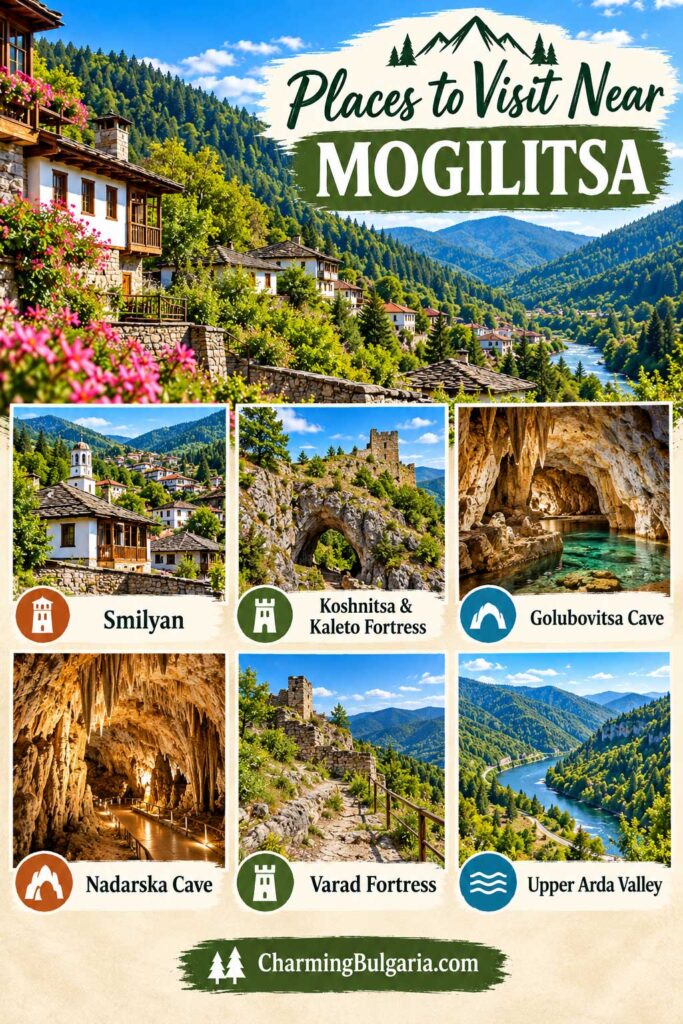
Mogilitsa works especially well as part of a longer trip through the Upper Arda Valley. Several villages, caves and mountain attractions are close enough to combine over a day or weekend.
Smilyan
Smilyan is one of the easiest places to combine with Mogilitsa.
The village is best known for its famous Smilyan beans, but it is also a useful stop for food, supplies or a short walk before continuing deeper into the valley.
If you are driving from Smolyan to Mogilitsa, you will pass through Smilyan along the way.
Koshnitsa and Kaleto Fortress
Near Koshnitsa, a marked trail climbs toward a striking natural rock arch and the remains of Kaleto Fortress above it.
The climb takes roughly half an hour and is fairly steep, so good footwear is useful. From the top, you get wide views over Koshnitsa and the surrounding Rhodope slopes.
Kaleto is an excellent addition to a Mogilitsa trip if you enjoy short hikes, viewpoints and archaeological sites.
Golubovitsa Cave
Golubovitsa Cave offers a very different experience from Uhlovitsa.
Golubovitsa 2 is a water cave with an underground river and lake, explored using boats and waterproof equipment. The surrounding Garga Dere route also includes a via ferrata and an alpine trolley similar to a zip line.
Access depends on water levels, so the cave does not operate throughout the entire year. Winter and spring conditions can keep it closed, with visits typically becoming possible once water levels fall in early summer.
If Golubovitsa is high on your list, check current access before arriving.
Nadarska Cave
Nadarska Cave lies about seven kilometers from Mogilitsa near the small settlements of Kremene and Nadarci.
Its entrance sits at approximately 1,150 meters above sea level, with views toward Nadarci and the surrounding mountains.
Unlike Uhlovitsa, Nadarska has not been developed as a conventional show cave. Visitors can enter only with a professional guide and by prior arrangement, with the necessary equipment provided as part of the visit.
The cave itself is relatively short but contains an unusually rich concentration of stalactites, stalagmites and other calcite formations.
Varad Fortress
For a much longer hike, consider the route to Varad Fortress northwest of Mogilitsa.
The marked route is approximately 19 kilometers long, gains about 550 meters in elevation and takes around seven to eight hours to complete.
The remains of the old fortress sit high above the Upper Arda region, and in clear weather the views extend south toward the mountains of northern Greece.
This is a full-day mountain outing rather than a casual walk, so come prepared with suitable footwear, water and enough daylight to complete the route comfortably.
Explore More of the Upper Arda Valley
Mogilitsa is surrounded by a surprisingly large network of marked routes.
Trails in the region lead toward the source of the Arda River, waterfalls, caves, mountain springs, viewpoints and old fortifications.
You do not need to see all of them in one trip.
Choose one or two attractions that interest you most, then leave some time for the villages and mountain roads in between. That usually makes for a much better day than trying to rush through every stop around Mogilitsa.
One-Day Mogilitsa Itinerary
You can see the main highlights of Mogilitsa in one day, especially if you start early and keep the itinerary focused on the village and nearby attractions.
Morning: Explore Mogilitsa
Begin with a walk through the village before visiting the Agushevi Konatsi.
Take some time to notice the older Rhodope houses, gardens and views across the Upper Arda Valley rather than heading straight to the main landmark.
If the Agushevi Konatsi is open, spend some time exploring the courtyards and residential complex. It provides useful historical context before you continue into the surrounding mountains.
Late Morning: Visit Uhlovitsa Cave
From Mogilitsa, continue toward Uhlovitsa Cave, located between the village and Koshnitsa.
Allow plenty of time for the visit. Reaching the entrance requires a steep uphill walk followed by metal steps, and there are additional stairs inside the cave.
Wear comfortable shoes and bring a light jacket. The cave remains cool throughout the year, with temperatures around 10–11°C.
Lunch: Stop in Mogilitsa or Smilyan
After the cave, stop for lunch in Mogilitsa or continue toward nearby Smilyan, where you are likely to find more options.
Look for regional dishes such as patatnik, klin, kachamak or Smilyan bean soup.
Afternoon: Explore Koshnitsa and the Upper Arda Valley
Keep the afternoon flexible rather than trying to fit in another major hike.
Depending on your interests, you could:
- Stop in Koshnitsa and hike toward the rock arch and Kaleto Fortress
- Spend some time exploring Smilyan
- Drive farther through the Upper Arda Valley
- Take a short walk along one of the marked trails
- Stop at viewpoints and smaller settlements along the way
If you want to hike to The Peak (Varhat) panoramic platform, plan it as a separate half-day outing. The walking route takes roughly two to two and a half hours in each direction, so combining it with Uhlovitsa Cave and the Agushevi Konatsi would make for a very rushed day.
Evening: Return to Mogilitsa
If you are staying overnight, return to Mogilitsa toward the end of the day.
This is a good time for another short walk through the village, when the roads are quieter and the late-afternoon light reaches the surrounding slopes.
Finish with a simple Rhodope meal and an evening in the Upper Arda Valley.
A day like this gives you a good introduction to Mogilitsa’s history, caves, village life and mountain scenery without trying to squeeze every nearby attraction into a single itinerary.
Travel Tips for Visiting Mogilitsa
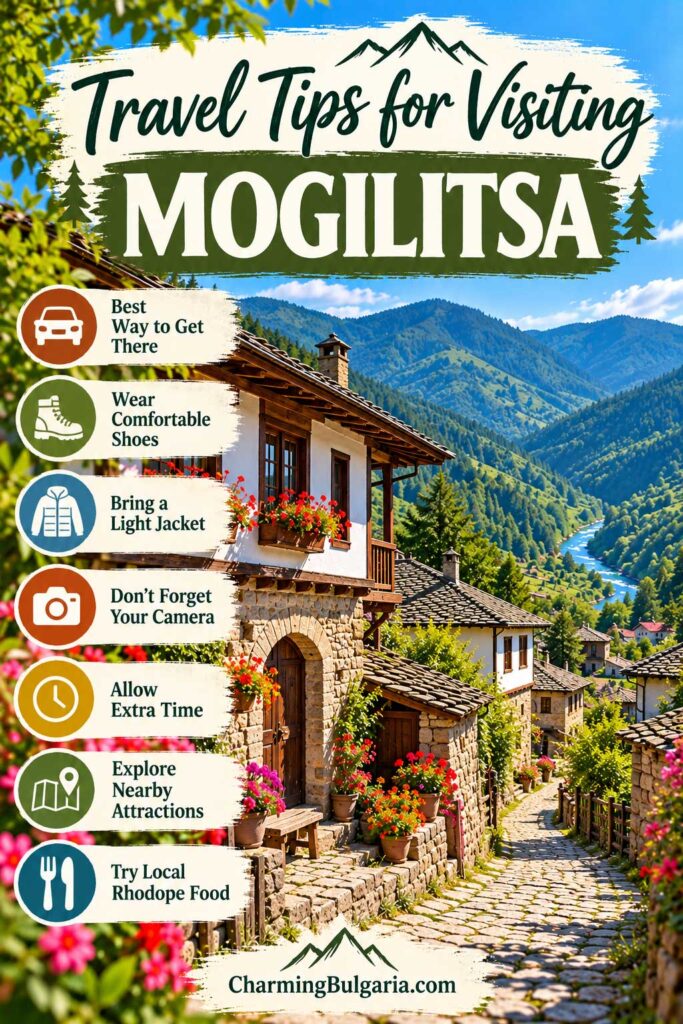
Mogilitsa is easy to visit, but a little preparation helps—especially if you plan to explore caves, mountain roads or hiking routes around the Upper Arda Valley.
Wear Comfortable Shoes
Even if you are not planning a long hike, sturdy shoes are a good idea.
Village streets can be uneven, while Uhlovitsa Cave requires a steep approach and numerous steps. Shoes with good grip are especially useful after rain.
Carry Some Cash
Smaller guesthouses, cafés and local attractions may not always accept cards.
Keep some Bulgarian leva with you, particularly if you are spending the day in smaller villages away from Smolyan.
Download Offline Maps
Mountain areas do not always have reliable mobile coverage.
Download your route in advance if you plan to explore smaller roads, hiking trails or viewpoints around Mogilitsa.
Check Opening Hours
Opening times for rural attractions can change seasonally.
If Agushevi Konatsi, Uhlovitsa Cave or another specific site is important to your trip, check current hours before setting out.
Fuel Up Before Heading Deeper Into the Mountains
Smolyan is the best place to handle practical needs such as fuel, groceries and other supplies.
Services become more limited once you continue farther into the Upper Arda Valley.
Drive Carefully
Roads around Mogilitsa are winding and can be narrow in places.
Allow extra time, especially in fog, rain or colder weather when mountain conditions may affect visibility and road surfaces.
Respect Local Life
Remember that Mogilitsa is home to local residents.
Avoid entering private property, blocking narrow roads for photographs or taking close-up pictures of residents without permission.
Allow More Time Than You Think
Distances in the Rhodopes can look short on a map but take longer because of winding roads, steep trails and frequent stops.
Build a little flexibility into your schedule, especially if you are combining Mogilitsa with Uhlovitsa Cave, Koshnitsa, Smilyan or one of the mountain viewpoints.
That way, you can enjoy the area without turning the day into a race between attractions.
Frequently Asked Questions About Mogilitsa Bulgaria
Is Mogilitsa Worth Visiting?
Yes. Mogilitsa is especially worth visiting if you enjoy traditional villages, historic architecture, caves and mountain scenery.
The Agushevi Konatsi, Uhlovitsa Cave and the Upper Arda Valley give you enough variety for a rewarding day in this quieter part of the Western Rhodopes.
How Much Time Do You Need in Mogilitsa?
For most visitors, one full day is enough to see the main highlights.
If you want to hike, visit additional caves or explore more of the Upper Arda Valley, staying overnight makes the trip much more relaxed.
Is Mogilitsa Good for Families?
Yes, especially for families who enjoy nature and outdoor activities.
Keep in mind that Uhlovitsa Cave requires a steep uphill approach and many steps, so it may be tiring for very young children or anyone with limited mobility.
Do You Need a Car to Visit Mogilitsa?
A car is strongly recommended.
Public transportation connects villages in the region with Smolyan, but driving makes it much easier to reach Uhlovitsa Cave, Koshnitsa, viewpoints and other attractions spread across the Upper Arda Valley.
Can You Visit Mogilitsa as a Day Trip From Smolyan?
Yes.
Mogilitsa is about 25 kilometers from Smolyan and works very well as a day trip. You can also combine it with Smilyan, Uhlovitsa Cave or Koshnitsa along the way.
What Is Mogilitsa Best Known For?
Mogilitsa is best known for the Agushevi Konatsi, its unusual 19th-century fortified residential complex.
The village is also known for its location in the Upper Arda Valley and for nearby natural attractions such as Uhlovitsa Cave.
Is Mogilitsa Crowded?
Usually not.
It generally feels much quieter than better-known Rhodope destinations such as Pamporovo, Shiroka Laka or Trigrad, although summer weekends and local events can bring more people into the area.
What Should You Bring?
Comfortable shoes, water, some cash and weather-appropriate clothing are useful.
If you plan to hike or drive farther into the mountains, also download offline maps and make sure your phone is fully charged.
What Is the Best Time to Visit Mogilitsa?
For most travelers, May through early October offers the easiest conditions.
Late spring brings green landscapes and wildflowers, summer is good for hiking and cave visits, and September into early October can be especially attractive for photography.
Is Mogilitsa Good for Slow Travel?
Yes.
Mogilitsa works particularly well for travelers who prefer small villages, local history and time outdoors over busy sightseeing schedules.
You can explore a few important attractions, then leave room for short walks, scenic drives and unplanned stops around the Upper Arda Valley.
Why Mogilitsa Is Worth Visiting
Mogilitsa may not be one of Bulgaria’s best-known mountain villages, but it has plenty to make a visit worthwhile.
The Agushevi Konatsi gives the village a strong historical identity, while Uhlovitsa Cave, the Upper Arda Valley and the surrounding Rhodope Mountains add nature, hiking and scenic drives to the experience.
What makes Mogilitsa especially appealing is how easily these different elements come together.
You can spend the morning exploring a 19th-century residential complex, continue to a cave hidden in the mountains, stop for traditional Rhodope food and finish the day driving through small villages and forested valleys.
That variety makes Mogilitsa more than just a quick roadside stop.
For travelers exploring the Western Rhodopes, it is a rewarding place to include alongside Smilyan, Koshnitsa and other destinations in the Upper Arda region.
Whether you come for a day or stay overnight, Mogilitsa offers a memorable combination of history, nature and everyday village life in the Rhodopes.
More Charming Places to Explore in Bulgaria
If Mogilitsa makes you want to explore more of the Rhodope Mountains, several other villages offer their own mix of mountain scenery, traditional architecture and local culture.
- Smilyan – Rhodope Traditions and the Famous Smilyan Bean – Continue through the Upper Arda Valley to a village known for its famous beans, Rhodope food and local traditions.
- Trigrad – A Dramatic Mountain Village in the Rhodopes – Explore one of the most spectacular corners of the Western Rhodopes, surrounded by steep cliffs, forests and the dramatic Trigrad Gorge.
- Yagodina – A Beautiful Rhodope Village Near Yagodina Cave – Combine traditional mountain scenery with Yagodina Cave, panoramic viewpoints and the limestone landscapes of the Buynovo Gorge.
- Shiroka Laka – Traditional Houses, Music and Rhodope Culture – Wander through one of the Rhodopes’ best-known historic villages, famous for its stone houses, narrow streets and musical traditions.
- Gela – Mountain Views, Folklore and Rhodope Traditions – Discover a small mountain village surrounded by open meadows, forests and beautiful highland scenery.
- Dolen – One of Bulgaria’s Best-Preserved Mountain Villages – Explore cobbled lanes, stone-roofed houses and traditional Revival architecture in another atmospheric Rhodope village.
Each place offers something different, from the caves and gorges around Trigrad and Yagodina to the food traditions of Smilyan and the historic architecture of Shiroka Laka and Dolen.
Together, they show just how varied the villages of the Rhodopes can be—and why this part of Bulgaria deserves more than a single stop.es can be—and why the Rhodopes deserve more than a single stop on your itinerary.