Deep in the green forests of Bulgaria’s Strandzha Mountains lies Balgari, Bulgaria, a small village known for one of the country’s most remarkable living traditions.
At first glance, Balgari—also written as Bulgari—feels peaceful and remote. Traditional houses line quiet streets, wooded hills surround the village, and the pace of life feels far removed from the busy resorts along Bulgaria’s Black Sea coast.
But Balgari is famous for something extraordinary.
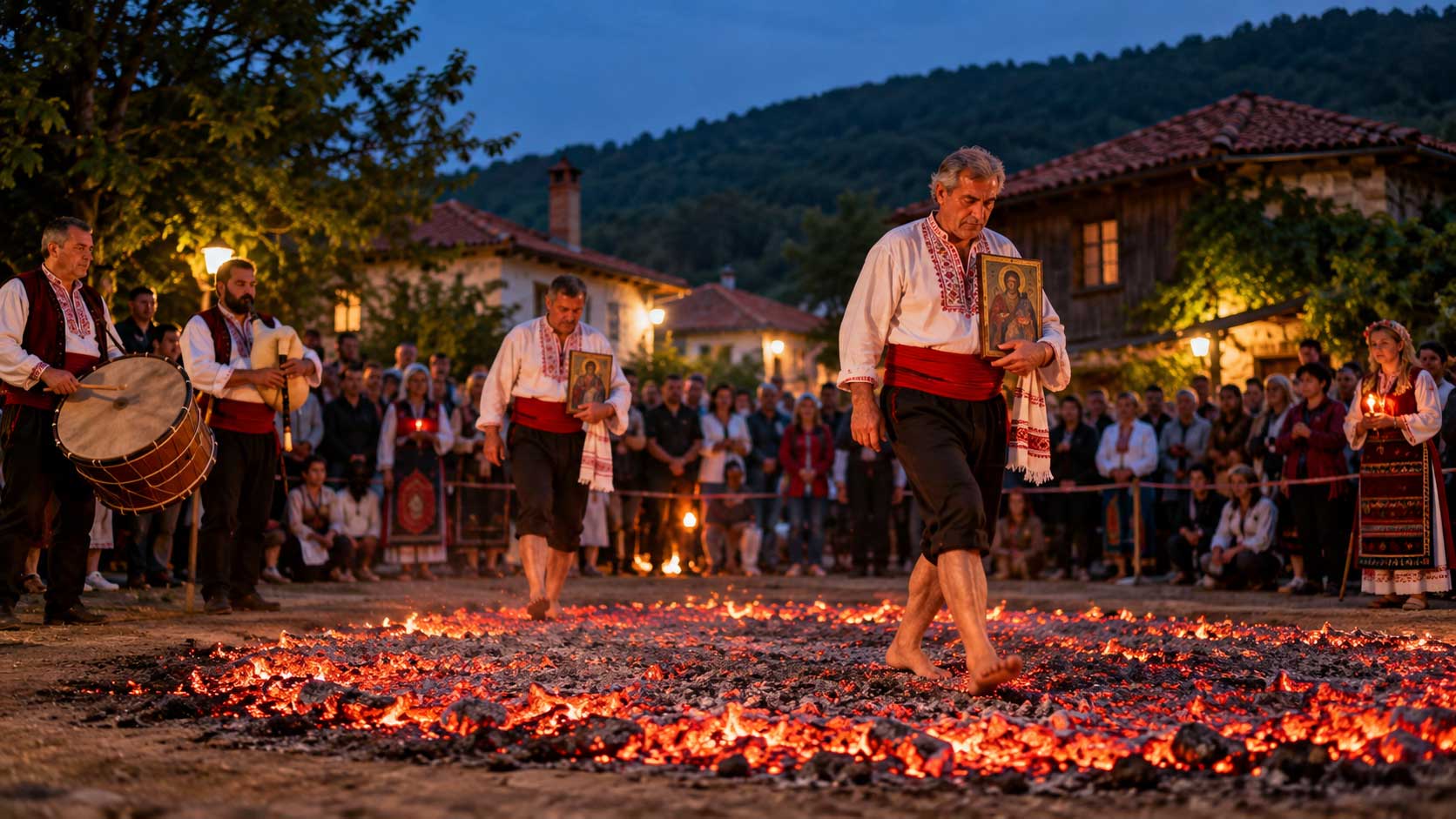
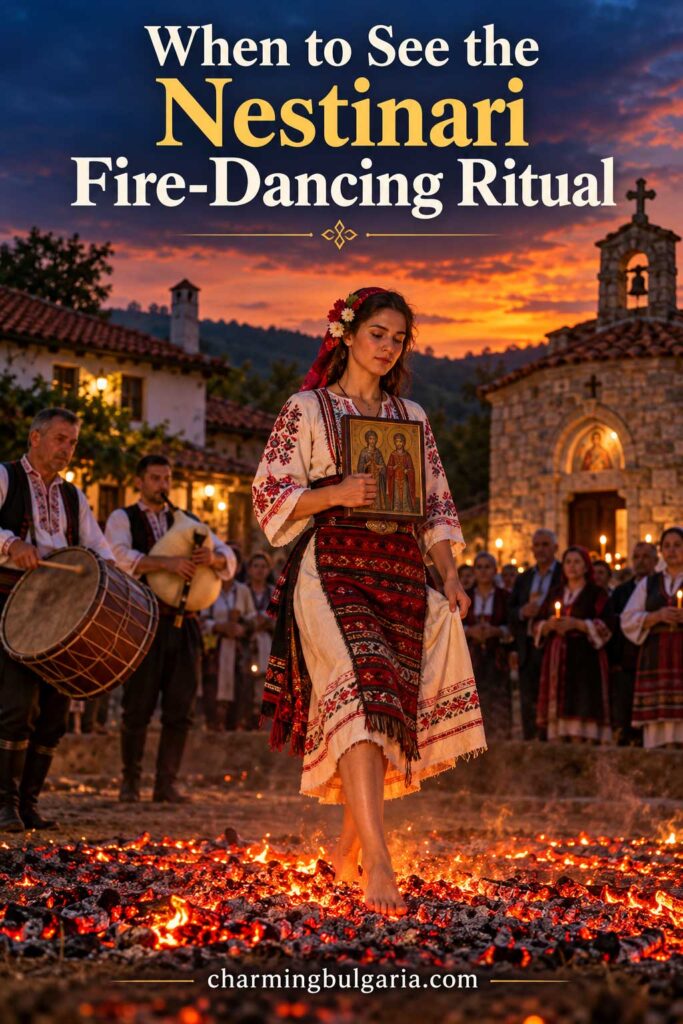
The village is closely associated with Nestinarstvo, the centuries-old Bulgarian fire-dancing tradition in which the nestinari walk barefoot across glowing embers, sometimes carrying sacred icons of Saints Constantine and Helena.
This is much more than a folklore performance for visitors. Nestinarstvo forms part of the annual Panagyr of Saints Constantine and Helena, traditionally held on June 3 and 4. The celebration includes religious rituals, a procession with sacred icons, the sound of drums and bagpipes, a visit to a holy spring, and finally the nighttime fire-dancing ceremony.
In 2009, UNESCO inscribed Nestinarstvo on the Representative List of the Intangible Cultural Heritage of Humanity, recognizing its importance to the cultural identity of the Strandzha region. The UNESCO page on the Nestinarstvo tradition also explains the annual Panagyr, procession to the holy spring and evening fire-dancing ceremony.
For travelers interested in Bulgarian traditions, historic villages and the culture of Strandzha, Balgari offers something increasingly rare: the chance to experience a living tradition in the community that has preserved it for generations.
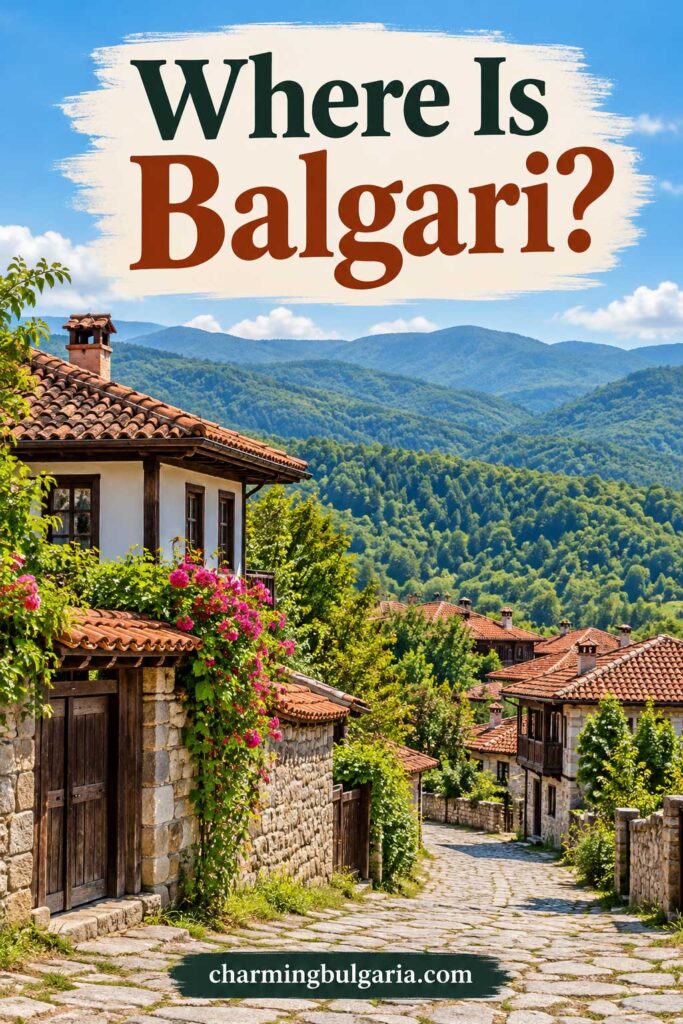
Balgari is a small village in the Strandzha Mountains of southeastern Bulgaria, about 17 kilometers inland from Tsarevo and the southern Black Sea coast. It sits at roughly 300 meters above sea level, surrounded by deep valleys, forested hills and the rounded ridges that shape much of the Strandzha landscape.
The official Strandzha Nature Park guide to Balgari provides additional information about the village’s history, church, Nestinari heritage and nearby natural areas.
Although coastal towns such as Tsarevo, Ahtopol and Sinemorets attract most visitors to this part of Bulgaria, Balgari feels very different. Instead of beaches and seaside promenades, the scenery here is dominated by forests, mountain roads and quiet rural landscapes.
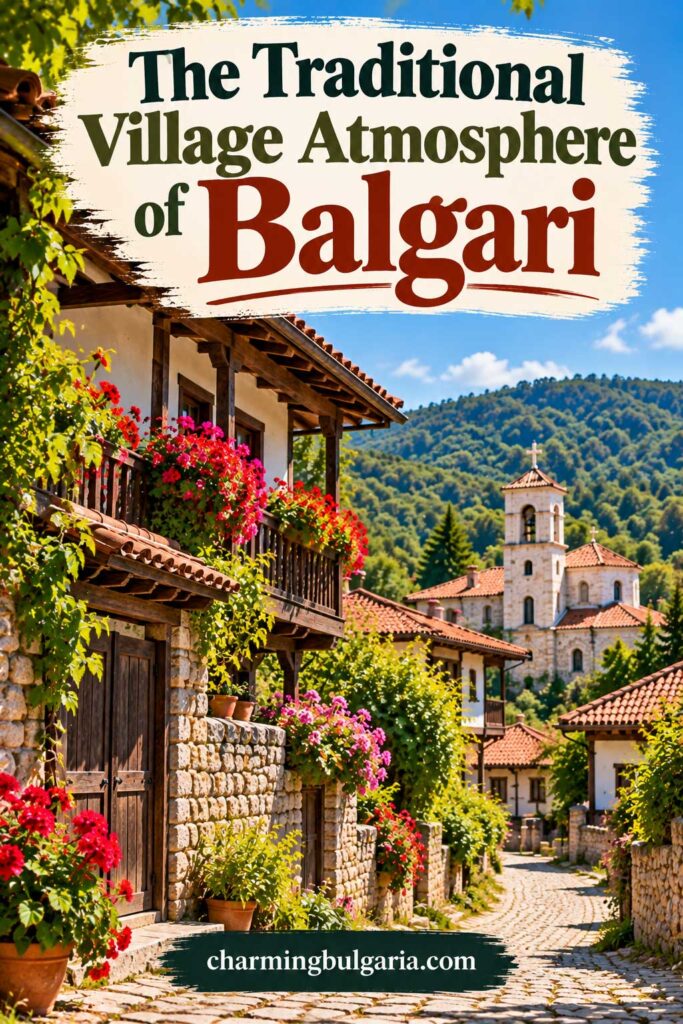
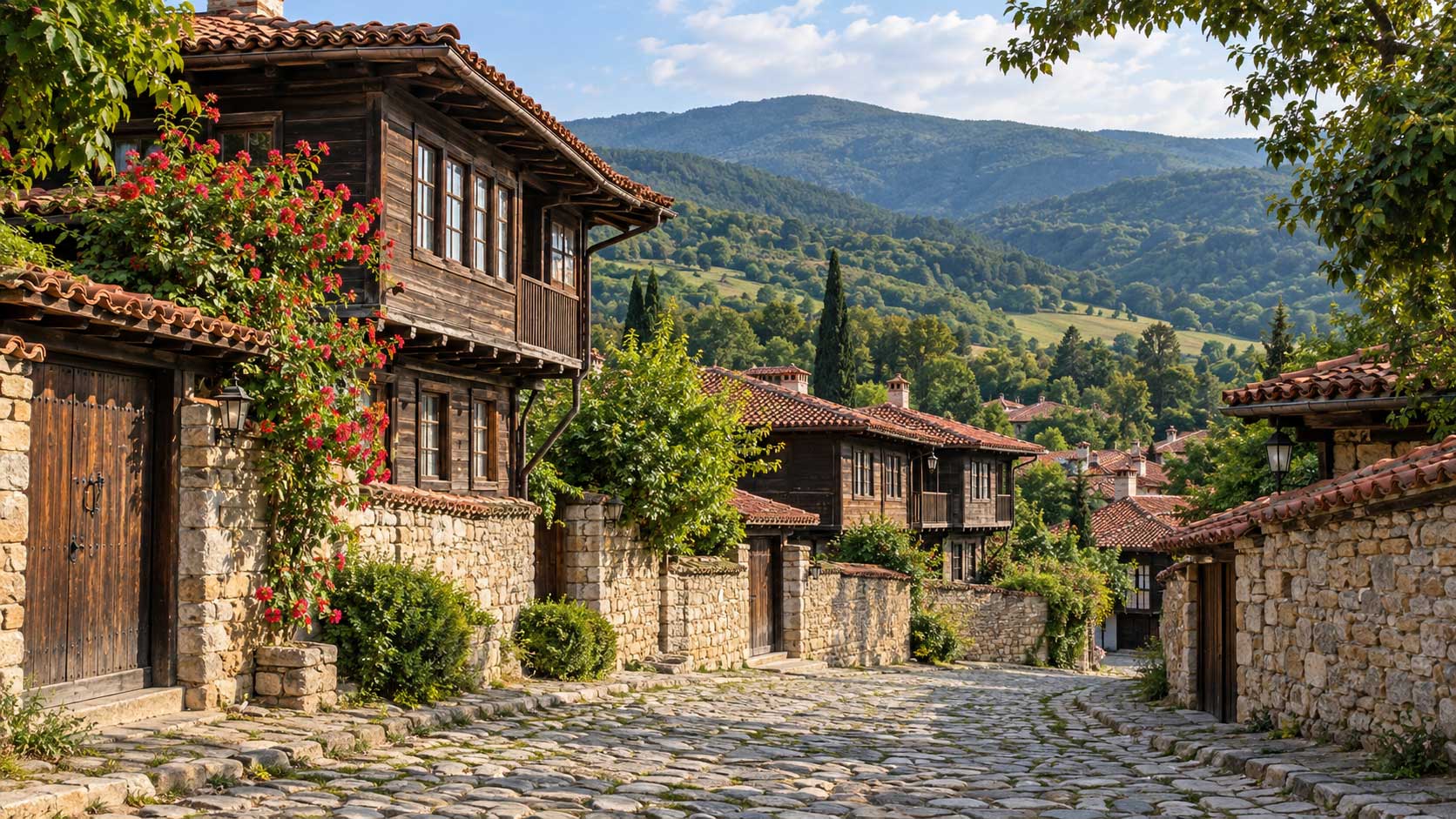
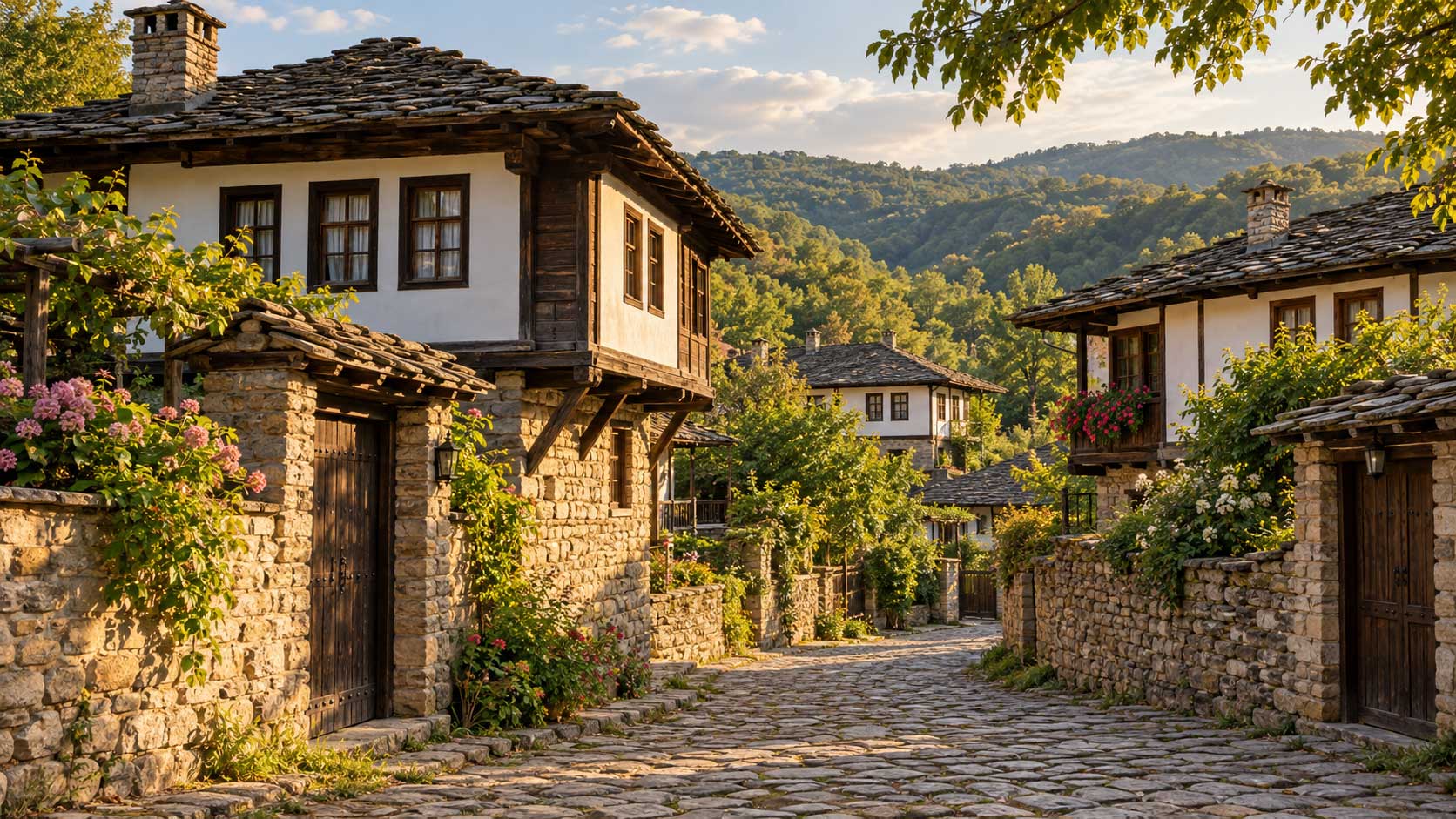
The village itself is compact and easy to explore on foot. Traditional houses, red-tiled roofs, small gardens and views of the Strandzha hills give Balgari a peaceful rural atmosphere.
A Brief History of Balgari
Balgari is not only important because of the Nestinari tradition. It is also considered one of the oldest villages in the Strandzha region, with a recorded history stretching back several centuries.
From Urgari and Urguri to Balgari
The village appears in a written document from 1454, while older forms of its name include Urgari and Urguri. Strandzha Nature Park notes that the settlement’s origins may reach back as far as the First Bulgarian Empire, although its documented history begins much later.
For centuries, life here developed among the forests, valleys and relatively isolated settlements of Strandzha. This setting helped local customs, religious practices and folklore remain an important part of community life.
Balgari and the Survival of Nestinarstvo
Nestinarstvo was once practiced in around 30 Bulgarian and Greek villages in the wider Strandzha region. Over time, the tradition disappeared from many of those communities, while Balgari became the village most closely associated with its continued practice.
This gives Balgari an importance that extends well beyond the village itself.
UNESCO describes Nestinarstvo and the Panagyr as an important expression of Strandzha identity, bringing together ritual, music, dance, food traditions and traditional clothing. The tradition was once practiced across a much wider group of Bulgarian and Greek communities, while Balgari became its best-known surviving center.
In 2009, UNESCO inscribed Nestinarstvo on the Representative List of the Intangible Cultural Heritage of Humanity, recognizing its importance to the cultural identity of the Strandzha region. The UNESCO page on the Nestinarstvo fire-dancing tradition also describes the annual Panagyr, the procession to the holy spring and the evening fire-dancing ceremony.
Every June, Balgari once again becomes a gathering place as people arrive for the annual celebration of Saints Constantine and Helena and the Nestinari fire-dancing ritual.
For travelers interested in Bulgaria’s cultural heritage, this continuity is one of the most fascinating things about the village. Balgari does not simply preserve memories of old Strandzha traditions—it remains one of the places where those traditions continue to be practiced.
A Village Shaped by Strandzha Traditions
Balgari’s identity has been shaped by much more than its famous fire-dancing ceremony.
For generations, life in this part of Strandzha revolved around the surrounding forests, farming, religious feast days and the changing seasons. Music, shared meals, processions and village gatherings all played a role in keeping local customs alive.
Nestinarstvo is the best-known of those traditions, but it belongs to a much wider cultural landscape.
That is part of what makes Balgari so interesting to visit. The ritual is not separated from the village around it. The church, sacred spaces, surrounding countryside and annual religious calendar all help explain why Nestinarstvo remains such an important part of Balgari’s identity.
What Is Nestinarstvo?
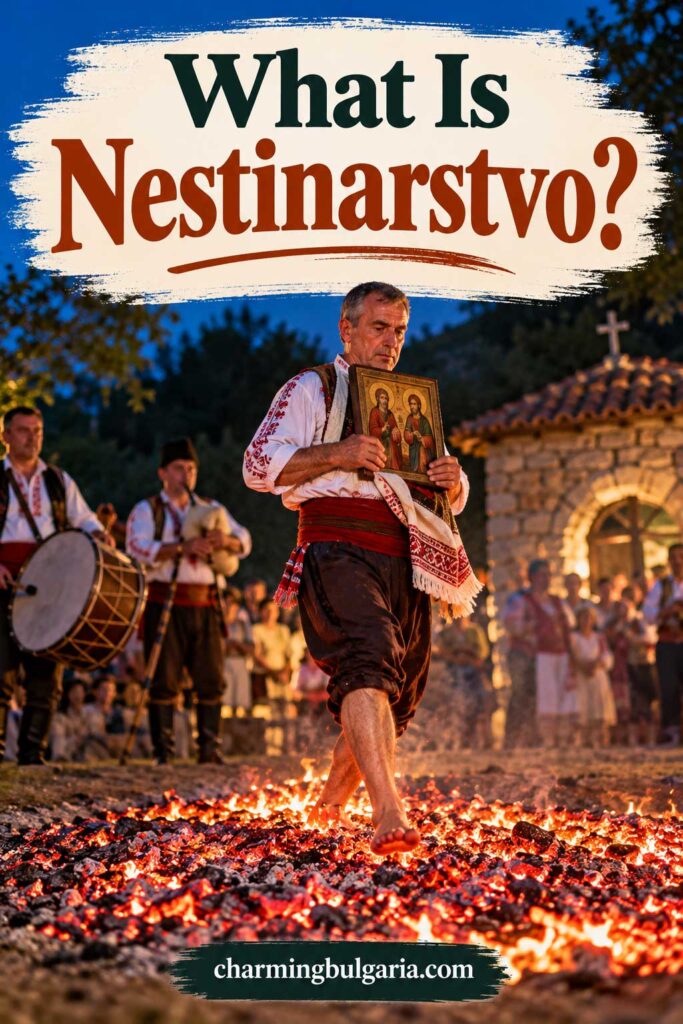
Nestinarstvo is a centuries-old ritual tradition dedicated to Saints Constantine and Helena. It is best known for barefoot fire dancers stepping onto glowing embers.
But the fire-dancing is only one part of a much larger ceremony.
Earlier in the day, religious rituals and a procession take place in the village. Sacred icons of Saints Constantine and Helena are carried toward a holy spring outside Balgari, accompanied by the sound of drums and bagpipes. At the spring, holy water and candles are distributed to those taking part in the celebration.
After sunset, attention turns to the fire.
A large fire is allowed to burn down until only a wide bed of glowing embers remains. People gather quietly around the fire as the steady rhythm of the sacred drum continues.
The Nestinari then enter the circle and walk barefoot across the hot embers. Sacred icons of Saints Constantine and Helena remain an important part of the wider ceremony, while the dancers themselves hold a special spiritual role within the traditional beliefs surrounding Nestinarstvo.
For visitors, the fire-walking is usually the part they remember most. For the people who have preserved the tradition, however, Nestinarstvo carries a much deeper meaning connected with faith, health, fertility and the well-being of the village.
The Music and Sacred Symbols of Nestinarstvo
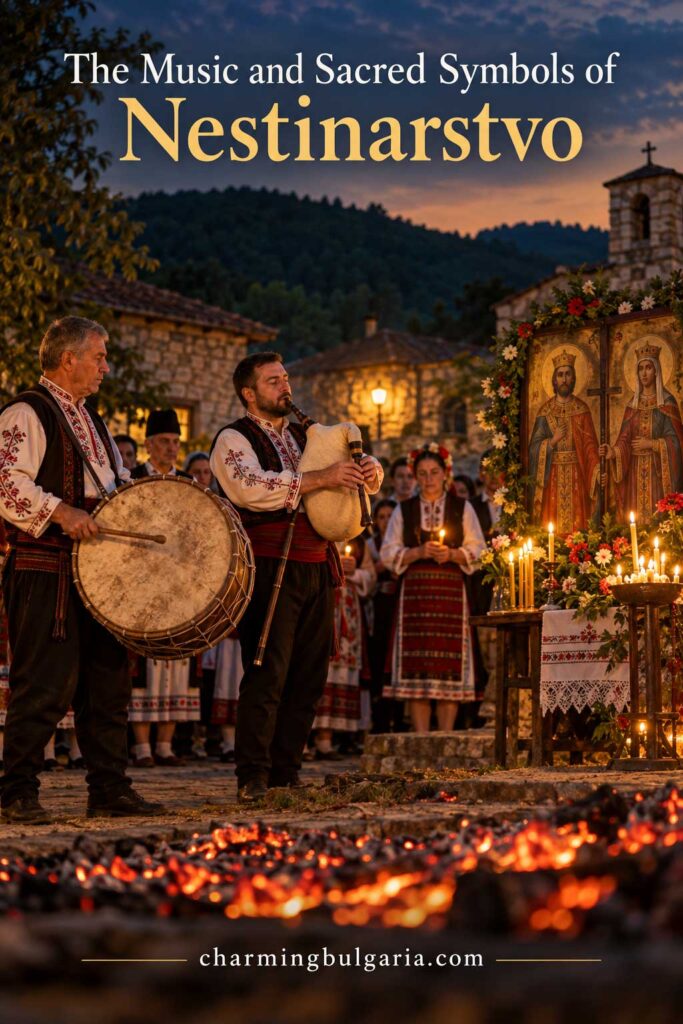
Nestinarstvo is much more than walking barefoot across glowing embers. The tradition brings together sacred icons, music, ritual movement, foodways and traditional clothing as part of the wider cultural identity of Strandzha. UNESCO’s description of the cultural significance of Nestinarstvo explains why the ritual is recognized as an important form of intangible cultural heritage.
The Sacred Drum and Bagpipes
The ceremony is traditionally accompanied by the deep rhythm of a drum and the sound of bagpipes. These instruments are not simply background music.
UNESCO describes the sacred drum as an important part of the evening ritual, guiding the gathering as people form a circle around the glowing embers before the Nestinari enter the fire. Earlier in the day, drums and bagpipes also accompany the procession from the village toward the holy spring.
The repeated rhythm, movement of the participants and quiet concentration of the crowd create an atmosphere very different from an ordinary folklore performance.
The Icons of Saints Constantine and Helena
The sacred icons of Saints Constantine and Helena are another central part of Nestinarstvo.
Earlier in the celebration, the icons are carried in procession from Balgari to a holy spring outside the village. Holy water and candles are distributed there before the procession eventually returns.
The icons remain closely connected with the fire-dancing ceremony and reinforce the religious meaning behind the ritual. The glowing embers may be the part visitors remember most, but Nestinarstvo is much broader than walking across fire.
UNESCO describes the tradition as an expression of Strandzha identity that brings together ritual, music, dance, foodways and traditional clothing.
Understanding these details makes the ceremony in Balgari much more meaningful. The music, icons, procession and shared religious traditions are what give Nestinarstvo its deeper cultural identity.
When to See the Nestinari Fire-Dancing Ritual
The most important time to visit Balgari is in early June, when the village holds its traditional celebration dedicated to Saints Constantine and Helena.
The main fire-dancing ritual takes place on the evening of June 3. Earlier in the day, religious ceremonies are held and the sacred icons of Saints Constantine and Helena are carried in procession to a holy spring outside the village, accompanied by drums and bagpipes.
As evening approaches, a large fire is allowed to burn down until a wide bed of glowing embers remains.
The steady beat of the tupan drum, the sound of the gaida and the glow of the fire create an atmosphere unlike an ordinary folklore performance. People gather around the embers, and the Nestinari eventually enter the circle and walk barefoot across the hot coals.
Today, the celebration attracts large numbers of visitors. UNESCO notes that although Balgari itself is a very small village, thousands of people gather there during the Panagyr.
Bulgaria’s official tourism portal provides additional background on the traditional Nestinari fire-dancing ritual, including its connection to Balgari and other fire-dancing performances in Strandzha.
Even with the crowds, seeing Nestinarstvo in Balgari is very different from watching a staged fire-dancing show elsewhere in Bulgaria. Here, the ritual remains connected to the religious feast, local community and Strandzha traditions that have preserved it for generations.
If seeing Nestinarstvo is one of the main reasons for your visit, arrive in Balgari well before evening. This gives you time to explore the village before the main gathering begins and avoids trying to arrive during the busiest part of the celebration.
Can You See Nestinari Fire-Dancing Outside June 3?
Yes. Fire-dancing performances can also take place at other times of year in Strandzha and along Bulgaria’s Black Sea coast.
However, these should not be confused with experiencing Nestinarstvo in Balgari during its traditional religious celebration. Bulgaria’s official tourism portal associates the annual Balgari ceremony with the evening of June 3, while UNESCO describes the wider Panagyr of Saints Constantine and Helena as taking place on June 3 and 4.
A staged performance may recreate the dramatic sight of walking barefoot across glowing embers, but the ceremony in Balgari is connected to a much larger religious tradition involving the local community, sacred icons, music and procession.
If experiencing Nestinarstvo in its traditional setting is important to you, plan your trip around early June and confirm the current year’s program before visiting.
Respecting the Nestinari Tradition
If you visit Balgari during the Nestinari celebration, remember that you are watching a religious and community tradition rather than an event organized primarily for tourists.
For the people who preserve the tradition, the ritual carries deep religious and cultural meaning. The sacred icons, music, procession and fire are all part of a ceremony that has been passed down through generations.
Watch the Ceremony Respectfully
Visitors should avoid blocking processions, touching sacred objects or entering areas being used by participants.
If you are taking photographs, try to do so without getting in the way of the ceremony. Avoid intrusive flash photography or moving too close to the Nestinari simply to get a better photo.
Remember the Meaning Behind the Fire
The fire-dancing may be the most dramatic part of Nestinarstvo, but it is only one element of a much larger religious tradition.
Watching quietly and giving participants space helps preserve the atmosphere of the ceremony and shows respect for the community that continues to keep the tradition alive.
That respect is especially important in Balgari, where Nestinarstvo remains closely connected to local identity, faith and the cultural heritage of Strandzha.
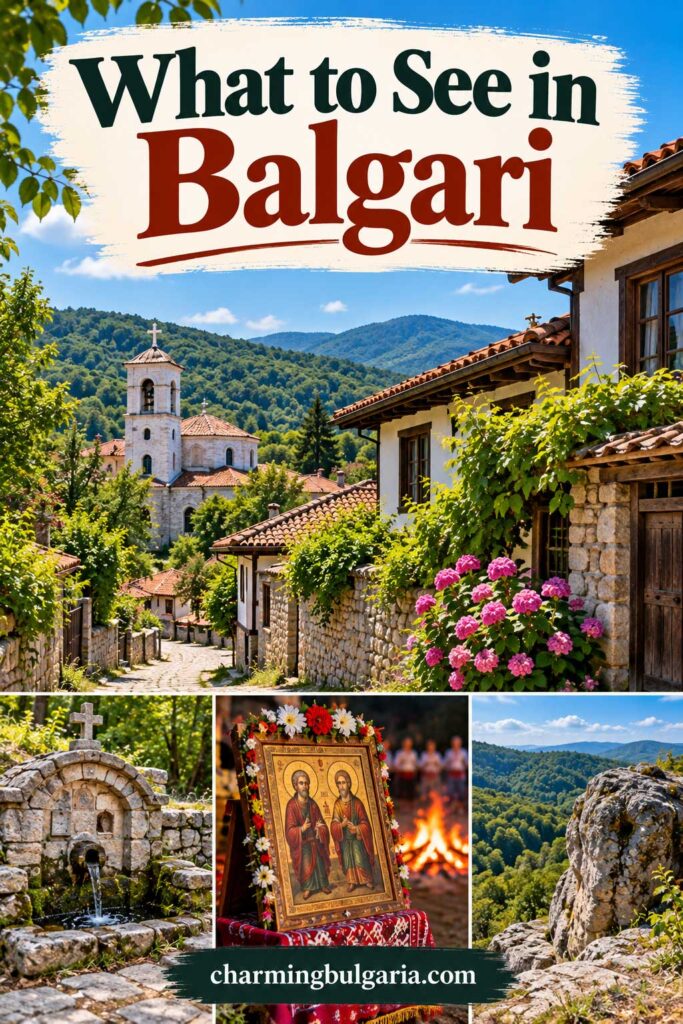
What to See in Balgari
Balgari is a small village, so you do not need an entire day to explore it. What makes it interesting is how closely several of its landmarks are connected to the Nestinari tradition and the cultural history of Strandzha.
The main landmark is the Church of Saints Constantine and Helena in the center of the village. The stone church was built in the second half of the 19th century, destroyed by fire during the Ilinden–Preobrazhenie Uprising in 1903, and rebuilt in 1910. Today, it is recognized as a cultural monument.
Nearby is Konacheto, the small sacred building closely associated with the Nestinari. The traditional fire-dancing drum is kept here, and the sacred icons are placed inside before important parts of the ceremony. The building also serves as one of the key ritual spaces before the Nestinari procession begins.
Several small chapels are scattered around the village and surrounding countryside. These include chapels dedicated to St. Constantine, St. Helena, St. Elijah and the Holy Mother of God. Some lie a short distance outside Balgari, giving visitors an easy reason to explore the forested landscape beyond the village center.
Balgari also has a private ethnographic collection housed in an old Strandzha home. The collection includes traditional clothing, handmade textiles, household furnishings and old tools that offer a glimpse into everyday rural life in the late 19th and early 20th centuries.
Balgari may not have a long list of conventional tourist attractions, but that is part of its charm. The best way to experience the village is slowly—walking through the center, visiting the places connected with Nestinarstvo and taking in the quiet Strandzha surroundings.
The Traditional Village Atmosphere of Balgari
Outside the early-June celebration, everyday life in Balgari moves at a much slower pace.
Quiet Streets and Strandzha Scenery
The village sits on a broad ridge surrounded by deep valleys and rounded, forest-covered hills. This setting gives Balgari a very different atmosphere from the busy resorts along Bulgaria’s southern Black Sea coast.
Walking through the village, you will pass gardens, old fences, red-tiled roofs and houses tucked among the greenery. Some buildings have been renovated, while others retain a more traditional rural appearance.
There is no need for a strict sightseeing route. Part of the pleasure of visiting Balgari is simply walking beyond the center, following the smaller streets and seeing how naturally the village blends into the surrounding Strandzha landscape.
Outside festival time, the difference is especially noticeable. The crowds disappear and Balgari returns to its everyday pace.
For photographers, the quieter details of Balgari can be just as interesting as the famous fire-dancing ceremony. Old houses, tiled roofs, village gardens and the green hills beyond the streets reveal a very different side of southeastern Bulgaria.
Nature Around Balgari
Part of Balgari’s appeal comes from its setting in the Strandzha Mountains, where forested hills, deep valleys and old woodland surround the village.
Silkosia Nature Reserve
Just east of Balgari lies Silkosia Nature Reserve, Bulgaria’s oldest nature reserve. Established in 1933, it protects mature forests and distinctive Strandzha vegetation.
Silkosia is only about 1 kilometer from the village, but because it is strictly protected, visitors should check current access rules before entering. The official Strandzha Nature Park guide to Silkosia Nature Reserve provides more information about the reserve, its forests and visitor regulations.
Marina Reka and the Forests of Strandzha
Another nearby natural area is Marina Reka, around 7 kilometers northeast of Balgari. It is known for the unusual vegetation and relict plant species that make Strandzha one of Bulgaria’s most distinctive natural regions.
The surrounding landscape also helps explain why traditional village life and customs remained deeply rooted here for so long. Forests, valleys and relatively isolated settlements shaped everyday life across Strandzha for generations.
For visitors, the countryside around Balgari adds an important second layer to the trip. The village is not only about Nestinarstvo—it is also a good starting point for experiencing the forests, quiet roads and rural landscapes of Strandzha.
You can spend part of the day exploring Balgari, continue into the surrounding countryside, and then visit other traditional Strandzha villages such as Brashlyan, Kosti, Kondolovo or Gramatikovo.
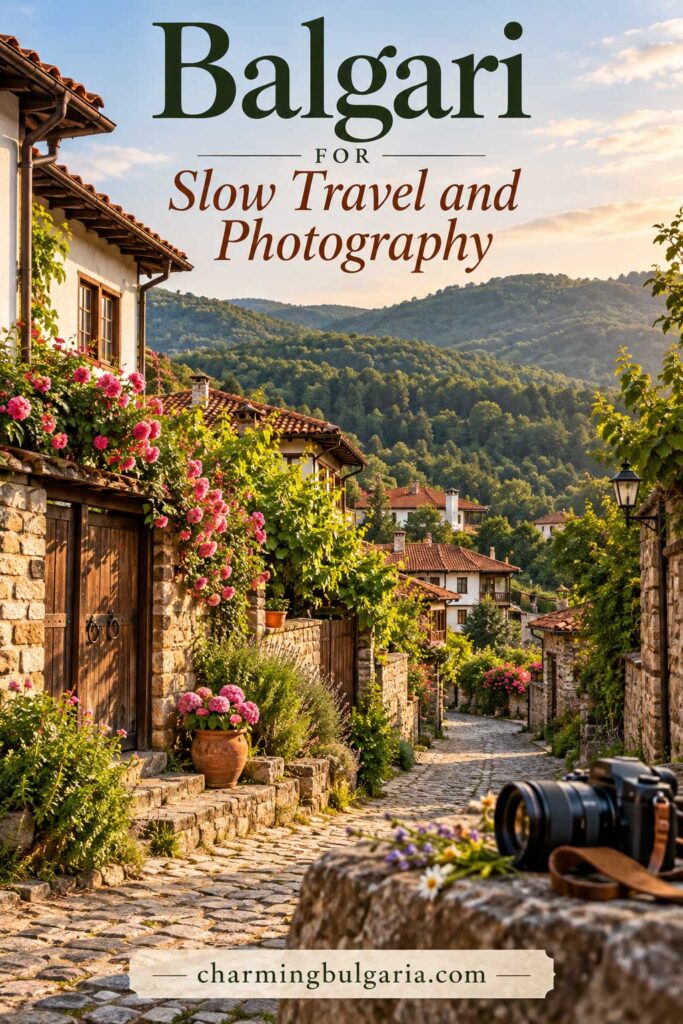
Balgari for Slow Travel and Photography
Balgari is especially appealing to travelers who enjoy slow travel, village photography and quiet places surrounded by nature.
The village sits at around 300 meters above sea level on a broad ridge overlooking the rounded, forested hills of Strandzha. Deep valleys and old woodland surround the area, making Balgari feel surprisingly remote despite its relatively short distance from the Black Sea coast.
Photographing the Village
For photographers, some of the most interesting scenes are often the simplest ones: old houses, wooden gates, village gardens, small religious buildings and quiet streets framed by greenery.
Early morning and late afternoon are especially pleasant times to explore, when the light is softer and the village tends to be quieter.
During the Nestinari celebration, photography requires more sensitivity. The religious character of the ceremony is more important than getting the perfect shot, so avoid blocking processions or moving too close to participants simply for a photograph.
Nature Photography Around Balgari
The forests surrounding Balgari offer plenty of opportunities for landscape and nature photography.
Instead of focusing only on individual landmarks, look for the details that make Strandzha distinctive: forest-covered ridges, old trees, dense vegetation and quiet roads disappearing into the hills.
Nearby areas such as Silkosia Nature Reserve and Marina Reka offer even more opportunities to photograph the region’s unusual landscapes and vegetation. Check current access rules before visiting protected areas.
Outside festival season, Balgari can feel wonderfully uneventful. That slower pace is part of what makes the village enjoyable.
Some of the best moments here come from walking slowly, noticing small details and letting Strandzha set the pace of the visit.
Best Time to Visit Balgari
The best time to visit Balgari depends on whether you want to experience the famous Nestinari tradition or enjoy the village when it is quieter.
Visit in Early June for Nestinarstvo
If seeing the Nestinari fire-dancing ritual is the main reason for your trip, plan your visit around the annual celebration of Saints Constantine and Helena in early June.
UNESCO describes the traditional Panagyr in Balgari as taking place on June 3 and 4, with religious ceremonies, a procession to a holy spring and the evening fire-dancing ritual forming part of the celebration.
This is the most important cultural event of the year in Balgari and also the busiest time to visit. If you are traveling specifically to see the fire dancing, check the current year’s program before arriving, as the timing of individual ceremonies may vary.
Visit in Spring or Autumn for a Quieter Experience
For a more peaceful visit, late spring and early autumn are excellent alternatives. The surrounding Strandzha forests are beautiful during these seasons, and exploring the village is much easier without the crowds that gather for the annual celebration.
Summer also works well if you are already traveling along Bulgaria’s southern Black Sea coast. Balgari is only about 17 kilometers from Tsarevo, making it an easy inland addition to a coastal road trip.
Even outside festival season, the village is worth visiting for its traditional atmosphere, church, Nestinari heritage and access to the forests of Strandzha.
If experiencing Nestinarstvo is your priority, however, early June is the time to come.
How to Get to Balgari
Balgari is easiest to reach by car, especially if you are already exploring Bulgaria’s southern Black Sea coast. Having your own vehicle also makes it much easier to combine the village with other places in Strandzha.
From Tsarevo and the Black Sea Coast
Balgari is about 17 kilometers from Tsarevo, on the road leading inland toward Malko Tarnovo. From the coast, the scenery quickly changes from seaside towns and beaches to wooded hills and the quieter landscapes of Strandzha.
If you are staying in Tsarevo, Ahtopol or another resort along the southern Black Sea coast, Balgari makes an easy inland addition to a day trip.
From Burgas and by Public Transport
From Burgas, follow the main coastal route south through Sozopol and Primorsko toward Tsarevo. From Tsarevo, continue inland toward Balgari and the interior of Strandzha Nature Park.
Traveling without a car requires a little more planning. Public buses connect Burgas with Tsarevo, but onward transportation to small inland villages such as Balgari can be limited. Check current local schedules before traveling rather than relying on older published timetables.
For most visitors, driving or renting a car offers the most flexibility. It also makes it possible to combine Balgari with Silkosia Nature Reserve, Kosti, Kondolovo and other Strandzha villages during the same trip.
Roads through Strandzha can be narrow and winding in places, so allow extra time and enjoy the drive rather than judging the journey only by distance.
Where to Stay Near Balgari
Balgari is a very small village, so most travelers will find it easier to stay in a nearby coastal town or another village in the Strandzha region and visit Balgari as part of a day trip.
Stay in Tsarevo, Ahtopol or Sinemorets
Tsarevo is one of the most practical bases because Balgari is only about 17 kilometers away. Staying there also gives you easier access to restaurants, shops and the southern Black Sea coast.
Farther south, Ahtopol and Sinemorets are good choices if you want to combine Balgari with beaches and coastal scenery. Sinemorets is about 20 kilometers from Tsarevo, while Ahtopol lies just north of it, making both convenient for a longer trip through southeastern Bulgaria.
Strandzha Nature Park also lists accommodation options in both Ahtopol and Sinemorets, including villas, guesthouses and small family hotels.
Stay Inland for a Quieter Strandzha Experience
If you prefer rural tourism, you can also look for guesthouses in the inland villages of Strandzha. Staying away from the coast gives you a quieter experience and makes it easier to explore forests, traditional villages and nature trails.
The official Strandzha Nature Park accommodation directory includes small guesthouses and rooms in villages such as Kosti, showing that rural stays are available in the wider region.
If you are visiting specifically for the Nestinari celebration in early June, booking ahead is a good idea because more visitors come to the area during the festival period.
For most travelers, spending one or two nights around Tsarevo or elsewhere in Strandzha gives enough time to explore Balgari without rushing and still include nearby villages, forests and the Black Sea coast.
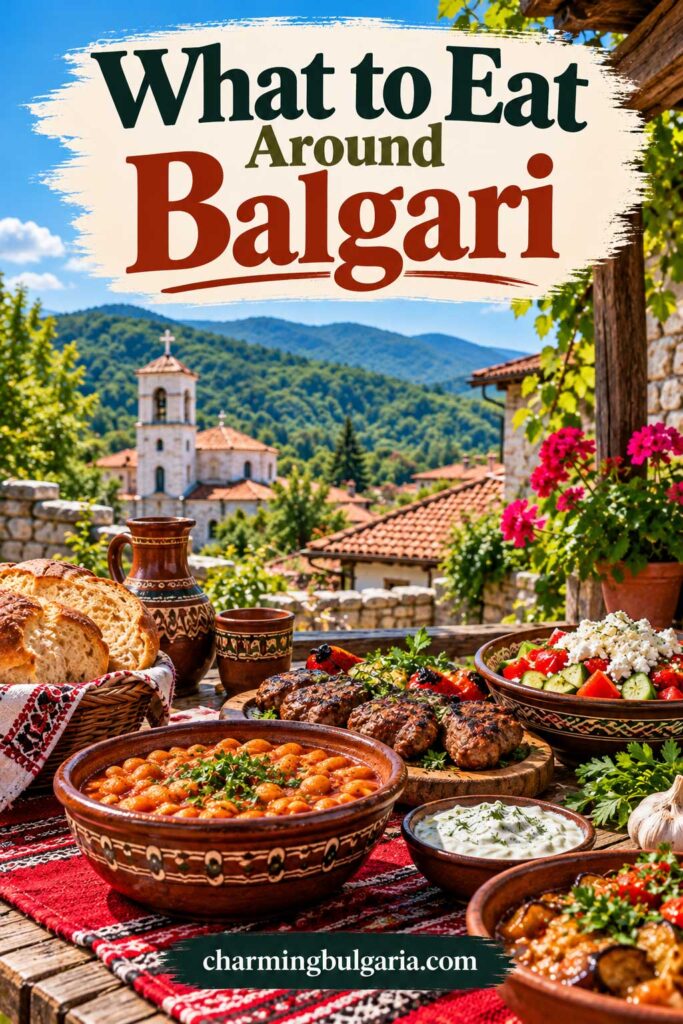
What to Eat Around Balgari
A visit to Balgari is also a chance to discover some of the traditional foods of Strandzha, a region where local cooking has long been shaped by seasonal ingredients, village agriculture and products gathered from the surrounding landscape.
Traditional Strandzha Foods to Look For
One regional specialty is Strandzha zelnik, traditionally prepared with leafy greens such as amaranth, orache and sorrel. Recipes vary, but the dish reflects the old Strandzha habit of cooking with seasonal plants that were readily available in the countryside.
Another product closely associated with the region is manov med, or honeydew honey. Beekeeping has deep roots in Strandzha, and the region is well known for this dark, intensely flavored honey. Tsarevo has even hosted a dedicated honeydew honey festival for many years.
Other traditional foods connected with Strandzha include Strandzha dyado, homemade preserves, dishes made with nettles and other wild greens, and various traditional ways of preserving fish and meat.
Where to Eat Near Balgari
Balgari is a small rural village, so it is better not to plan your visit around finding a large selection of restaurants there.
If trying regional food is an important part of your trip, combine Balgari with Tsarevo, Ahtopol or another larger settlement nearby, where you will have more dining options.
Also keep an eye out for locally produced Strandzha honey and homemade regional foods sold at village events, festivals and small local markets. Traditional food stalls have been part of Strandzha festivals in the past, including events held in Balgari itself.
Trying a few of these local products adds another layer to a visit to Balgari and helps connect the village with the wider food traditions of Strandzha.
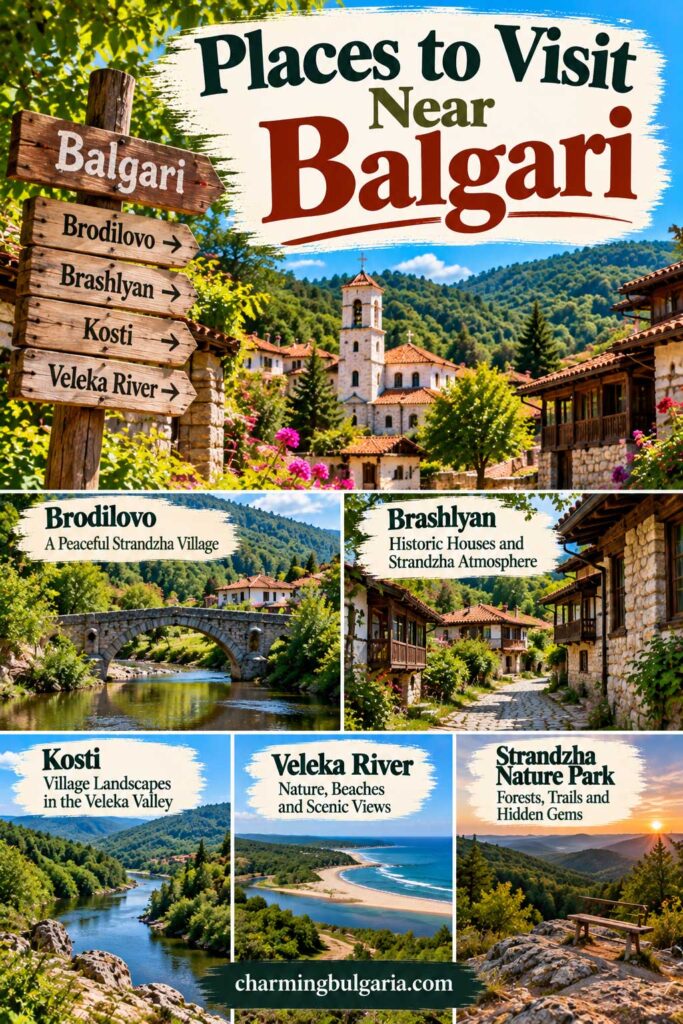
Places to Visit Near Balgari
One of the advantages of visiting Balgari is that you can easily combine the village with several other interesting places in Strandzha Nature Park. Forest reserves, traditional villages and the Black Sea coast are all close enough to include in a wider trip through southeastern Bulgaria.
Silkosia Nature Reserve
Silkosia Nature Reserve, about 1 kilometer east of Balgari, is an easy addition for travelers interested in Strandzha’s forests and unusual vegetation. Because access is regulated, check the current visiting rules before planning to enter the reserve.
Kosti and the Veleka River Valley
Another worthwhile stop is Kosti, a traditional Strandzha village set in the picturesque valley of the Veleka River and surrounded by forested hills.
Kosti is particularly interesting in connection with Balgari because it was historically another fire-dancing settlement. The village therefore adds useful context for understanding how the Nestinari tradition once extended across several communities in the Strandzha region.
Several older houses have survived in the village, and the surrounding countryside includes chapels, holy springs and traces of ancient settlement.
Brodilovo and the Black Sea Coast
Farther toward the coast, Brodilovo lies near the Veleka River at the southeastern foot of the Golyama Papia massif. The surrounding area contains traces of ancient fortifications, burial mounds, old churches and evidence of historic metalworking.
Brodilovo works particularly well as another village stop if you are traveling between inland Strandzha and the southern Black Sea coast.
From there, you can continue toward Tsarevo, which lies about 17 kilometers from Balgari and provides an easy connection back to the coast.
If you have more than one day, Balgari is best experienced as part of a wider Strandzha road trip rather than as an isolated destination. Combining Balgari, Silkosia, Kosti and Brodilovo gives you a much better sense of the region’s forests, village traditions and cultural history before returning to the Black Sea coast.
A One-Day Itinerary for Balgari and Strandzha
If you are staying along Bulgaria’s southern Black Sea coast, Balgari fits easily into a relaxed one-day road trip through Strandzha.
Morning: Tsarevo to Balgari
Start the morning in Tsarevo and drive inland toward Balgari. The village is about 17 kilometers from Tsarevo, but the landscape changes quickly as you leave the coast and enter the forested hills of Strandzha.
Spend the morning walking through Balgari, visiting the Church of Saints Constantine and Helena and seeing the places connected with the Nestinari tradition. Give yourself time to wander through the quieter streets rather than treating the village as a quick photo stop.
Late Morning: Explore the Strandzha Forests
After Balgari, continue to the Marina Reka protected area, around 7 kilometers northeast of the village. It is one of the more accessible places to experience the distinctive vegetation of Strandzha and is especially known for its rich collection of relict plant species.
Silkosia Nature Reserve is even closer to Balgari, but access is more restricted. Visits inside the reserve are permitted only along the marked trail and with an inspector-guide, so arrange access in advance if you specifically want to include Silkosia.
Afternoon: Continue to Kosti and Brodilovo
From the Balgari area, continue toward Kosti, a traditional Strandzha village in the valley of the Veleka River. Kosti was historically another fire-dancing settlement and is surrounded by old forests, making it an interesting companion to Balgari.
If you still have time, continue toward Brodilovo. The village lies near the Veleka River at the southeastern foot of the Golyama Papia massif and is surrounded by forests, old religious sites and traces of ancient settlement.
Evening: Return to the Black Sea Coast
Finish the day back on the southern Black Sea coast. Tsarevo or Ahtopol are convenient places to stop for dinner before returning to your accommodation.
This route brings together some of the things that make southeastern Bulgaria so interesting: traditional villages, Nestinari heritage, old Strandzha forests, quiet mountain roads and the Black Sea coast.
You do not need to rush through every stop. If you prefer a slower day, visit Balgari, choose one nature area and add either Kosti or Brodilovo before heading back to the coast.
Travel Tips for Visiting Balgari
Balgari is easy to explore, but a little planning can make the visit much more enjoyable—especially if you are coming for the Nestinari celebration in early June.
Come Prepared for Walking
Wear comfortable shoes, particularly if you plan to explore beyond the village center. Streets and paths can be uneven, and nearby natural areas may involve walking on forest trails or rural roads.
During the warmer months, bring water, sun protection and insect repellent, especially if you plan to spend time in the surrounding Strandzha countryside.
Arrive Early for the Nestinari Celebration
If you are visiting specifically for the fire-dancing ritual, arrive well before the evening ceremony begins. Balgari becomes much busier during the annual celebration, and reaching the village earlier gives you more time to explore before the main crowds gather.
It also reduces the stress of trying to arrive just before the ceremony starts.
Carry Some Cash
It is a good idea to bring some cash with you. Small villages in Strandzha may have fewer ATMs, shops and card-payment options than larger towns along the Black Sea coast.
Do not rely on Balgari for everything you might need during the day. If possible, bring water, snacks and other basics before leaving Tsarevo or another larger town.
Take Your Time
Balgari is most enjoyable when you do not treat it as a quick roadside stop.
Allow time to walk through the village, see the places connected with Nestinarstvo and explore some of the surrounding Strandzha countryside. If your schedule allows, combine Balgari with nearby villages, nature areas or a return to the southern Black Sea coast.
A slower visit gives you a much better sense of what makes this small Strandzha village special.
Why Balgari Is Worth Visiting
Balgari is not a village you visit for a long list of famous sights. Its appeal comes from something much harder to find: a strong sense of place and traditions that are still closely connected to the local community.
The village is especially interesting for travelers drawn to Bulgarian folklore, rural life and traditional Bulgarian villages. Nestinarstvo is the tradition that made Balgari widely known, but the surrounding forests, old religious sites and quiet village streets are just as important to the overall experience.
A visit here is less about rushing from attraction to attraction and more about understanding how the village, landscape and local traditions fit together. You can walk through the center, explore the surrounding countryside and see places that still play a role in customs passed down through generations.
Balgari also offers a striking contrast with Bulgaria’s southern Black Sea coast. A relatively short drive inland takes you away from busy seaside resorts and into a much quieter landscape of forested hills, narrow roads and traditional Strandzha villages.
Even if you do not visit during the Nestinari celebrations in early June, Balgari is still worth seeing for its peaceful atmosphere, cultural heritage and beautiful natural setting.
Balgari works especially well for travelers who prefer small places with a strong local identity rather than destinations built around a long checklist of attractions.
Frequently Asked Questions About Balgari
What is Balgari village famous for?
Balgari is best known for Nestinarstvo, the traditional Bulgarian fire-dancing ritual in which the Nestinari walk barefoot across glowing embers. The ceremony is dedicated to Saints Constantine and Helena and forms part of a much larger religious and cultural tradition.
Where is Balgari, Bulgaria?
Balgari is a small village in the Strandzha Mountains of southeastern Bulgaria, about 17 kilometers inland from Tsarevo and the southern Black Sea coast.
When does the Nestinari fire-dancing take place in Balgari?
The annual celebration of Saints Constantine and Helena takes place in early June, with the traditional fire-dancing ceremony in Balgari associated with the evening of June 3. UNESCO describes the wider Panagyr as taking place on June 3 and 4. If seeing the ritual is the main reason for your trip, check the current year’s program before visiting.
Is Balgari worth visiting outside the festival?
Yes. Outside the early-June celebration, Balgari is much quieter and offers a very different experience. It is a good place to visit if you are interested in traditional Bulgarian villages, Strandzha culture, rural landscapes and nearby forests.
How much time do you need in Balgari?
A few hours is usually enough to explore the village itself. Allow at least half a day if you also want to visit nearby natural areas or neighboring Strandzha villages. A full day works well if you are combining Balgari with places such as Kosti, Brodilovo or the Black Sea coast.
Can you visit Balgari from the Black Sea coast?
Yes. Balgari is about 17 kilometers from Tsarevo, making it an easy inland trip from Bulgaria’s southern Black Sea coast, especially if you are traveling by car.
Do the Nestinari really walk barefoot on hot embers?
Yes. During the ritual, the Nestinari enter a circle of glowing embers and walk barefoot across them. UNESCO describes the fire dance as the climax of the Panagyr rather than a standalone performance.
Is Nestinarstvo unique to Balgari?
Nestinarstvo was once practiced in around 30 Bulgarian and Greek villages in the wider Strandzha region. UNESCO notes that the tradition has survived in Balgari, making the village particularly important for preserving this form of intangible cultural heritage.
Is Nestinarstvo just a tourist performance?
No. Although the ceremony now attracts many visitors, Nestinarstvo has deep religious and cultural meaning. The fire dancing is only one part of a larger ritual involving sacred icons, processions, music, holy water and the celebration of Saints Constantine and Helena.
Balgari: Where the Traditions of Strandzha Still Live
Balgari is one of those Bulgarian villages whose cultural importance is much greater than its size might suggest.
Its quiet streets, forested surroundings and traditional atmosphere make it pleasant to explore, but what truly sets the village apart is its connection to Nestinarstvo. Few customs in Bulgaria are as visually striking, and even fewer remain so closely tied to the community that has preserved them.
Visiting during the early-June celebration gives you the chance to experience Balgari at its most active, when sacred icons, music, processions and fire come together as part of a tradition passed down through generations.
At other times of year, the village feels completely different. The festival crowds are gone, the forests of Strandzha take center stage, and Balgari becomes a peaceful place to explore old religious sites, rural landscapes and nearby villages.
For travelers who want to discover Bulgarian traditions beyond the better-known tourist routes, Balgari offers a memorable glimpse into the culture of Strandzha.
It may be best known for the Nestinari walking barefoot across glowing embers, but the real experience of Balgari goes much deeper than the fire.
It is a village where landscape, history and tradition still feel closely connected.
Explore More of Strandzha and Rural Bulgaria
If Balgari made you curious about the quieter, more traditional side of Bulgaria, continue exploring with these guides: