12 Traditional Bulgarian Villages Where Time Stands Still

- March 10, 2026
- 19
- Historic Villages , Culture & Traditions , Slow Travel Bulgaria
There are places in Bulgaria where the modern world seems to fade the moment you arrive.
The roads become narrower. Apartment blocks disappear behind forested hills. Stone walls line quiet lanes, wooden balconies lean over cobbled streets, and the sound of traffic gives way to church bells, birds, running water, and conversations drifting from nearby gardens.
Some of the country’s traditional Bulgarian villages still preserve a remarkably strong connection with the Bulgaria of generations past.
Across the Balkan Mountains, the Rhodopes, Strandzha, and other rural regions, you can find villages filled with centuries-old houses, stone fountains, small churches, workshops, and family-run guesthouses. Many preserve architecture associated with Bulgaria’s National Revival period, particularly the 18th and 19th centuries.
But the real appeal of these places goes far beyond old buildings.
It is the feeling of slowing down.
Instead of rushing from one attraction to the next, you might spend an afternoon following a cobblestone lane, sitting beneath a wooden veranda, eating homemade banitsa or local cheese, or simply watching the mountains change color as evening approaches.
Villages such as Bozhentsi and Zheravna are especially well known for their preserved Revival-era architecture, while settlements deeper in the Rhodope Mountains offer a different atmosphere shaped by stone houses, mountain traditions, music, and rural life.
Some have become popular weekend destinations. Others remain quiet enough that you may see only a handful of visitors while wandering their streets.
That contrast is part of what makes traveling through rural Bulgaria so rewarding.
One village may have beautifully restored guesthouses and traditional restaurants, while another feels almost forgotten, with old stone homes beneath walnut trees and narrow lanes still following routes laid out generations ago.
These are not places you visit because they have dozens of famous attractions.
You come because the village itself is the attraction.
In this guide to 12 traditional Bulgarian villages where time stands still, we’ll travel from atmospheric mountain settlements and protected architectural reserves to quieter rural corners where old Bulgaria can still be felt in the houses, streets, landscapes, and traditions.
Some are perfect for a short stop during a road trip. Others deserve an entire quiet weekend.
And a few may make you want to stay much longer than you originally planned.
1. Zheravna – A Village of Wooden Houses and Cobblestone Lanes
Few places in Bulgaria fit the idea of a village frozen in time quite as well as Zheravna.
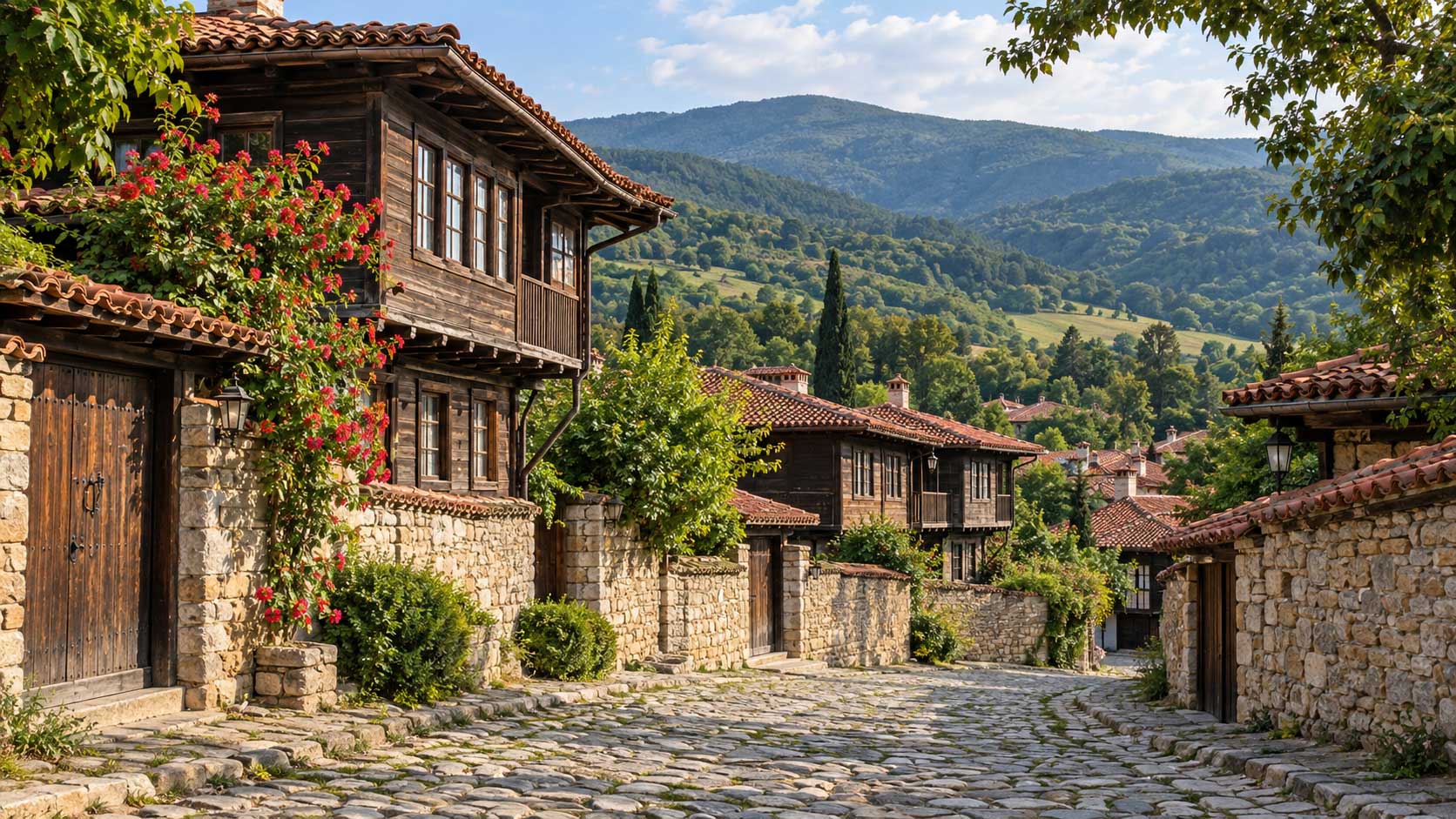
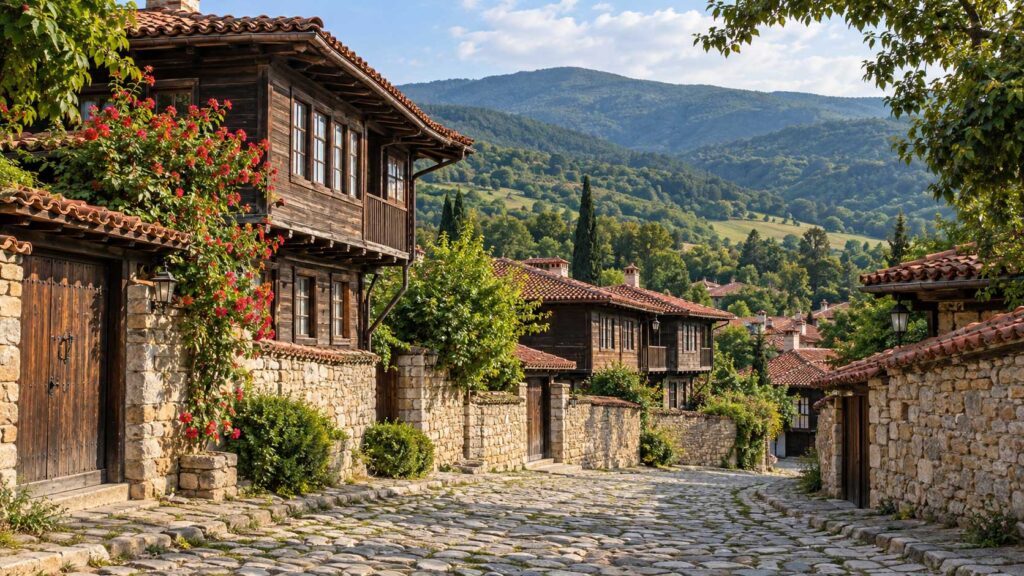
Tucked into the eastern Balkan Mountains near Kotel, the village is known for its narrow cobblestone streets, stone walls, red-tiled roofs, and dark wooden houses that seem to belong to another century.
Zheravna grew into an important craft and cultural center during the 17th century. Today, it is protected as an architectural and museum reserve, with 172 houses recognized as cultural monuments.
What makes Zheravna especially memorable is how complete the historic setting feels.
Rather than finding one restored street surrounded by modern development, you can walk through large parts of the village where traditional architecture still shapes the view. Wooden houses rise above stone foundations, small fountains appear beside the lanes, and heavy wooden gates hide quiet courtyards behind high walls.
What Makes Zheravna Special
The architecture is the main reason to visit, but it is the small details that give Zheravna its character.
Many preserved homes date from Bulgaria’s National Revival period and feature timber façades, carved interiors, deep roofs, and enclosed courtyards. The village also has a long connection with traditional crafts, including weaving and other forms of handmade production that once played an important role in local life.
Zheravna is best explored slowly.
Follow the cobbled lanes without worrying too much about a route. Notice the weathered wooden doors, vines spilling across stone walls, old fountains tucked beside the road, and chimneys rising above the rooftops.
Those details often leave a stronger impression than any single landmark.
What to See in Zheravna
Several historic houses have been turned into museums, giving visitors a closer look at village life, traditional crafts, architecture, and local history.
The House of Rusi Chorbadzhi is particularly interesting if you want to understand the role of craftsmanship in Zheravna. Historic weaving equipment and textiles help show how closely everyday life was once connected with work done by hand.
Beyond the museums, much of the pleasure comes from simply wandering through the old village.
Traditional houses, workshops, stone fountains, wooden gates, and small courtyards appear naturally along the streets, so exploring Zheravna feels less like moving between individual attractions and more like walking through a preserved historic landscape.
Why Zheravna Feels Frozen in Time
Zheravna is no longer an undiscovered village, but tourism has not erased the atmosphere that makes it special.
Many guesthouses are located inside restored Revival-era homes rather than large modern hotels, allowing visitors to stay within the same traditional surroundings they came to experience.
The village feels especially atmospheric early in the morning or toward evening.
Once many day visitors have left, the cobbled lanes become quieter, doors close behind old stone walls, and the sounds of everyday village life begin to replace the daytime activity.
For travelers exploring traditional Bulgarian villages where time seems to stand still, Zheravna deserves its place near the top of the list.
2. Bozhentsi – One of Bulgaria’s Best-Preserved Revival Villages
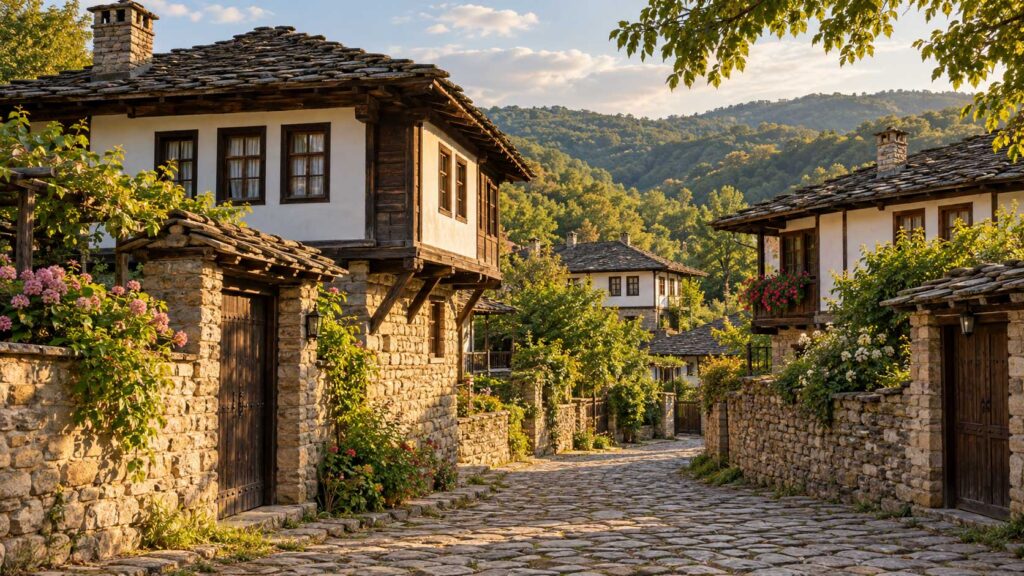
Surrounded by green hills near Gabrovo, Bozhentsi is one of those places where the landscape and the architecture seem to belong together.
Whitewashed houses with dark timber details line narrow stone streets, while heavy roofs, wooden gates, old fountains, and small courtyards preserve the atmosphere of an older Bulgaria.
The village lies about 15 kilometers east of Gabrovo and is protected as a historical and architectural reserve because of its remarkably well-preserved buildings from the Bulgarian Revival period.
What Makes Bozhentsi Special
What stands out in Bozhentsi is how completely the traditional architecture shapes the village.
Many houses are built with stone lower floors, white upper levels, dark wooden details, and broad roofs suited to the mountain climate. Instead of following a strict modern street plan, the homes sit naturally along curved lanes and gentle slopes.
According to local tradition, the village is connected with a noblewoman named Bozhana, who is said to have fled Tarnovo after the Ottoman conquest and settled here with her family. The story remains part of Bozhentsi’s identity, although it is better understood as local legend than firmly documented history.
Bozhentsi was officially declared a historical and architectural reserve in 1964, helping protect the Revival-era character visitors still see today.
What to See in Bozhentsi
The best way to experience Bozhentsi is on foot.
Follow the cobbled lanes through the old center, wander between traditional houses, and take your time exploring the quieter side streets.
Several historic homes have been turned into museum spaces.
The Baba Rayna House Museum presents an ethnographic exhibition focused on life in the 18th century, while the Doncho Popa House Museum explores the livelihoods and everyday routines of local residents during the 19th century.
Another interesting stop is the Mengemata, an old wax-cleaning workshop where an authentic early-19th-century wax press has been preserved.
Higher in the village stands the Church of St. Prophet Elijah, built in 1839. Its stone construction and later bell tower fit naturally into the surrounding Revival-era setting.
Stay Overnight for the Best Experience
Bozhentsi is easy to visit as a day trip, but staying overnight gives you a better sense of the village.
Some traditional houses now operate as guesthouses, allowing visitors to stay inside buildings that still preserve much of the character of a 19th-century Bulgarian home.
Evening is when Bozhentsi often feels most atmospheric.
As the streets empty, you begin to notice the smaller sounds—the water running through the village, footsteps on stone, birds in the surrounding hills, and the occasional conversation from behind a courtyard wall.
Without the daytime activity, the old lanes and houses feel even more connected to the past.
For anyone exploring traditional Bulgarian villages where time stands still, Bozhentsi deserves a place near the top of the list.
3. Shiroka Laka – Rhodope Traditions Among Stone Houses and Mountain Streets
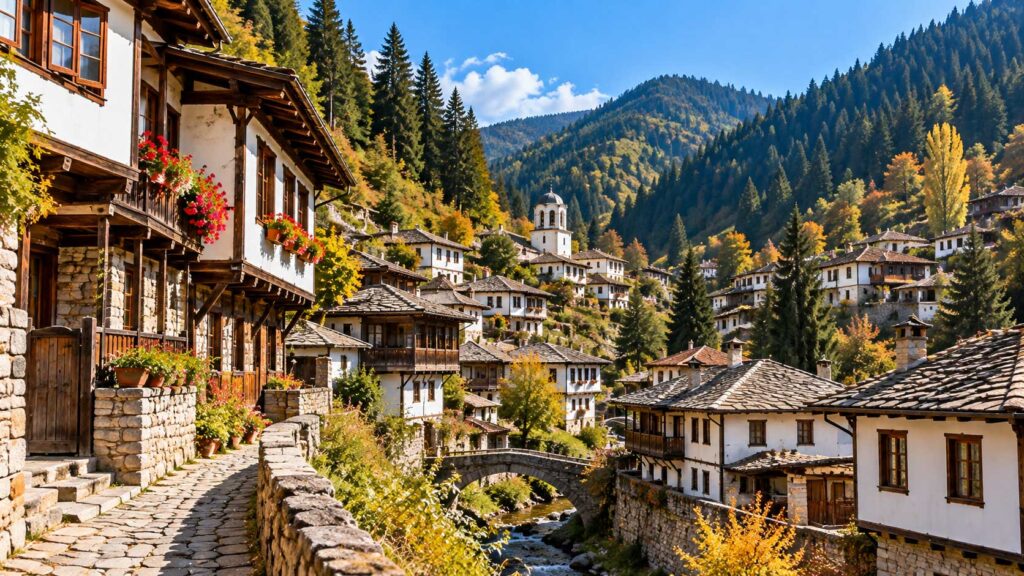
Deep in the Rhodope Mountains, Shiroka Laka is one of the best places in Bulgaria to experience a village where architecture, music, landscape, and tradition are still closely connected.
The village stretches along a narrow mountain valley, with whitewashed houses climbing the slopes above the river. Stone walls, wooden balconies, cobbled lanes, arched bridges, and dark roofs give Shiroka Laka an unmistakably Rhodope character.
The village is protected as an architectural and ethnographic reserve, and 97 houses, bridges, and churches have been declared cultural monuments. Some of the oldest surviving houses date from the beginning of the 19th century.
What Makes Shiroka Laka Special
The traditional houses are immediately recognizable.
Many are large, two-story buildings constructed from stone and wood, with upper floors projecting over the streets and spacious rooms inside. Narrow cobbled lanes wind between them, occasionally crossing the river over small arched bridges.
But Shiroka Laka is more than a collection of beautiful old houses.
The village has a strong cultural identity connected with Rhodope music, folklore, traditional songs, customs, and the distinctive local dialect.
That living culture is a big part of what makes the village memorable.
As you walk through the old streets, you are not simply looking at preserved architecture. You are moving through a place shaped by generations of mountain life and traditions that remain closely associated with Shiroka Laka today.
What to See in Shiroka Laka
The historic center is best explored slowly and without a strict route.
Steep lanes reveal different views at almost every turn—old houses stacked along the mountainside, wooden balconies above the river, small bridges between the streets, and forest-covered slopes rising behind the rooftops.
One of the village’s most important landmarks is the Church of the Assumption of the Virgin Mary.
Permission to build the church was granted in 1834, and according to Smolyan Municipality, local residents completed it in just 38 days. The church was later decorated by Dimitar Zograf, brother of the celebrated Bulgarian painter Zahari Zograf.
Shiroka Laka is also a good base for exploring the surrounding mountains. Walking routes lead toward nearby villages including Gela, Stoykite, Solishta, and Stikul, making it easy to combine village sightseeing with time in the Rhodope countryside.
A Village Shaped by Rhodope Music
Music is inseparable from Shiroka Laka’s identity.
The village is closely associated with the kaba gaida, the deep-toned bagpipe that has become one of the best-known sounds of the Rhodope Mountains.
Traditional songs, bagpipe music, folklore, and local celebrations have helped keep that musical heritage visible from one generation to the next.
You do not have to arrive during a festival to appreciate it.
Music is part of the story of the village itself, just as much as the old houses, stone bridges, and surrounding mountains.
Why Shiroka Laka Feels Frozen in Time
What makes Shiroka Laka feel timeless is the way everything fits together.
Old houses rise directly from narrow streets. Stone bridges cross the river between them. Forest-covered mountains seem to close around the village, while historic buildings remain part of everyday life rather than being separated into a museum complex.
Early morning can be especially atmospheric, when the streets are quiet and mist hangs over the surrounding slopes.
Winter brings an entirely different mood, with snow settling across the rooftops and mountain ridges.
For travelers exploring traditional Bulgarian villages where time stands still, Shiroka Laka offers something particularly special—not simply preserved architecture, but a living piece of Rhodope culture.
4. Kovachevitsa – A Stone Village Hidden in the Western Rhodopes
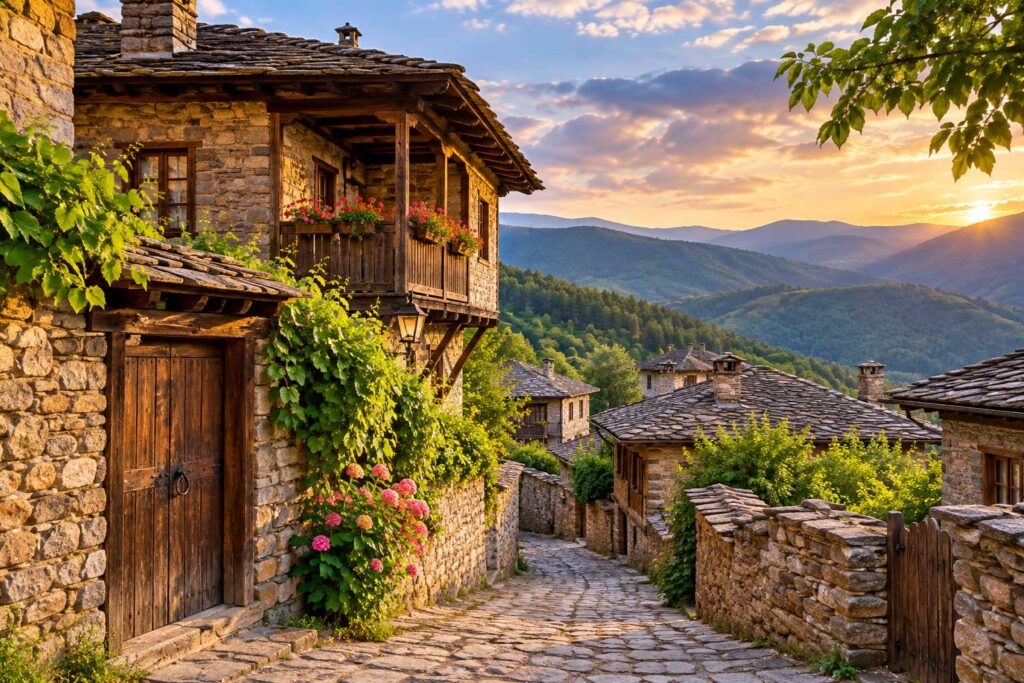
Kovachevitsa feels as though it was built directly from the mountain around it.
Set high in the western Rhodope Mountains, about 23 kilometers from Gotse Delchev, the village is known for its tall stone houses, narrow cobbled lanes, wooden balconies, and heavy stone roofs. Together, they give Kovachevitsa one of the most distinctive appearances of any traditional village in Bulgaria.
What Makes Kovachevitsa Special
The traditional houses are the heart of the village.
Many rise two or three stories above the narrow streets, with solid stone lower levels and upper floors extending slightly outward. Historically, the ground floors were often used for animals and food storage, while families lived on the levels above.
Kovachevitsa was declared a historical and architectural reserve in 1977, helping protect the architectural character that makes the village so recognizable today.
Unlike the lighter whitewashed villages found elsewhere in Bulgaria, Kovachevitsa feels heavier, older, and more rugged.
Stone is everywhere.
It forms the walls, foundations, lanes, and many of the roofs, making the village seem almost like an extension of the surrounding mountain landscape.
What to See in Kovachevitsa
The best way to begin is simply to walk through the old center.
Narrow cobblestone lanes twist between high stone walls and traditional houses, occasionally opening to views across the hills and forests of the western Rhodopes.
One of the main landmarks is the Church of St. Nicholas, built in 1847. A four-story bell tower was added in 1900 and remains one of the most recognizable features of the village skyline.
But Kovachevitsa is not really a place for rushing from one attraction to another.
Much of its appeal is in the details you notice while walking: weathered wooden gates, old chimneys, small gardens hidden behind stone walls, balconies leaning over the lanes, and roofs stacked above one another on the hillside.
Several traditional houses have also been restored as guesthouses, allowing visitors to stay within the historic village itself.
Slow Down and Stay a Night
Kovachevitsa is especially well suited to travelers who enjoy slow travel and rural tourism.
A visit here is less about filling a day with activities and more about spending time in the village—walking the old streets, eating traditional Bulgarian food, enjoying the surrounding mountains, and letting the pace slow naturally.
Staying overnight makes that feeling even stronger.
Early in the morning or toward evening, when most day visitors have gone, the lanes become noticeably quieter.
You may hear little more than birds, footsteps on stone, a dog barking somewhere behind a courtyard wall, or the faint sounds of everyday village life.
That is when Kovachevitsa feels most removed from the modern world.
Why Kovachevitsa Feels Frozen in Time
Kovachevitsa’s strongest impression comes from how complete the old village still feels.
The stone houses stand close together, the lanes remain narrow and irregular, and the surrounding mountains frame the settlement from almost every direction.
Modern comforts exist behind many of those old walls, of course, but visually the village still feels remarkably cohesive.
Among these traditional Bulgarian villages where time stands still, Kovachevitsa stands out for its rugged stone architecture and unmistakable Rhodope setting.
5. Leshten – A Tiny Rhodope Village Made for Slow Travel
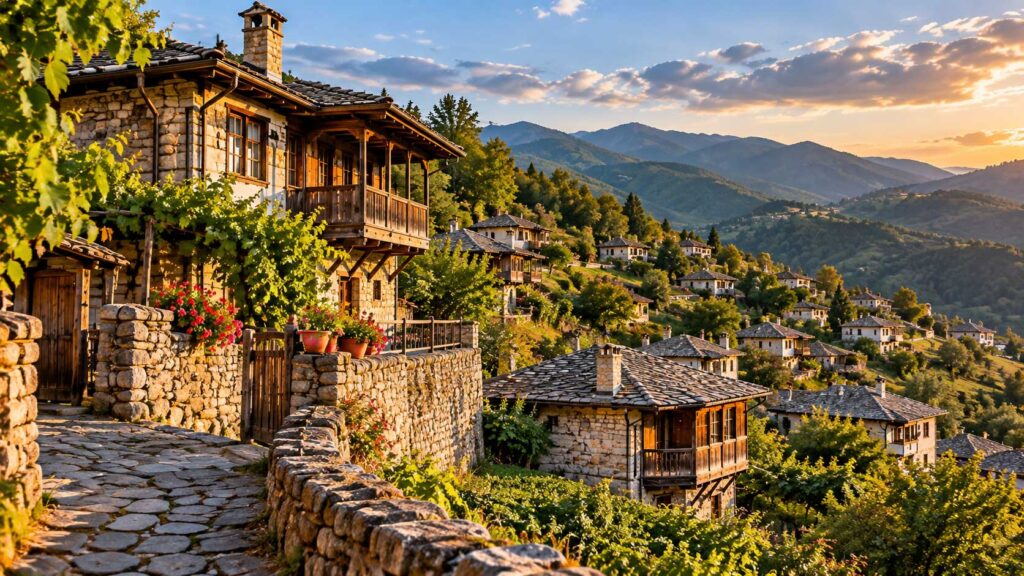
Not far from Kovachevitsa, Leshten offers another glimpse of old rural Bulgaria, but with a softer and more intimate atmosphere.
The village sits in the western Rhodope Mountains, around 8 kilometers from Garmen and roughly 15 kilometers from Gotse Delchev. From parts of Leshten, you can also catch beautiful views toward the Pirin Mountains.
What Makes Leshten Special
Leshten is known for its old Revival-era houses, narrow cobbled lanes, stone walls, wooden balconies, and roofs covered with heavy stone slabs.
Around 15 traditional houses have been restored, and several now operate as guesthouses.
Because the village is small, you do not need a detailed itinerary.
The best way to experience it is simply to wander.
Follow the lanes uphill, look between the houses toward the surrounding mountains, and notice how naturally the old buildings blend into the landscape.
In autumn, when the hills around Leshten turn shades of gold, orange, and red, the village becomes especially atmospheric.
Traditional Houses and Quiet Streets
Leshten’s architecture combines white façades, stone construction, wooden details, and heavy stone roofs typical of this part of the Rhodopes.
Some houses have been carefully restored, while others still retain a rougher, more weathered appearance.
That contrast is part of the charm.
Leshten does not feel like a perfectly polished open-air museum. It feels more like an old mountain village that has adapted to tourism without losing all of its original character.
Stone walls still border the lanes, gardens appear between old houses, and mountain views open unexpectedly as you move through the village.
Stay in an Old Village House
One of the best ways to experience Leshten is to spend the night.
Several restored traditional houses offer accommodation, giving visitors the chance to wake up surrounded by stone roofs, quiet streets, and mountain scenery.
Many guesthouses also serve traditional Bulgarian food, making an overnight stay feel much more connected to the village than a quick daytime stop.
Instead of leaving before sunset, you can stay for dinner, watch the light fade over the mountains, and walk through Leshten after most visitors have gone.
That quieter evening atmosphere is when the village often feels at its best.
Explore the Surrounding Rhodopes
Leshten is also an excellent stop on a longer road trip through the western Rhodopes.
Nearby Kovachevitsa and Dolen offer their own versions of traditional mountain architecture, while Ribnovo provides a different glimpse of local culture. The mineral springs around Ognyanovo are another easy addition to the same route.
The surrounding countryside is also suitable for hiking, fishing, and short excursions through the mountains.
This makes Leshten easy to combine with both cultural sightseeing and a quieter day outdoors.
Why Leshten Feels Frozen in Time
Leshten’s charm comes largely from its size and simplicity.
There are no major monuments demanding your attention and no long list of attractions to work through.
Instead, there are stone lanes, old houses, garden walls, wooden balconies, mountain air, and long stretches of quiet.
It is the kind of place where you can spend an afternoon doing very little and still feel that you experienced it properly.
For travelers exploring traditional Bulgarian villages where time stands still, Leshten shows how memorable even a tiny mountain settlement can be.
6. Dolen – A Quiet Rhodope Village of Stone Roofs and Narrow Lanes
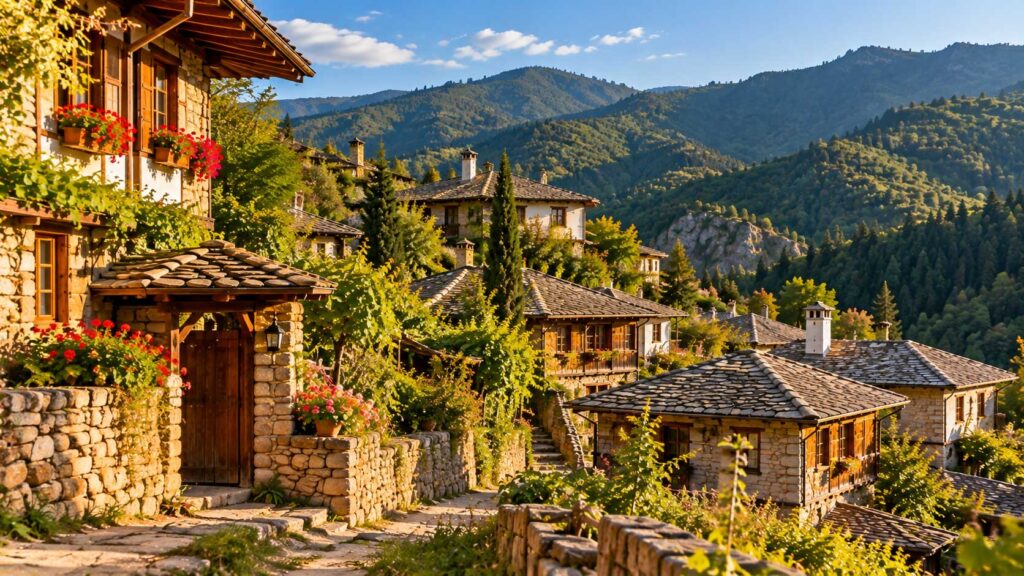
If Kovachevitsa and Leshten are already on your route through the western Rhodopes, Dolen is well worth adding.
The village lies about 26 kilometers from Gotse Delchev and is protected as a historical and architectural reserve because of its preserved Revival-era houses. Around 70 buildings are recognized as cultural monuments, giving Dolen one of the strongest collections of traditional architecture in this part of Bulgaria.
What Makes Dolen Special
Dolen has the kind of atmosphere that makes you want to slow down and simply walk.
Traditional houses stand close together along uneven streets, with stone lower levels, broad upper floors, wooden balconies, and heavy stone-slab roofs. Some interiors also preserve carved wooden ceilings characteristic of Dolen’s Revival architecture.
The surrounding hills add to the sense of seclusion.
Dolen’s historic character is not limited to one restored street. Old houses, stone walls, garden plots, and narrow lanes appear throughout much of the village, while rooftops overlap as the settlement climbs gently across the slopes.
That gives Dolen a more natural, lived-in feeling than places where the historic center feels carefully separated from everyday life.
What to See in Dolen
You do not need a long sightseeing checklist here.
Start in the older part of the village and follow the cobbled lanes wherever they lead.
Some of the most memorable views appear unexpectedly—a wooden balcony extending over a narrow street, an old gate framed by stone, a small garden hidden behind a wall, or layers of stone roofs set against the green Rhodope hills.
Because Dolen is an architectural reserve, the main attraction is really the village as a whole rather than one individual monument.
That makes it especially appealing for travelers interested in traditional architecture, photography, and quieter rural places.
Combine Dolen With Kovachevitsa and Leshten
Dolen fits naturally into a road trip through this part of the western Rhodopes.
The Bulgarian Ministry of Tourism groups it with nearby Leshten and Kovachevitsa, noting that all three preserve traditional architecture and have developed as rural-tourism destinations.
Seeing all three also makes their differences easier to appreciate.
Kovachevitsa feels dramatic and strongly defined by stone.
Leshten is smaller, softer, and more intimate.
Dolen feels quieter and a little less polished, with an atmosphere that can seem closer to everyday village life.
That contrast is exactly why it deserves its own stop rather than being treated as simply another village nearby.
Why Dolen Feels Frozen in Time
Dolen’s greatest strength is that it does not feel overdesigned for visitors.
The traditional houses are beautiful, but they still sit among ordinary gardens, fruit trees, stone walls, village roads, and working rural spaces.
That slight roughness around the edges is part of what makes the village appealing.
Visit early in the morning or toward late afternoon, when the lanes are quiet and soft light catches the uneven stone roofs, and Dolen can feel remarkably removed from the modern world.
For anyone exploring traditional Bulgarian villages where time stands still, Dolen is one of the quieter and more atmospheric stops in the western Rhodopes.
7. Brashlyan – A Traditional Strandzha Village Hidden Among Ancient Forests
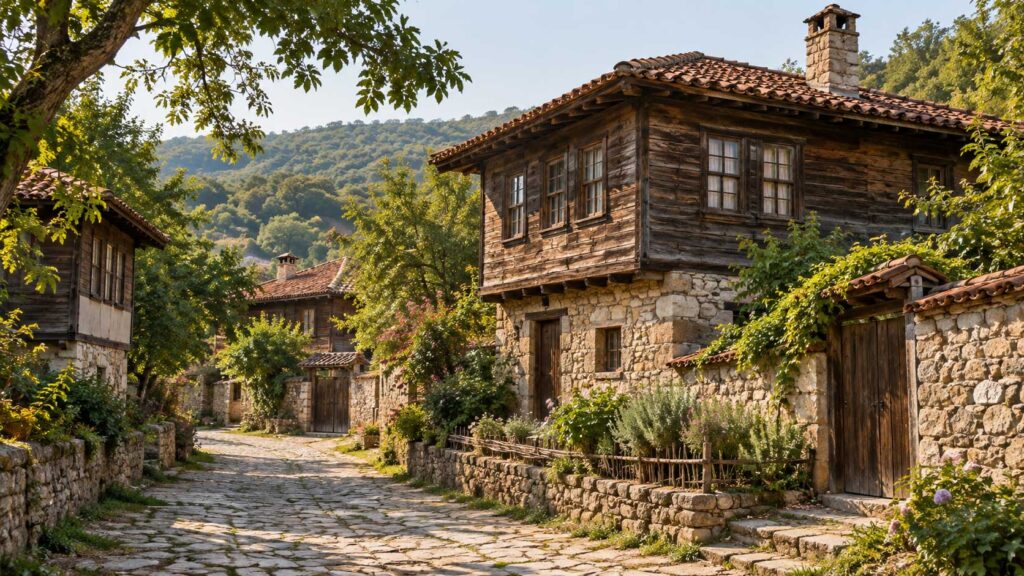
After several villages in the Rhodopes, Brashlyan reveals a very different side of rural Bulgaria.
Hidden among the oak and beech forests of Strandzha Nature Park, about 14 kilometers northwest of Malko Tarnovo, Brashlyan preserves dark wooden houses, tiled roofs, stone foundations, and quiet village lanes.
Brashlyan is protected as an architectural reserve, and many of its old homes are recognized as cultural monuments. Some have stood here for around two centuries.
What Makes Brashlyan Special
Brashlyan does not have the dramatic stone architecture of Kovachevitsa or the white Revival houses of Bozhentsi.
Its beauty is quieter and more rustic.
Traditional Strandzha houses are generally built with stone ground floors and wooden upper stories, often reached by an exterior staircase. Dark timber walls and weathered red-tile roofs blend naturally with the forests surrounding the village.
Walk through Brashlyan and you will see wooden fences, grapevines stretching across courtyards, barns, vegetable gardens, uneven lanes, and houses that still feel part of everyday village life.
That is a big part of its appeal.
Brashlyan has not been polished into a picture-perfect tourist attraction. Its older buildings sit alongside working gardens and ordinary rural spaces, giving the village a character that feels genuinely lived in.
Visit the Church of St. Dimitar
One of Brashlyan’s most important landmarks is the Church of St. Dimitar, which dates from the end of the 17th century and forms part of the village’s protected architectural and cultural heritage.
Its modest appearance fits naturally into the traditional architecture of the village and reflects the religious building traditions of Strandzha.
Beside it stands a restored monastery school, where local boys once learned to read and write.
The small classroom offers a glimpse into education in a 19th-century Strandzha village, when lessons were far simpler than they are today and pupils practiced writing on reusable surfaces.
Together, the church and school form one of the most atmospheric corners of Brashlyan.
Step Inside a Traditional Strandzha House
Another worthwhile stop is the village’s ethnographic house museum, set inside a traditional building around 150 years old.
The house retains its historic layout, with a stone lower level and wooden living quarters above.
Inside, displays introduce visitors to domestic life and traditional crafts practiced in Brashlyan during the late 19th and early 20th centuries. An old loom is among the objects that help illustrate how weaving once formed part of everyday village life.
The museum is small, but it adds useful context to the houses you see outside.
After stepping inside one, it becomes easier to imagine how these buildings actually worked as homes—where families lived, where food and supplies were stored, and how daily life was organized beneath the same roof.
Explore the Forests Around Brashlyan
Much of Brashlyan’s atmosphere comes from its setting.
The village is surrounded by the dense forests of Strandzha, creating a secluded feeling very different from the open valleys and high mountain scenery of the Rhodopes.
Walking routes lead from the village toward chapels, old trees, archaeological sites, and natural areas hidden in the surrounding countryside.
You do not need to take on a long hike to appreciate the landscape.
Even a short walk beyond the last houses quickly brings you onto quiet paths surrounded by forest, meadows, and the softly rolling hills characteristic of Strandzha.
Why Brashlyan Feels Frozen in Time
Brashlyan earns its place on this list because very little here encourages you to hurry.
Old wooden houses stand behind simple fences. Gardens reach toward the lanes. Vines climb across courtyards, and dense forest appears almost immediately beyond the rooftops.
There is no large tourist complex dominating the village.
Instead, Brashlyan feels like a small Strandzha settlement that has preserved an unusual amount of its traditional character while continuing to function as a real village.
That makes it especially rewarding for travelers who have already seen Bulgaria’s better-known Revival destinations and want something quieter.
Among the traditional Bulgarian villages where time stands still, Brashlyan reveals a different side of the country—one shaped by wooden houses, forest paths, and Strandzha traditions.
8. Arbanasi – Fortified Houses, Hidden Courtyards, and Painted Churches
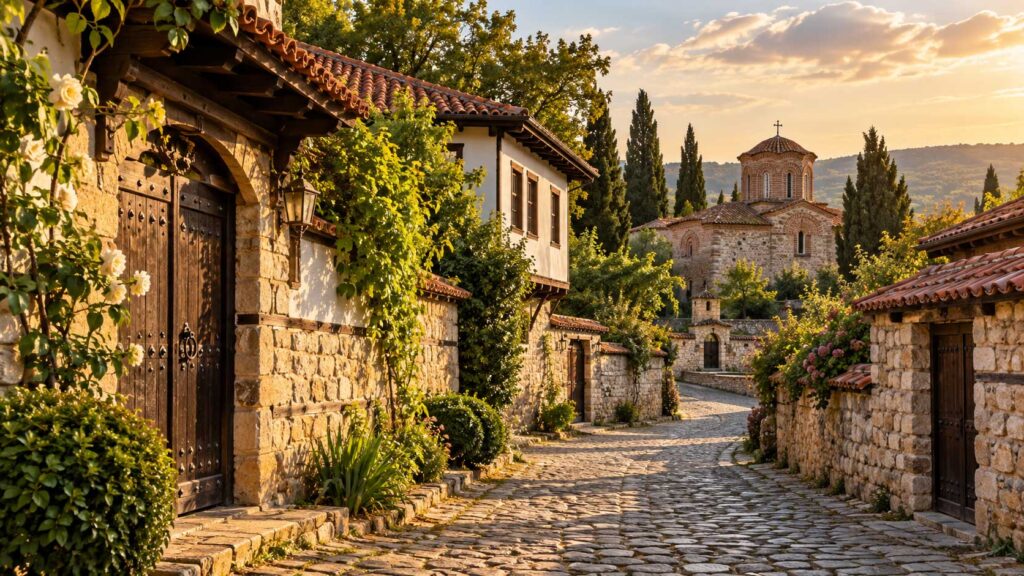
Just outside Veliko Tarnovo, Arbanasi feels very different from the mountain villages earlier on this list.
Set on the Arbanasi Plateau above the old Bulgarian capital, the village is known for massive stone houses, high defensive walls, heavy wooden gates, and richly decorated churches.
What Makes Arbanasi Special
Arbanasi’s traditional houses often look more like small fortresses than village homes.
From the street, many appear almost closed off, with thick stone walls, small openings, high fences, and enormous wooden gates.
Step inside, however, and the character changes completely.
Historic interiors were often far more comfortable and decorative, with carved wooden ceilings, ornamental plasterwork, painted details, and sheltered courtyards hidden from the street.
That combination gives Arbanasi much of its character.
The houses were designed not only to look impressive, but also to provide privacy, security, and comfortable living space for prosperous merchant families.
Explore the Historic Houses
One of the best ways to understand Arbanasi is to step inside one of its preserved traditional homes.
These houses reveal how wealthy local families once lived, with substantial stone ground floors, wooden upper levels, inner courtyards, storage areas, decorated rooms, and carefully crafted furnishings.
Even when you are simply walking through the village, the architecture creates a sense of curiosity.
High stone walls hide gardens and courtyards from view, while old wooden gates hint at spaces you cannot see from the street.
That sense of mystery is part of what makes Arbanasi so enjoyable to explore.
Discover Arbanasi’s Painted Churches
Arbanasi is also remarkable for its historic churches.
Seven 17th-century churches have been preserved in the village. Their exteriors are generally restrained and blend naturally into the surrounding architecture, while the interiors are known for extensive mural decoration and carved woodwork.
Important religious landmarks include the Church of the Archangels Michael and Gabriel, the St. Nicholas Monastery, and the Monastery of the Assumption of the Mother of God.
The contrast is striking.
From the outside, some of these buildings can appear almost modest. Inside, the walls open into richly painted religious spaces filled with color, detail, and centuries of history.
For many visitors, the churches are one of the most memorable parts of Arbanasi.
Walk Beyond the Main Streets
Arbanasi is more developed for tourism than some of the quieter villages on this list, so it is worth wandering beyond the busiest areas.
Take the smaller side streets and look for sections where stone walls, fruit trees, vines, traditional gates, and old houses still dominate the view.
These quieter corners reveal a different side of the village.
You may be only a few kilometers from Veliko Tarnovo, but the stone lanes and enclosed courtyards can make Arbanasi feel surprisingly separate from the city below.
There are also viewpoints toward Veliko Tarnovo and the surrounding hills, especially beautiful in the softer light of early morning or late afternoon.
Combine Arbanasi With Veliko Tarnovo
Arbanasi lies only about 4 kilometers from Veliko Tarnovo, making the two destinations easy to combine in one trip.
A good day could begin with the fortress, old streets, and historic neighborhoods of Veliko Tarnovo before continuing up to Arbanasi for an afternoon among traditional houses, churches, and quieter lanes.
If your schedule allows, staying overnight gives the village a different atmosphere.
Once many day visitors leave, the streets settle down and the historic surroundings become much easier to appreciate without the daytime activity.
Why Arbanasi Feels Frozen in Time
Arbanasi is not a village untouched by modern tourism.
It has restaurants, guesthouses, and contemporary comforts.
What makes it feel timeless is the historic structure that still defines the village.
High stone walls continue to line the streets. Massive gates conceal old courtyards. Centuries-old churches sit behind understated façades, and fortified merchant houses remain among the village’s most recognizable features.
For travelers exploring traditional Bulgarian villages where time stands still, Arbanasi adds a very different chapter shaped by merchant houses, hidden courtyards, and religious art.
9. Gela – Mountain Meadows, Kaba Gaida Music, and Old Rhodope Traditions
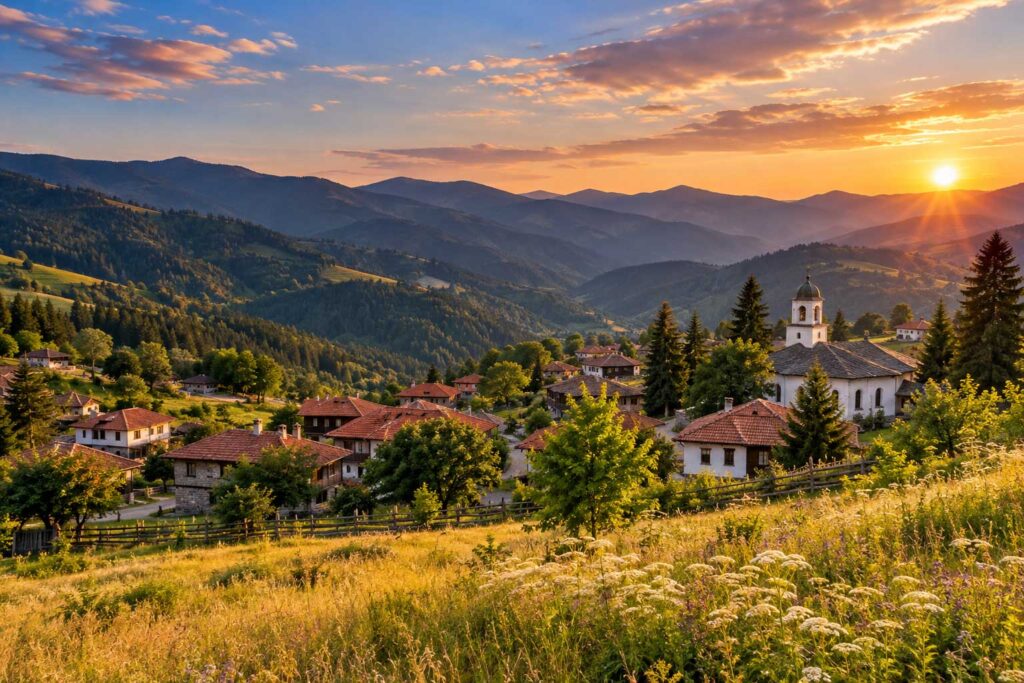
High in the Rhodope Mountains, Gela feels less like a compact historic village and more like a collection of homes scattered across broad mountain meadows.
The village sits at roughly 1,400–1,500 meters above sea level, about 5 kilometers from Shiroka Laka and around 15 kilometers from Pamporovo. Its setting beneath high Rhodope peaks, surrounded by grasslands and forests, is a major part of what makes it special.
What Makes Gela Special
Gela feels wonderfully open.
Instead of tightly packed streets, houses are spread across rolling slopes and connected by small roads and paths winding through the meadows.
Traditional Rhodope homes, stone walls, farm buildings, hayfields, and grazing animals still form part of the landscape, while forests and mountain ridges rise in the distance. Traditional Rhodope homes, stone walls, farm buildings, hayfields, and grazing animals still form part of the landscape, while forests and mountain ridges rise in the distance.
If you are looking for rural Bulgaria rather than a carefully preserved architectural reserve, Gela is an excellent choice.
Here, the landscape matters just as much as the buildings.
A Village Closely Connected With Rhodope Music
Gela is especially famous for its connection with the kaba gaida, the deep-toned bagpipe that has become one of the defining sounds of the Rhodope Mountains.
Each summer, musicians and visitors gather on the Ilinden Meadows near the village for a major bagpipe event celebrating Rhodope music and folklore.
The organized competition dates from 2002, but the gathering developed from an older local tradition in which families met on the meadows to socialize, sing, dance, and celebrate together.
The setting makes the experience especially memorable.
Hearing kaba gaidas carry across an open mountain meadow connects the music with the landscape in a way that is difficult to reproduce anywhere else.
Walk Through the Meadows
One of the best ways to experience Gela is on foot.
Small roads and paths lead between houses, hayfields, forests, and wide grassy slopes.
Because the village sits so high in the Rhodopes, views open in almost every direction. On clear days, mountain ridges dominate the horizon. On misty mornings, the scattered houses and meadows can feel almost dreamlike.
Smolyan Municipality describes Gela as a place of high mountain peaks and broad open meadows, and that combination defines much of the experience here.
Explore the Mountains Around Gela
Gela is also a natural starting point for exploring the surrounding Rhodopes.
The area lies near several major peaks and high ridges, including Golyam Perelik, the highest summit in the Rhodope Mountains, as well as Orpheus Peak and other nearby mountain areas.
You do not need to take on a demanding hike to enjoy the scenery.
Even short walks beyond the village quickly lead into pine forests, grass-covered slopes, wildflower meadows, and wide views across the mountains.
Late spring and summer are especially beautiful when the meadows are green, while early autumn brings cooler air and changing colors to the surrounding forests.
Try Traditional Rhodope Food
Gela is also a good place to experience the hearty food associated with the Rhodope Mountains.
Regional specialties include patatnik, local dairy products, slow-roasted meats such as cheverme, and simple mountain dishes shaped by the colder climate and rural traditions of the region.
After a walk through the meadows or surrounding hills, sitting down for a long meal feels completely natural here.
Food, landscape, and the slower rhythm of the village all fit together.
Why Gela Feels Frozen in Time
Gela does not need rows of perfectly restored historic houses to create a sense of timelessness.
What feels enduring here is the relationship between village life and the mountain landscape.
Homes remain scattered among meadows. Animals graze on the slopes. Paths disappear into the forest, and traditional Rhodope music continues to play an important role in the identity of the area.
On a quiet morning, when mist drifts across the hills and there is little traffic on the roads, Gela can feel remarkably distant from the modern resorts only a short drive away.
Among the traditional Bulgarian villages where time stands still, Gela represents a different kind of preservation—one rooted in mountain life, music, folklore, and the Rhodope landscape.
10. Medven – Wooden Revival Houses Beneath the Balkan Mountains
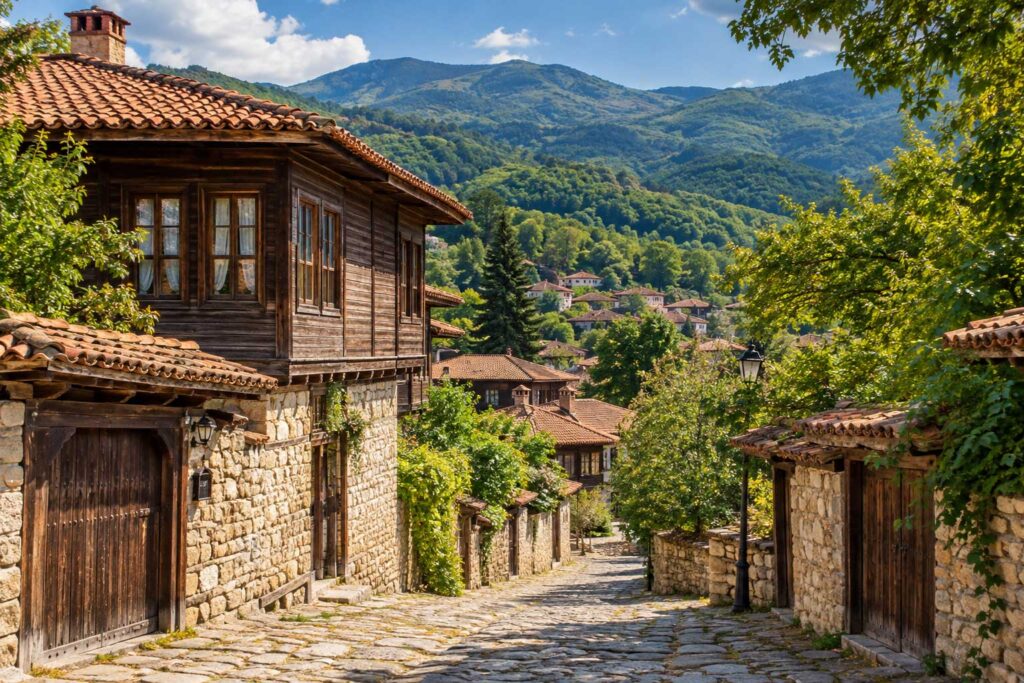
Not far from Zheravna, Medven is a quieter choice for travelers who want traditional Bulgarian architecture without quite as many visitors.
Set beneath the eastern slopes of the Balkan Mountains, the village preserves old houses dating mainly from the 18th and 19th centuries. Medven is also closely connected with Bulgarian writer and revolutionary Zahari Stoyanov, who was born here.
What Makes Medven Special
Medven has many of the details that make old Bulgarian mountain villages so appealing.
Traditional houses combine stone lower floors with dark wooden upper stories, broad roofs, small windows, enclosed courtyards, and red clay tiles.
Many stand behind stone walls and wooden gates, partly hidden by grapevines, walnut trees, fruit trees, and gardens.
Compared with some of Bulgaria’s better-known architectural reserves, Medven feels less polished and more relaxed.
Everyday village life still unfolds around the historic houses. You may see firewood stacked beneath a roof, vegetables growing behind a stone fence, laundry drying in a courtyard, or an old wooden balcony partly hidden beneath vines.
That lived-in quality is one of the village’s greatest strengths.
Visit the Zahari Stoyanov House Museum
Medven is best known historically as the birthplace of Zahari Stoyanov, the Bulgarian revolutionary, writer, and chronicler closely associated with the events surrounding the April Uprising of 1876.
His birthplace has been preserved as a museum and is one of the village’s main cultural landmarks.
The house also gives visitors a closer look at domestic life in a 19th-century Balkan Mountain village.
Instead of seeing traditional architecture only from the street, you can get a better sense of the modest rooms, wooden construction, household objects, and everyday surroundings that shaped life here generations ago.
Wander Through the Old Streets
Medven rewards unhurried wandering.
There is no need to follow a complicated route.
Take the smaller lanes and look for weathered timber façades, stone foundations, carved gates, tiled roofs, and balconies covered with vines.
Part of what makes the village so photogenic is that the traditional houses still sit naturally among gardens, trees, and ordinary rural spaces rather than feeling separated into a museum zone.
That gives Medven a warmth and informality that fits perfectly with slow travel in Bulgaria.
Walk to the Blue Pool
Medven also offers an easy way to combine traditional architecture with nature.
About 2 kilometers from the village, an eco-trail leads toward the Blue Pool, or Sini Vir, a small natural pool and waterfall hidden in the surrounding greenery.
The walk is a good reason to spend more than a quick hour in Medven.
You can explore the old streets first, then leave the houses behind and follow the trail into the landscape around the village.
During the warmer months, it makes for an easy combination: historic architecture in the morning and a short nature walk later in the day.
Combine Medven With Zheravna
Because Zheravna and Medven are close to one another, the two villages fit naturally into the same trip.
Bulgaria’s slow-tourism guide presents Medven as a nearby stop when exploring Zheravna and this part of the Balkan Mountains.
But the experience is different.
Zheravna has a stronger architectural-reserve atmosphere and attracts more visitors.
Medven feels smaller, greener, and less polished.
Seeing both gives you a better sense of the traditional architecture of the region while showing how two nearby villages can preserve very different moods.
Why Medven Feels Frozen in Time
Medven’s charm comes from the fact that history is not confined to one museum or one restored street.
It appears in ordinary corners of the village.
An old wooden house sits beneath a grapevine. A stone wall disappears behind trees. Red-tiled roofs rise above gardens, while the Balkan Mountains remain visible beyond the settlement.
Modern comforts and restored guesthouses are part of Medven today, but they have not erased the village’s older character.
For travelers exploring traditional Bulgarian villages where time stands still, Medven can easily become an unexpected favorite—quiet, green, historic, and still closely connected with the architecture and everyday rhythms of old Bulgaria.
11. Balgari – The Strandzha Village Where an Ancient Fire-Dancing Tradition Survives
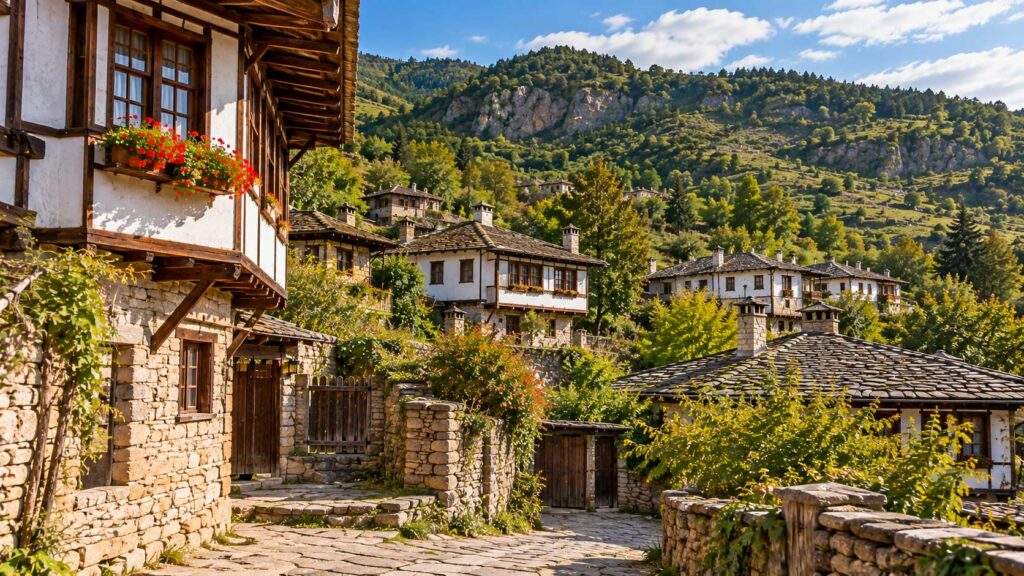
Deep inside Strandzha Nature Park, the village of Balgari preserves something even rarer than traditional architecture.
It is one of the places most closely associated with Nestinarstvo, the ritual tradition in which barefoot fire dancers known as nestinari step across glowing embers while carrying sacred icons.
Balgari lies about 17 kilometers from Tsarevo, surrounded by wooded ridges, deep valleys, and the old forests characteristic of Strandzha. The nature park notes that the village appears in written records as early as 1454, making it one of the region’s long-established settlements.
What Makes Balgari Special
At first glance, Balgari is a quiet rural village.
Traditional homes with red-tiled roofs stand among mature trees and gardens, while the forested hills of Strandzha rise beyond the settlement.
Its real importance, however, goes far beyond architecture.
Balgari remains closely associated with Nestinarstvo, the ritual tradition that UNESCO inscribed on the Representative List of the Intangible Cultural Heritage of Humanity in 2009.
That living tradition makes Balgari different from villages preserved mainly for their historic buildings.
Here, cultural heritage survives through ritual, music, religious belief, processions, food, and community gatherings.
Experience the Nestinarstvo Tradition
The most significant time to visit Balgari is during the annual celebration dedicated to Saints Constantine and Helena.
Held on June 3 and 4, the celebration includes a procession in which sacred icons are carried toward a holy spring, accompanied by drum and bagpipe music before the evening fire-dancing ritual.
The most dramatic moment comes later, when a large fire is prepared and allowed to burn down until glowing embers remain.
The embers are spread across the ground, and the nestinari enter barefoot while carrying sacred icons.
It is important not to view the ritual simply as a spectacle for visitors.
UNESCO describes Nestinarstvo as an expression of local cultural identity that brings together religious beliefs, music, dance, clothing, food, and traditions passed from one generation to another.
That deeper meaning is what makes experiencing the tradition in Balgari so different from simply watching a fire-walking performance elsewhere.
Visit the Church of Saints Constantine and Helena
At the center of the village stands the Church of Saints Constantine and Helena.
The original stone church was built during the second half of the 19th century.
It was destroyed by fire along with much of Balgari during the Ilinden-Preobrazhenie Uprising in 1903 and rebuilt in 1910. Today, the church is protected as a cultural monument.
Its dedication to Saints Constantine and Helena also connects it directly with the village’s Nestinarstvo tradition.
See the Konacheto – The Sacred Home of the Nestinari
Near the village fountain stands one of Balgari’s most unusual cultural sites: the Konacheto.
This small sacred building plays an important role in Nestinarstvo.
The ceremonial drum associated with the ritual is kept here, and sacred icons are prepared before the procession begins. Strandzha Nature Park describes the Konacheto as a central sacred place within the traditions of the village.
Seeing it helps put the fire walking into context.
Nestinarstvo is not simply about crossing burning embers. The ritual is connected with sacred objects, religious belief, music, particular places in and around the village, and traditions preserved within the community.
Explore the Ancient Forests Around the Village
Balgari is also a rewarding destination for travelers interested in the wilder side of Strandzha.
Just east of the village lies Silkosia, Bulgaria’s oldest nature reserve, while the surrounding forests contain some of the distinctive plant life associated with Strandzha, including Pontic rhododendron.
The landscape feels very different from the open mountain scenery of the Rhodopes.
Roads disappear beneath thick woodland, valleys remain heavily forested, and small villages can feel surprisingly isolated even though Bulgaria’s Black Sea coast is not far away.
That sense of seclusion is an important part of Balgari’s atmosphere.
Why Balgari Feels Frozen in Time
Balgari belongs on this list not because every old house has been perfectly restored, but because an extraordinary cultural tradition remains tied to the place where generations have practiced it.
The church, Konacheto, village square, surrounding forests, music, sacred icons, and annual rituals all form part of the same story.
For much of the year, Balgari is remarkably quiet.
Then, during the celebration of Saints Constantine and Helena, the village becomes the setting for one of Bulgaria’s most distinctive surviving cultural traditions.
Among the traditional Bulgarian villages where time stands still, Balgari is an important reminder that preserving the past is about more than protecting old buildings.
Sometimes it means keeping rituals, beliefs, music, sacred places, and community traditions alive.
12. Staro Stefanovo – A Quiet Revival Village Near Lovech
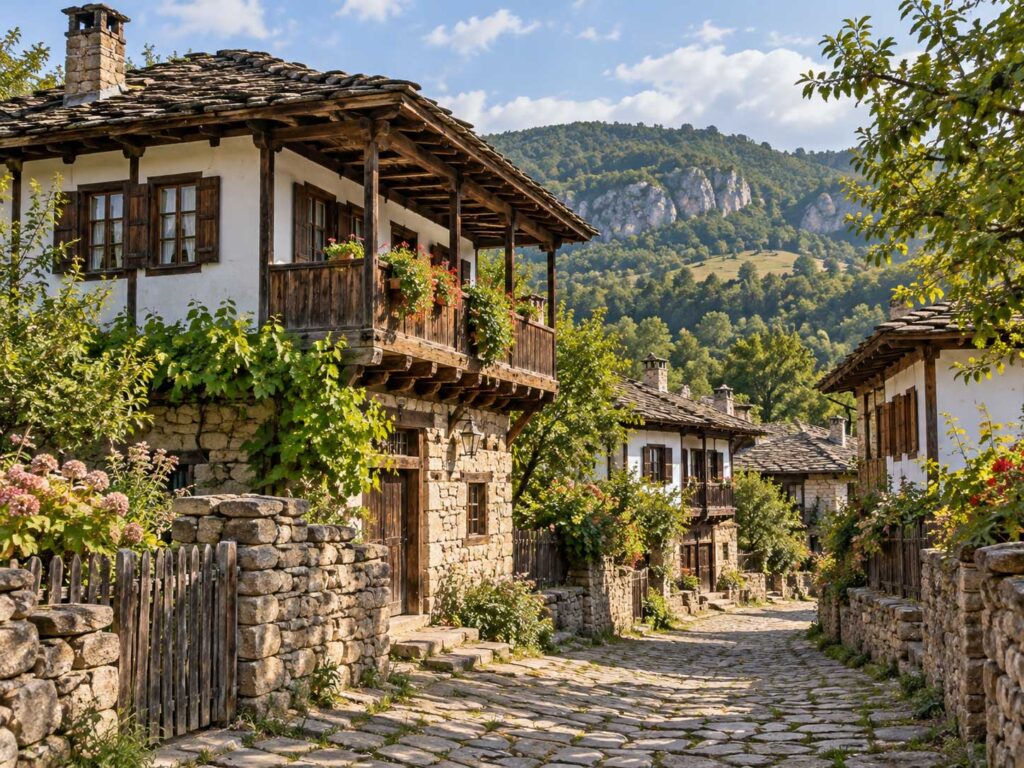
For the final village on this list, Staro Stefanovo feels almost made for the phrase where time stands still.
Hidden among the hills of the Central Fore-Balkan, around 20 kilometers southeast of Lovech, the old part of the village preserves a remarkable collection of traditional houses, stone walls, cobbled lanes, wooden verandas, and heavy stone roofs.
In 1982, Staro Stefanovo was declared an architectural reserve, with 96 sites designated as cultural monuments, including houses built mainly during the early and middle decades of the 19th century.
What Makes Staro Stefanovo Special
Staro Stefanovo receives far less attention than villages such as Zheravna, Bozhentsi, or Arbanasi.
That is part of its appeal.
There are few large tourist attractions and relatively little that feels designed specifically for visitors. Instead, the village retains the slightly weathered, uneven character of a real rural settlement.
Traditional houses are typically two stories high, with stone foundations, timber construction, external staircases leading to wooden verandas, shuttered windows, and roofs covered with heavy stone slabs.
Dry-stone walls follow the contours of the narrow streets, while traditional outdoor ovens still survive beside some of the old houses.
Some homes have been carefully restored.
Others clearly show their age.
Together, they give Staro Stefanovo a character that feels natural rather than reconstructed.
Walk the Cobbled Village Streets
There is no complicated route you need to follow here.
Start near the center and wander.
The streets rise and fall with the surrounding hills instead of following a modern grid, creating unexpected scenes around almost every bend.
You might find a whitewashed house behind an old stone wall, an exterior staircase climbing toward a wooden chardak, flowers spilling from a courtyard, or a traditional outdoor oven standing beside a home.
Lovech’s tourism portal highlights the cobbled streets, dry-stone walls, outdoor staircases, shutters, stone roofs, and traditional ovens as some of the defining features of the architectural reserve.
This is the kind of village where the details matter more than a checklist of major sights.
Look for the Old Village Fountain and Popovoto Bridge
Two modest landmarks help tell the story of everyday life in Staro Stefanovo.
The village fountain dates from 1830, while Popovoto Bridge dates from 1836. Both are associated with local master Marin Hristov and are protected cultural monuments.
Neither is a grand attraction.
And that is exactly why they belong here.
These were practical parts of village life—places connected with water, movement, work, and daily routines long before anyone thought of Staro Stefanovo as a tourist destination.
Their survival adds to the feeling that history here remains woven into ordinary surroundings.
Visit the Village Church
Another important landmark is the Church of the Nativity of the Virgin Mary.
Permission to build a church was granted by Ottoman decree in 1864, and the present building was completed in 1880. Local residents contributed money, materials, and labor to its construction.
The church’s icons and iconostasis are associated with Rusalim Dichov, an icon painter who later settled with his family in the village and also decorated local houses.
The church adds another layer to Staro Stefanovo’s Revival-era story and remains an important part of the old village landscape.
A Village That Became a Natural Film Set
Staro Stefanovo’s preserved appearance has also attracted filmmakers.
Because so much traditional architecture survives in a relatively complete setting, the village has been used for numerous Bulgarian film and television productions.
Lovech Municipality lists titles filmed here over the years including Hunting for Wolves (Hayka za valtsi), Yudino Zhelyazo, Pancho and the Goblins, and several later productions.
It is easy to understand why.
Walk through the older streets and very little visual imagination is needed to picture parts of Staro Stefanovo as a scene from another century.
Combine Staro Stefanovo With Lovech
Staro Stefanovo is close enough to Lovech to fit easily into a longer trip through central northern Bulgaria.
You could spend part of the day exploring Lovech’s historic Varosha Quarter and Covered Bridge, then continue into the countryside for the quieter atmosphere of Staro Stefanovo.
The village also fits naturally into a road trip toward Troyan and Apriltsi, especially if you are interested in traditional architecture, monasteries, mountain scenery, and Bulgaria’s National Revival heritage.
But Staro Stefanovo deserves enough time to wander without rushing.
That is when its character becomes much easier to appreciate.
Why Staro Stefanovo Feels Frozen in Time
Staro Stefanovo is a fitting place to end this list because it does not feel like it is trying very hard to impress anyone.
There are no grand monuments demanding your attention.
Instead, there are stone roofs softened by age, wooden verandas overlooking quiet courtyards, narrow lanes shaped by the hills, old fountains, fruit trees, garden walls, and houses that have watched generations come and go.
Its imperfections make the village more memorable.
Some buildings have been carefully maintained, while others need restoration and continued protection. Preservation remains an active concern, with local authorities, heritage specialists, and community groups discussing the condition of protected houses and the long-term future of the architectural reserve.
That contrast is important.
Staro Stefanovo is not simply an outdoor museum frozen at one moment in history. It is a historic village still trying to carry its architectural heritage into the modern world.
For travelers searching for traditional Bulgarian villages where time stands still, it is a fitting final stop.
Quiet, little-known, and remarkably atmospheric, Staro Stefanovo captures something essential about rural Bulgaria: history that survives not behind museum glass, but along ordinary streets, behind old wooden gates, and beneath roofs that have sheltered generations.
Frequently Asked Questions About Traditional Bulgarian Villages
What are the best traditional villages to visit in Bulgaria?
Some of the best traditional villages in Bulgaria include Zheravna, Bozhentsi, Shiroka Laka, Kovachevitsa, Leshten, Dolen, Brashlyan, Arbanasi, Gela, Medven, Balgari, and Staro Stefanovo.
Each offers something different. Some are known for Bulgarian Revival architecture, while others stand out for mountain scenery, folklore, crafts, religious traditions, or everyday rural life.
Which Bulgarian village has the best-preserved traditional architecture?
There is no single winner because different villages preserve different regional styles.
Zheravna and Bozhentsi are excellent examples of Bulgarian Revival architecture, while Kovachevitsa is known for its tall stone houses, narrow lanes, and heavy stone roofs.
Arbanasi offers something different again, with fortified merchant houses, enclosed courtyards, and richly decorated historic churches.
What is the most beautiful traditional village in Bulgaria?
That depends on what kind of scenery and atmosphere you prefer.
For dramatic stone architecture, Kovachevitsa is hard to beat. Leshten feels smaller and more intimate, while Zheravna and Bozhentsi are excellent choices for classic Revival-era streets and wooden houses.
If mountain views and Rhodope culture are more important to you, Shiroka Laka and Gela are especially memorable.
Can you stay overnight in traditional Bulgarian villages?
Yes. Many villages have family-run guesthouses, restored historic houses, and small rural hotels.
Staying overnight is often one of the best ways to experience them. Once the day visitors leave, the streets become quieter and the atmosphere changes completely.
You also have more time for local food, an early-morning walk, and exploring the surrounding countryside without rushing.
What is the best time to visit traditional villages in Bulgaria?
For most travelers, late spring through early autumn is the easiest time to explore Bulgaria’s villages.
May and June bring green landscapes and wildflowers, while September and October offer cooler temperatures and beautiful autumn colors.
Summer works especially well for higher mountain villages, although popular destinations can be busier on weekends.
Winter creates a completely different atmosphere in places such as Shiroka Laka and Gela, particularly when snow settles across the rooftops and surrounding mountains.
Do I need a car to visit traditional villages in Bulgaria?
A car is usually the most convenient option.
Some villages can be reached by public transportation, but connections may be limited or infrequent, particularly in remote mountain areas.
Driving also makes it much easier to combine nearby villages in one trip, such as Kovachevitsa, Leshten, and Dolen or Zheravna and Medven.
Are traditional Bulgarian villages worth visiting if I have already seen Sofia and Plovdiv?
Yes.
Sofia and Plovdiv reveal important parts of Bulgaria’s urban history, but the villages show a very different side of the country.
Traditional houses, mountain landscapes, regional food, folklore, crafts, and slower rural life can add an entirely different dimension to a Bulgaria itinerary.
How many days should I spend exploring Bulgaria’s traditional villages?
For a first trip, three to five days is a good amount of time for exploring one region without rushing.
Rather than trying to cross the country to see as many villages as possible, choose a smaller area and combine several nearby places.
In the western Rhodopes, for example, you could visit Kovachevitsa, Leshten, and Dolen, then continue toward Shiroka Laka and Gela if your route allows.
In the eastern Balkan Mountains, Zheravna and Medven make an easy pairing and can be combined with other nearby historic and natural attractions.
Why Bulgaria’s Traditional Villages Are Worth the Journey
Bulgaria’s traditional villages offer something that is becoming harder to find: places where history still feels woven into everyday life.
In Zheravna and Bozhentsi, Revival-era houses line cobbled streets. In Kovachevitsa, Leshten, and Dolen, stone roofs and mountain architecture seem to grow directly from the Rhodope landscape. Brashlyan and Balgari reveal the quieter traditions of Strandzha, while Gela keeps the music and rural character of the high Rhodopes closely tied to the surrounding mountains.
Then there are places such as Medven and Staro Stefanovo, where fewer visitors and a more lived-in atmosphere can make the experience feel even more personal.
What makes these villages memorable is not simply their age.
It is the small details.
An old wooden gate opening into a garden. Smoke rising from a chimney. A church bell carrying across the hills. Homemade food served in a family guesthouse. A cat sleeping beneath a wooden balcony while neighbors talk across the street.
These are not the kinds of moments you can add neatly to a sightseeing checklist.
You notice them when you slow down.
If your itinerary allows, resist the temptation to treat every village as a quick roadside stop. Choose one or two, stay overnight, walk the streets early in the morning, try the local food, and leave time to explore the surrounding countryside.
That is when these places become more than beautiful photographs.
They offer a glimpse of a quieter Bulgaria shaped by mountains, craftsmanship, folklore, family traditions, and communities that have adapted to change without completely losing their connection with the past.
None of these villages is literally frozen in time, and that is part of what makes them interesting.
They are living places, not museum sets.
Old houses stand beside restored guesthouses. Traditions continue alongside modern life. Some buildings have been carefully preserved, while others still carry the marks of age.
For travelers willing to leave the main highways behind, these traditional Bulgarian villages where time stands still can become some of the most memorable places in the country—not because nothing has changed, but because so much of their character still remains.
Explore More Traditional Villages in Bulgaria
If these timeless villages inspired you to explore more of rural Bulgaria, continue with these guides to traditional mountain communities, historic architecture, and quieter corners of the country:
- Trigrad – A Dramatic Mountain Village in the Rhodopes – Explore Trigrad Gorge, Devil’s Throat Cave, and one of the most dramatic mountain settings in Bulgaria.
- Shiroka Laka – Traditional Houses, Music and Rhodope Culture – Wander through cobbled streets lined with traditional houses and discover a village deeply connected with Rhodope music and folklore.
- Gela – A Peaceful Rhodope Village of Mountains and Folklore – Discover open mountain meadows, panoramic views, hiking routes, and one of the Rhodopes’ strongest connections with kaba gaida music.
- Smilyan – Rhodope Traditions, Mountain Scenery and the Famous Smilyan Bean – Experience village life, local food, traditions, and beautiful scenery in the Upper Arda Valley.
- Dolen – A Beautiful Bulgarian Village Frozen in Time – Explore stone-roofed houses, narrow lanes, and preserved Bulgarian Revival architecture in one of the western Rhodopes’ quietest villages.