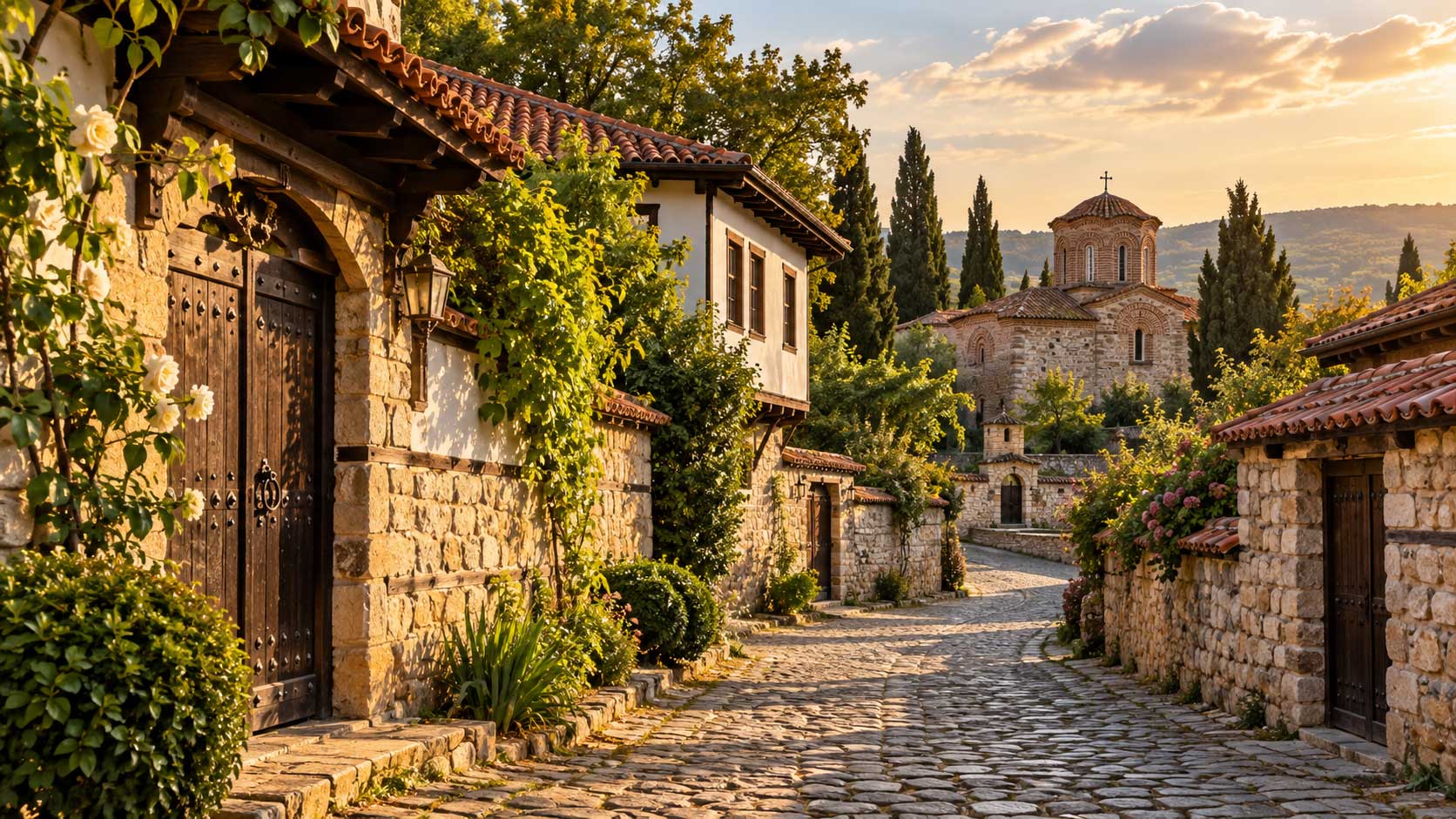
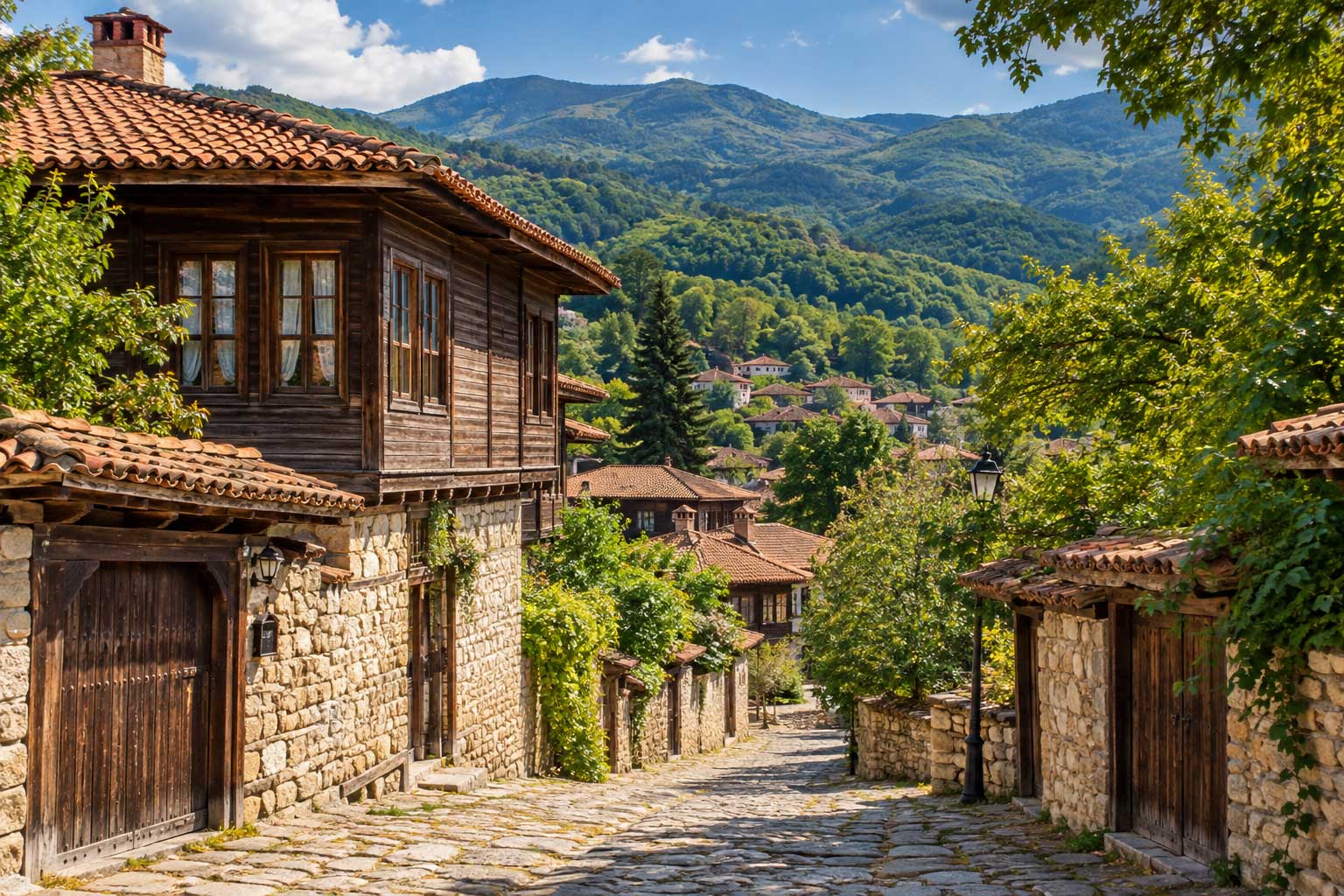
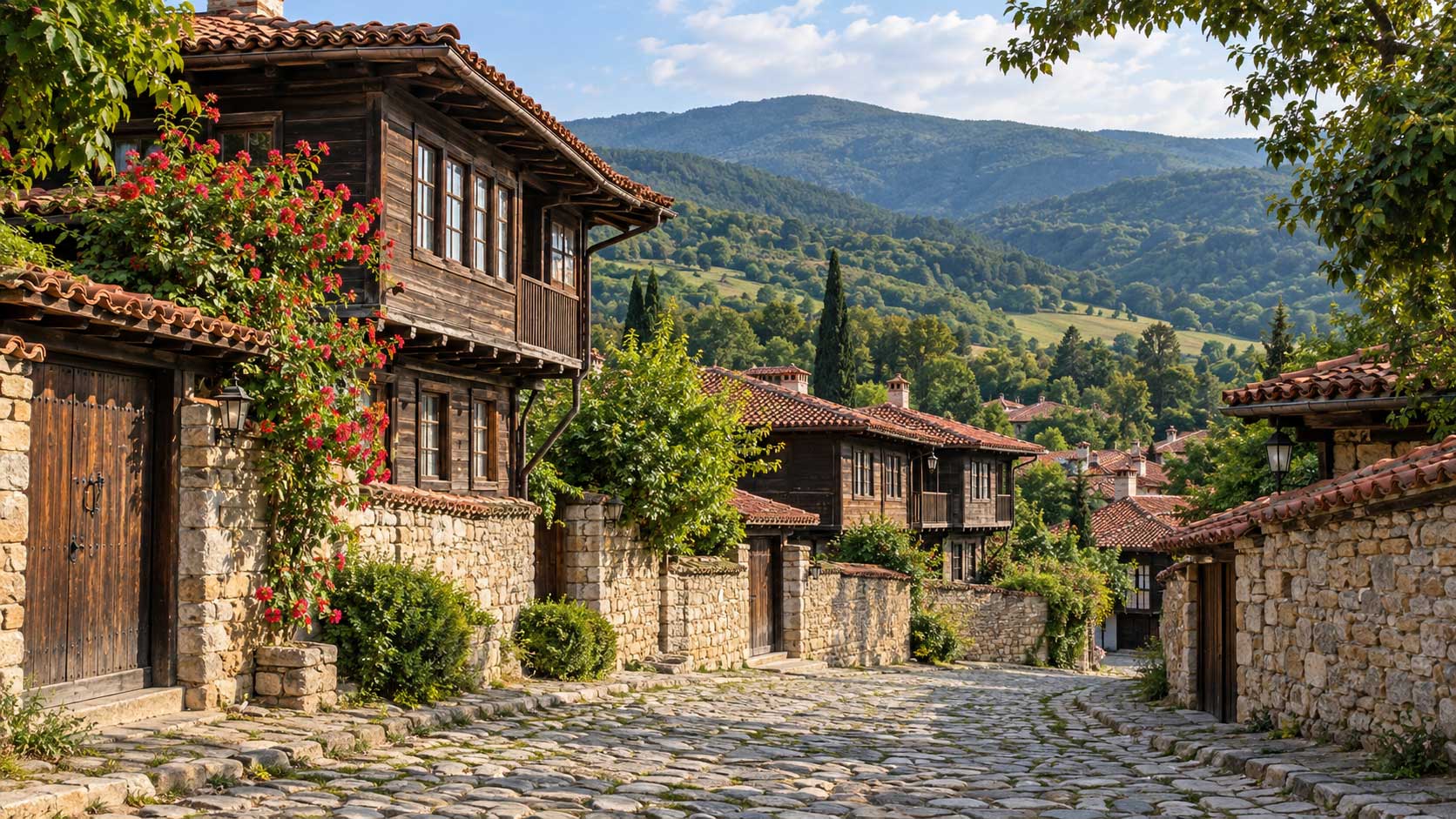
Arbanasi Bulgaria is a historic village just outside Veliko Tarnovo, known for its fortified merchant houses, richly painted churches and quiet stone lanes. At first glance, it feels almost built to guard its secrets.
Behind tall stone walls stand centuries-old houses with heavy wooden gates, hidden courtyards and interiors that once belonged to prosperous merchants. Scattered between them are historic churches whose modest exteriors reveal little of the remarkable frescoes and religious art preserved inside.
Arbanasi grew into a wealthy and important settlement during the Ottoman period, and much of its character still reflects the merchants and craftsmen who once lived here. One of the best places to understand that past is Konstantsalieva House, a late-17th-century home now preserved as a museum.
The village is equally famous for its churches. The Church of the Nativity of Christ is considered the earliest and most richly decorated church in Arbanasi, with surviving wall paintings dating from the end of the 16th century. Other historic churches, including the Church of the Archangels Michael and Gabriel, add to the village’s remarkable concentration of religious architecture.
Part of the appeal of visiting Arbanasi Bulgaria is how easily the village can be combined with Veliko Tarnovo. You can spend the morning exploring medieval fortresses and old streets in Bulgaria’s former capital, then head to Arbanasi for historic houses, stone lanes and a noticeably quieter atmosphere.
For travelers interested in Bulgarian history, traditional architecture and historic churches, Arbanasi is one of the most rewarding places to visit in central Bulgaria.
Arbanasi stands apart from many Bulgarian villages because its appearance was shaped by wealth, trade and the need for protection.
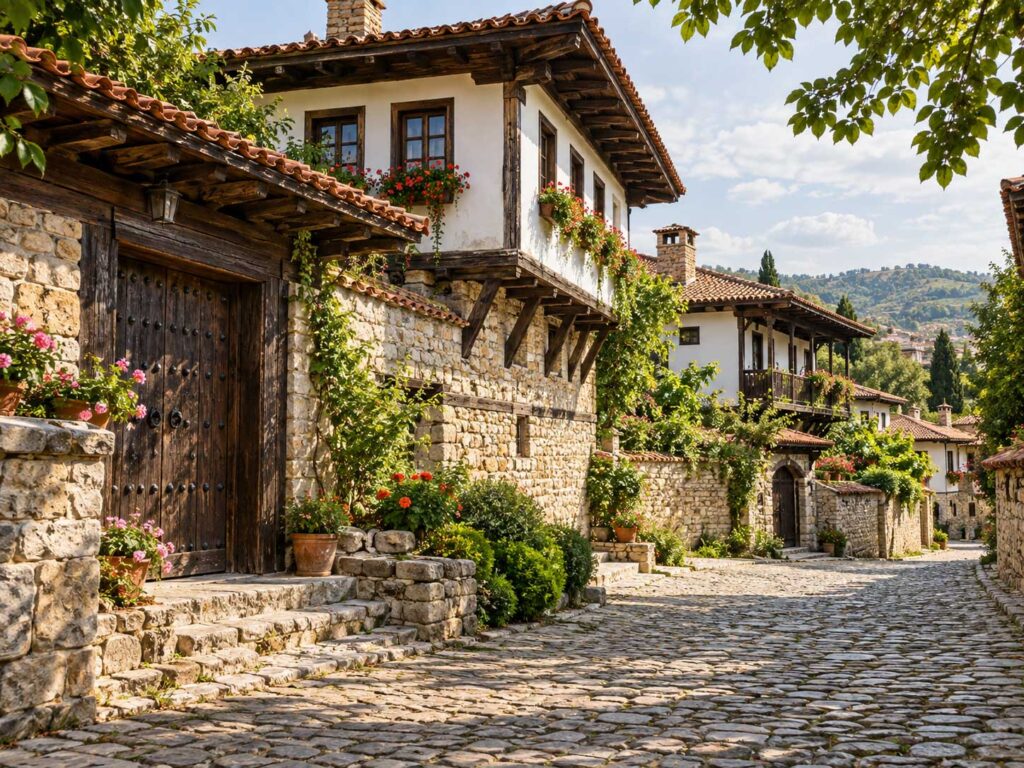
Rather than rows of simple rural homes, many of its historic houses resemble small fortresses. Thick stone walls surround the properties, while heavy wooden gates open into private courtyards hidden from the street. Inside, the homes were designed for both comfort and practicality, with spacious rooms, storage areas and decorative details that reflected the status of their owners.
This distinctive style developed when Arbanasi was home to successful merchants and craftsmen with trading connections far beyond the region. Their prosperity helped finance not only impressive houses, but also churches, monasteries and richly decorated religious interiors.
One of the most striking things about the village is the contrast between outside and inside. From the street, many buildings look plain, solid and defensive. Step through a gate or doorway, however, and you may find carved wooden ceilings, painted details, traditional furnishings and quiet courtyards filled with greenery.
Arbanasi also has an unusually rich collection of churches for a village of its size. Their simple stone exteriors give little hint of the artwork hidden within, where frescoes cover walls, arches and ceilings.
Together, the fortified houses, religious heritage and quiet lanes give Arbanasi a character that feels very different from nearby Veliko Tarnovo.
A Brief History of Arbanasi
Arbanasi has a long and fascinating history, with its greatest period of growth and prosperity taking place during the Ottoman era.
The earliest reliable written records of the settlement date from the late 15th and early 16th centuries. By the middle of the 1500s, Arbanasi was connected with powerful Ottoman officials, including Grand Vizier Rüstem Pasha. The village also benefited from certain privileges related to guarding a nearby mountain pass, creating favorable conditions for trade and development.
A Prosperous Trading Village
During the 17th and 18th centuries, Arbanasi grew into a wealthy trading settlement known for its merchants, fortified houses and Orthodox churches.
Local merchants dealt in livestock and other goods, while craftsmen worked as tailors, dyers, shoemakers and metalworkers. Some merchant families built commercial connections with major cities across the Ottoman Empire, making the village unusually prosperous for its size.
That prosperity left a lasting mark on Arbanasi. Wealthier families built large fortified homes surrounded by high stone walls, while money was also invested in churches, schools and religious art.
A Center of Orthodox Christian Life
Religion played an important role in the community.
Between the 16th and 18th centuries, seven churches were built, expanded or decorated in Arbanasi. Their surviving frescoes and religious artwork show just how much local families invested in their Orthodox faith and cultural traditions.
Many of these churches were intentionally modest from the outside, while their interiors were covered with elaborate paintings and decoration.
The Decline of Arbanasi
The village’s most prosperous period came to a violent end in 1798, when Arbanasi was attacked and heavily damaged by kardzhali raiders.
The settlement eventually recovered, but it never regained the same level of wealth and commercial importance it had enjoyed during the previous centuries.
Today, that prosperous past is still visible throughout Arbanasi—in its fortified stone houses, hidden courtyards, historic churches and remarkably preserved religious art.
Historic Houses of Arbanasi
The historic houses are one of the main reasons Arbanasi feels so distinctive.
Many were built during the village’s prosperous years in the 17th and 18th centuries, when successful merchants wanted homes that offered both comfort and security. From the street, some of these buildings look almost fortress-like, with thick stone walls, small lower-floor windows and heavy wooden gates.
Step inside, however, and the atmosphere changes completely.
Behind the defensive exteriors are spacious courtyards, wooden balconies, large upper-floor rooms and carefully decorated interiors. Some houses also included separate spaces for welcoming guests, storing goods and handling everyday household work.
Konstantsalieva House
One of the best-known examples is Konstantsalieva House, built in the late 17th century and enlarged over time.
Today, the house gives visitors a good sense of how a prosperous Arbanasi family once lived. Inside, traditionally furnished rooms show how the house combined practical defensive features with a surprisingly comfortable and elegant interior.
The contrast is part of what makes the building so memorable. From outside, it appears solid and protective. Inside, warm wood, decorative details and carefully arranged living spaces reveal a much softer side of life in the village.
More Than Individual Monuments
Konstantsalieva House may be the most famous example, but it is only part of the experience.
Other preserved homes throughout Arbanasi add to the village’s atmosphere, even when they are not open to visitors. Stone walls, tiled roofs, wooden gates and glimpses into hidden courtyards make simply walking through the old streets enjoyable.
Rather than feeling like isolated historic buildings surrounded by modern development, many of these houses still form part of a larger historic setting. That continuity is one of the reasons Arbanasi feels so atmospheric today.
The Church of the Nativity – Arbanasi’s Most Remarkable Church
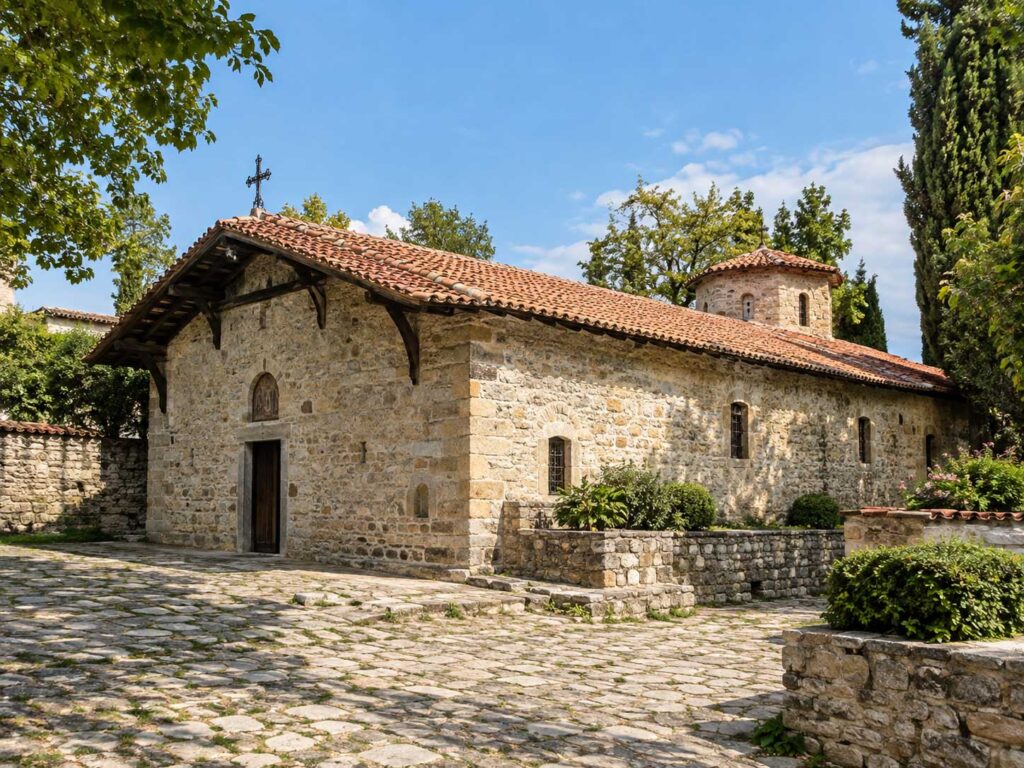
From the outside, the building is surprisingly modest. Its low profile and simple stone exterior give little indication of what is hidden within. Step inside, however, and the contrast is immediate—walls, arches and ceilings are covered with detailed religious paintings.
Centuries of Religious Art
The church developed in several stages, and its oldest surviving wall paintings date from the end of the 16th century.
The complex includes the main church, a narthex, a gallery and a chapel dedicated to St. John the Baptist. The Regional History Museum in Veliko Tarnovo describes it as the earliest and most richly decorated church in Arbanasi. You can find additional visitor information through the Regional History Museum Veliko Tarnovo.
The frescoes are what make the interior so memorable. Instead of a few isolated paintings, religious scenes cover almost every available surface, creating an immersive space filled with biblical figures, saints and symbolic imagery.
The Wheel of Life
One of the church’s most fascinating paintings is the Wheel of Life, found in the gallery.
The church also contains an unusual genealogical representation of Jesus Christ that includes twelve ancient philosophers. Details like these make the interior worth exploring slowly rather than simply walking through from one room to another.
What makes the church especially memorable is the dramatic contrast between its restrained exterior and richly painted interior. From the street, it would be easy to underestimate the building. Inside, it becomes clear why the Church of the Nativity is considered one of Arbanasi’s greatest cultural treasures.
For anyone interested in Bulgarian religious art, Orthodox traditions or historic architecture, this should be near the top of the list when visiting Arbanasi.
Like several of the village’s religious buildings, it is surprisingly modest from the outside. The simple stone exterior gives little indication of the artwork preserved within.
The church developed over the 17th and 18th centuries and includes an altar, nave, narthex and gallery, along with a small chapel dedicated to St. Paraskevi.
A Richly Decorated Interior
Inside, the church becomes much more impressive.
Wall paintings cover large parts of the interior, including distinctive images of female saints set against a star-filled background. The church also contains a carved wooden iconostasis connected with craftsmen from the Tryavna Art School, one of Bulgaria’s best-known traditions of woodcarving and religious art.
Spend a few extra minutes inside and smaller details begin to stand out, from the carved elements to individual fresco scenes. Together, they show how much care and investment went into Arbanasi’s churches during the village’s prosperous years.
A Quieter Alternative to the Church of the Nativity
Because the Church of the Nativity receives more attention, the Church of the Archangels Michael and Gabriel can feel like a quieter discovery.
It offers another striking example of something that defines Arbanasi: restrained architecture on the outside and unexpectedly rich religious art within.
If you have time, visit both churches. Seeing them together gives a much better sense of the importance of Orthodox faith, craftsmanship and artistic patronage in the history of Arbanasi.
Other Historic Churches and Monasteries in Arbanasi
Arbanasi has far more religious heritage than you might expect from such a small village.
Beyond the Church of the Nativity and the Church of the Archangels Michael and Gabriel, several other historic churches and monasteries are scattered around the settlement. Together, they show how closely faith, art and everyday life were connected during Arbanasi’s most prosperous centuries.
Among the other important churches are St. Demetrius, St. George and St. Athanasius. Their relatively simple exteriors follow the same pattern seen elsewhere in the village, while surviving frescoes, icons and architectural details offer another glimpse into Arbanasi’s Orthodox traditions.
The Monastery of the Dormition of the Mother of God
Arbanasi is also home to the Monastery of the Dormition of the Mother of God, one of the village’s most important spiritual sites.
The monastery is especially known for an icon of the Virgin Mary that has long been connected with local religious traditions. Its quieter setting creates a very different atmosphere from the better-known churches in the center of the village.
For visitors interested in Orthodox Christianity, the monastery adds another layer to the history of Arbanasi beyond its merchant houses and painted churches.
St. Nicholas Monastery
The Monastery of St. Nicholas lies toward the edge of Arbanasi and is another worthwhile stop if you have extra time.
Its traditional buildings, stone walls and more secluded setting give it a peaceful character that feels removed from the busier parts of the village.
You do not need to visit every church and monastery in Arbanasi to appreciate its religious heritage. Even adding one or two of these quieter sites to the main attractions helps reveal how deeply Orthodox faith shaped the community.
For travelers who enjoy historic churches, monasteries and religious art, Arbanasi can easily fill several hours rather than feeling like a quick stop outside Veliko Tarnovo.
Walking Through the Old Village
One of the best ways to experience Arbanasi is simply to explore it on foot.
The village is compact, and much of its charm comes from the details you notice between the main attractions. Stone walls line the lanes, heavy wooden gates hide private courtyards, and traditional houses appear around unexpected corners.
Compared with nearby Veliko Tarnovo, where steep hills and large historic monuments dominate the landscape, Arbanasi feels more intimate and enclosed.
Slow Down and Notice the Details
This is a place where walking without a strict route works well.
Take time to notice carved wooden doors, red-tiled roofs, weathered stonework, small gardens and glimpses into hidden courtyards. Some lanes are clearly part of the main visitor route, while others still feel residential and much quieter.
The old village is especially pleasant in the morning or later in the afternoon, when the light softens and the stone buildings take on warmer tones.
Even after visiting the main churches and historic houses, leave some time to wander.
Those unplanned moments often become one of the most memorable parts of visiting Arbanasi.
Views Toward Veliko Tarnovo
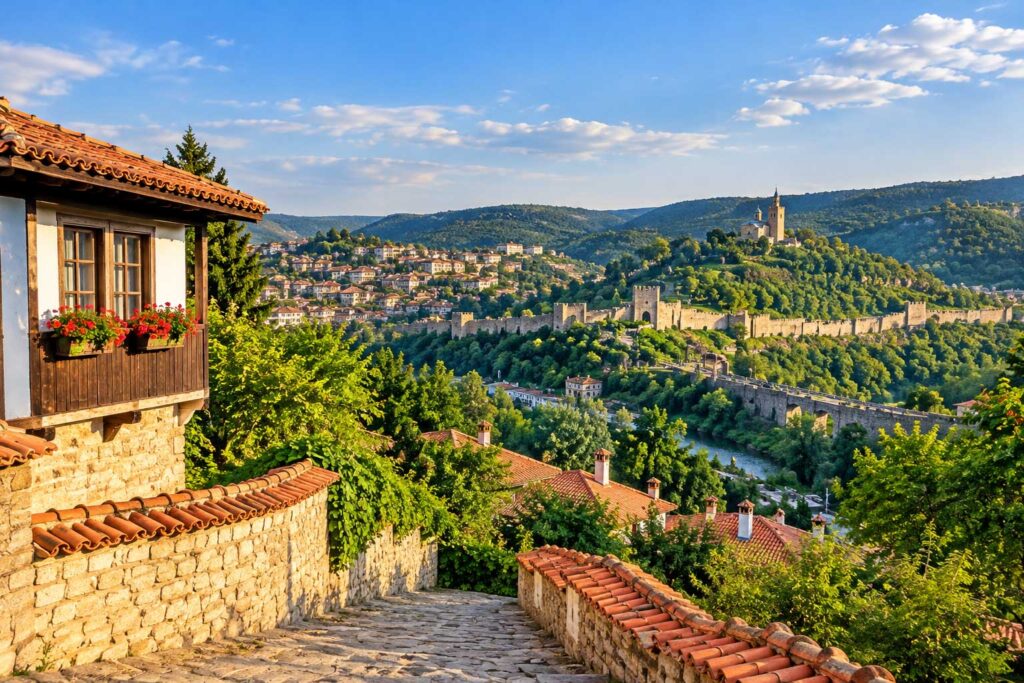
Arbanasi sits on a high plateau above Veliko Tarnovo, and its elevated position is part of its appeal.
From several points around Arbanasi, you can look across the surrounding hills and the dramatic landscape of central Bulgaria. On clear days, the contrast is especially striking: quiet village streets and old stone houses in the foreground, with the densely built hillsides of Veliko Tarnovo beyond.
The views are one of the reasons Arbanasi works so well as part of a day in the region. You can spend the morning exploring fortresses, museums and historic streets in Veliko Tarnovo, then reach a much calmer setting only a short distance away.
Spring and early autumn are particularly beautiful, when the surrounding hills are either fresh and green or beginning to turn gold and rust. Summer brings a more open, sunlit landscape, while the village’s higher position can make it feel less enclosed than the streets below.
Leave a little time between attractions to enjoy the scenery.
A short pause along the quieter edges of the village gives you a chance to take in the hills, rooftops and distant views toward Veliko Tarnovo—and helps you appreciate why Arbanasi’s setting has always been such an important part of its character.
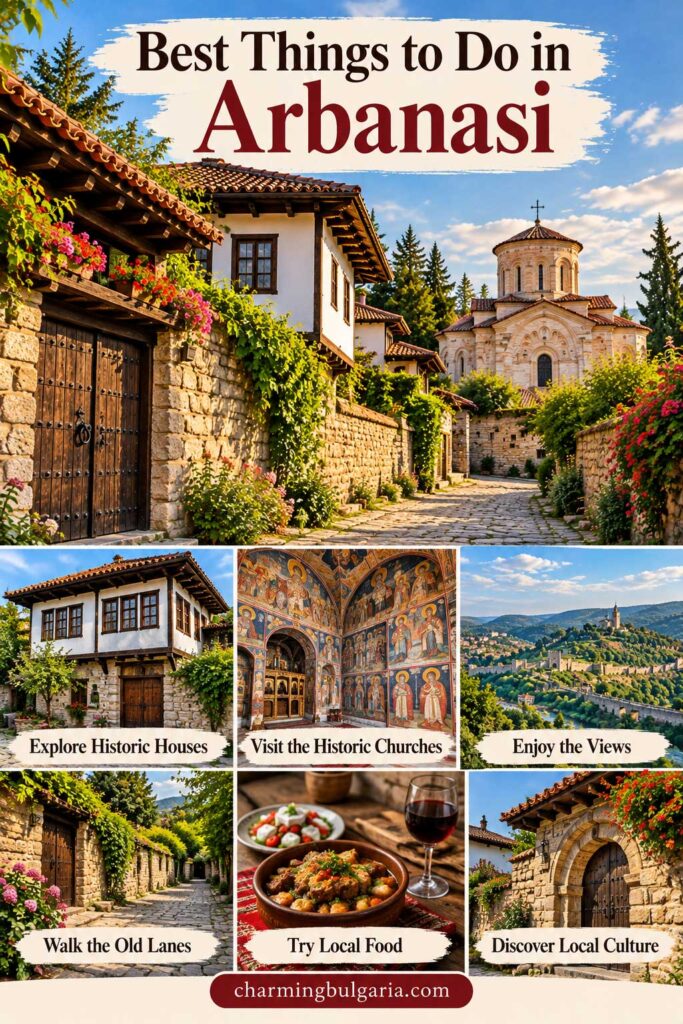
Best Things to Do in Arbanasi
Arbanasi may be small, but there is enough to see and do here to fill a relaxed half-day.
Visit the Church of the Nativity of Christ
Start with the Church of the Nativity of Christ, one of the village’s most important historic sites.
Its modest exterior gives little hint of the richly painted interior, where frescoes cover walls, arches and ceilings. If you visit only one church in Arbanasi, make it this one.
Explore Konstantsalieva House
Continue to Konstantsalieva House for a closer look at how wealthy merchant families once lived.
The fortified exterior, hidden courtyard and traditionally furnished rooms show how Arbanasi’s historic homes combined protection with comfort. Together with the Church of the Nativity, it captures much of what makes the village special.
Walk Through the Old Streets
After seeing the main attractions, spend some time exploring the older streets on foot.
Look beyond the major sights and notice the smaller details that give Arbanasi its character:
views toward Veliko Tarnovo and the surrounding hills
carved doors, tiled roofs and old stonework
Visit a Monastery
If you have more time, continue to one of the monasteries around the village.
The Monastery of the Dormition of the Mother of God and St. Nicholas Monastery offer a quieter experience and provide another glimpse into Arbanasi’s long Orthodox Christian heritage.
Stop for a Traditional Bulgarian Meal
A relaxed lunch also fits naturally into a half-day in Arbanasi.
Traditional Bulgarian dishes, grilled meats, salads and slow-cooked specialties make a good break between sightseeing, especially if you choose a restaurant in one of the village’s traditional-style buildings.
Take Your Time
Arbanasi is at its best when you do not rush from one attraction to the next.
The churches and historic houses are the main highlights, but much of the experience comes from simply walking, noticing small architectural details and enjoying the atmosphere.
A few hours is usually enough to see the main sights comfortably, while travelers interested in architecture, religious art or Bulgarian history could easily spend longer.
Best Time to Visit Arbanasi
Arbanasi can be enjoyed throughout the year, but spring and early autumn are especially pleasant.
From April through June, the village becomes greener, gardens begin to bloom and the weather is usually comfortable for walking between churches, historic houses and the quieter streets.
September and October are another excellent time to come. Summer crowds begin to ease, temperatures are often milder and the surrounding hills gradually take on warmer autumn colors.
Summer is the liveliest season, especially because Arbanasi is such an easy side trip from Veliko Tarnovo. During July and August, an earlier start is a good idea if you want to explore before the hottest part of the day.
Winter offers a completely different atmosphere. Snow can make the stone houses, wooden gates and red-tiled roofs look especially beautiful, although some attractions may operate on reduced hours and walking conditions can be less predictable.
For photography, morning and late afternoon usually offer softer light and warmer tones across the old houses, churches and surrounding landscape.
For the best combination of comfortable weather, attractive scenery and fewer visitors, May, June, September and early October are particularly good choices.
How to Get to Arbanasi from Veliko Tarnovo
Arbanasi is one of the easiest places to visit from Veliko Tarnovo, thanks to its location just a short distance from the city.
By Car
If you have a car, driving is the simplest option.
The trip usually takes around 10 to 15 minutes, depending on traffic and where you start in Veliko Tarnovo. The road climbs toward the plateau, and once you reach Arbanasi, parking is available in several areas near the historic center and main attractions.
Having a car also makes it easier to continue to nearby monasteries or other sights around Veliko Tarnovo later in the day.
By Taxi
A taxi is another convenient choice, especially if you are staying in Veliko Tarnovo without a rental car.
Because the distance is short, it can be a practical way to spend a few hours in Arbanasi and return to the city afterward without worrying about parking or driving.
By Public Transportation
Local public transportation may also connect Veliko Tarnovo with Arbanasi, although schedules can vary.
If you plan to travel this way, check the latest departure times locally before relying on a particular bus.
Walking from Veliko Tarnovo
It is possible to reach Arbanasi on foot, but this option is better suited to travelers comfortable with hills and longer walks.
The climb toward the plateau and sections of road shared with traffic make walking less convenient than driving or taking a taxi.
Combine Arbanasi with Veliko Tarnovo
Arbanasi works especially well as part of a full day in the region.
You can explore Tsarevets Fortress, the old town and Samovodska Charshia in Veliko Tarnovo, then head to Arbanasi for historic houses, churches and a quieter village atmosphere.
The short distance between the two makes it easy to experience both Bulgaria’s former medieval capital and one of the country’s best-known historic villages in the same day.
How Long to Spend in Arbanasi
For most visitors, two to four hours is enough to explore Arbanasi at a comfortable pace.
The Municipality of Veliko Tarnovo notes that the village can be explored on foot in roughly two to three hours, while a half-day gives you more time to enjoy the main sights without rushing. You can find additional itinerary information on the official Veliko Tarnovo tourism website.
If You Have Two to Three Hours
Focus on the main highlights.
Visit the Church of the Nativity of Christ, explore Konstantsalieva House and leave some time to walk through the historic streets.
This is enough for a good introduction to Arbanasi, especially if you are combining the village with a busy day in Veliko Tarnovo.
If You Have Half a Day
A half-day gives you a much more relaxed experience.
You can add another historic church or one of the monasteries, stop for lunch and spend more time wandering beyond the busiest streets.
This is the option I would recommend for most visitors because it allows you to enjoy the atmosphere rather than simply moving between attractions.
If You Prefer Slow Travel
Travelers who are especially interested in architecture, Orthodox art, photography or Bulgarian history may want to stay even longer.
Arbanasi is compact, but there is plenty of detail in its fortified houses, frescoes, courtyards and old lanes. The village rewards visitors who slow down and look beyond the main landmarks.
Arbanasi is also easy to combine with Veliko Tarnovo. Spend part of the day exploring the village, then use the rest for Tsarevets Fortress, the old town and other historic sights in the city.
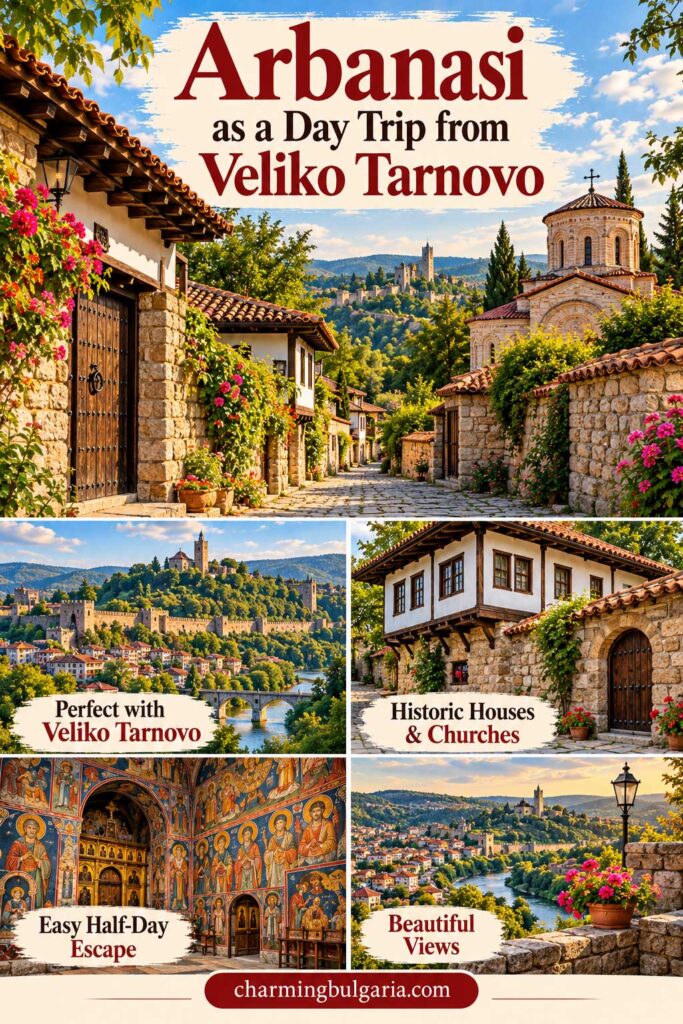
Arbanasi as a Day Trip from Veliko Tarnovo
Arbanasi is one of the easiest and most rewarding day trips from Veliko Tarnovo.
The village lies only about 5 km northeast of the city, so getting there takes very little time. Its compact size also makes Arbanasi particularly easy to combine with a day of sightseeing in Veliko Tarnovo.
A Simple Half-Day Itinerary
A good plan is to spend the morning exploring Tsarevets Fortress, the old town and some of Veliko Tarnovo’s historic streets, then continue to Arbanasi for a slower afternoon.
Once in the village, start with the Church of the Nativity of Christ and Konstantsalieva House. Afterward, leave time to wander through the old streets, visit another church or monastery, or simply enjoy the views from the plateau.
Two Very Different Experiences
One reason this combination works so well is that Veliko Tarnovo and Arbanasi have completely different atmospheres.
Veliko Tarnovo is dramatic and energetic, with steep hills, medieval fortresses and densely built historic neighborhoods.
Arbanasi feels smaller and more intimate. Stone walls, enclosed courtyards, merchant houses, churches and quiet lanes create a much slower rhythm.
Visiting both in the same day gives you two very different perspectives on the history of central Bulgaria.
Is Arbanasi Worth Adding to a Veliko Tarnovo Trip?
If you have only one or two days in the region, Arbanasi is still easy to fit into your itinerary.
You do not need to spend much time traveling, and even a few hours in the village adds something very different from the fortresses and city streets of Veliko Tarnovo.
For most travelers, a half-day in Arbanasi is enough to see the highlights without feeling rushed.
What to Eat in Arbanasi
A visit to Arbanasi is also a good opportunity to enjoy traditional Bulgarian food in a quieter village setting.
Restaurants in and around the village often focus on familiar Bulgarian dishes, including grilled meats, fresh salads, slow-cooked specialties and traditional dishes you’ll see on menus across the region.
Traditional Dishes to Look For
Some good choices include:
Shopska salad with tomatoes, cucumbers, peppers and white cheese
Kavarma, a rich dish made with meat and vegetables
Kyufte and kebapche, classic Bulgarian grilled meat specialties
Banitsa, especially if you are visiting earlier in the day
Stuffed peppers and other seasonal vegetable dishes
Bulgarian yogurt, served simply or used in traditional desserts
In cooler weather, hearty stews and oven-baked dishes fit especially well with the atmosphere of the village.
Enjoy a Slow Lunch in the Village
The setting is part of the experience.
Some restaurants in Arbanasi occupy traditional-style buildings with stone walls, wooden details and outdoor terraces, which makes stopping for lunch feel like a natural extension of exploring the historic streets.
If your schedule allows, plan your meal after visiting the main churches and houses rather than heading straight back to Veliko Tarnovo.
A relaxed lunch gives you a chance to slow down and experience Arbanasi as a living village, not just a collection of historic monuments.
Where to Stay in Arbanasi
Although many travelers visit Arbanasi as a short trip from Veliko Tarnovo, staying overnight can make the experience feel much more relaxed.
The village has a mix of small hotels, guesthouses and traditional-style accommodations, many designed to reflect the historic character of the area. Stone walls, wooden balconies, garden courtyards and views over the surrounding hills are common features.
Stay Near the Historic Center
For most visitors, the most convenient place to stay is close to the historic center.
This puts the main churches, preserved houses, restaurants and older streets within easy walking distance, so you can explore without relying on a car every time you want to go out.
Staying nearby also makes it easier to enjoy Arbanasi early in the morning or later in the evening, when the village feels much quieter.
Why Stay Overnight in Arbanasi?
Once most day-trippers leave, Arbanasi becomes noticeably quieter.
The streets become calmer, restaurants feel more relaxed and you can enjoy an evening walk without trying to fit another attraction into the schedule.
The next morning gives you another chance to experience the village before it becomes busier, which is especially nice if you enjoy photography or slower travel.
Arbanasi or Veliko Tarnovo?
Arbanasi can also work well as a base for exploring Veliko Tarnovo and central Bulgaria, particularly if you have a car.
You get quick access to the city while returning each evening to a quieter village setting.
If nightlife, shopping and a larger choice of restaurants are more important to you, staying in Veliko Tarnovo will usually be more convenient.
But if you prefer historic surroundings, peaceful evenings and a slower atmosphere, spending a night in Arbanasi can be a very appealing alternative.
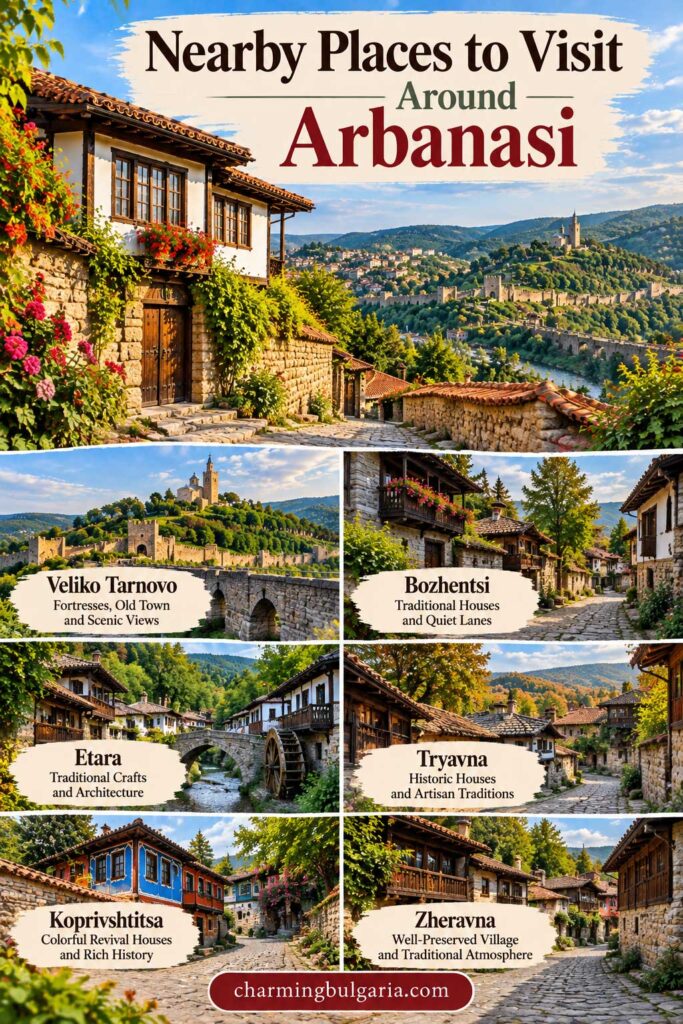
Nearby Places to Visit Around Arbanasi
Arbanasi is surrounded by some of the most interesting historic attractions in central Bulgaria, making it easy to include the village in a longer itinerary around Veliko Tarnovo.
Veliko Tarnovo
The obvious first stop is Veliko Tarnovo, only a short drive from Arbanasi.
The former medieval capital is home to Tsarevets Fortress, the old town, Gurko Street and Samovodska Charshia. Together, these sights make Veliko Tarnovo one of the most rewarding historic destinations in Bulgaria.
Trapezitsa Fortress
Across from Tsarevets, Trapezitsa Fortress adds another important chapter to the medieval story of Veliko Tarnovo.
Archaeological excavations have revealed the remains of numerous churches and other structures connected with the Second Bulgarian Empire. The elevated setting also adds another perspective on Veliko Tarnovo and the surrounding hills.
Preobrazhenski Monastery
If you have a car, consider adding Preobrazhenski Monastery, also known as the Monastery of the Transfiguration.
Located north of Veliko Tarnovo beneath dramatic rocky cliffs, it is a good choice for travelers interested in monasteries, religious art and quieter historic sites away from the city center.
Patriarchal Monastery of the Holy Trinity
Another peaceful stop is the Patriarchal Monastery of the Holy Trinity, set in the countryside near Veliko Tarnovo.
The monastery is closely connected with the literary traditions associated with Patriarch Euthymius of Tarnovo, an important figure in medieval Bulgarian culture.
Its more secluded setting makes it a good addition if you want to combine history with a quieter natural environment.
Nicopolis ad Istrum
Travelers with more time can continue to Nicopolis ad Istrum, the ruins of an ancient Roman and Early Byzantine city north of Veliko Tarnovo.
The archaeological site offers a completely different historical experience from the medieval fortresses and Revival-era architecture closer to Arbanasi.
Walking among the remains of streets, public buildings and other ancient structures helps show just how many different layers of history exist in this part of Bulgaria.
Build a Longer Veliko Tarnovo Itinerary
With so many historic places concentrated around Veliko Tarnovo, Arbanasi works especially well as part of a two- or three-day trip through central Bulgaria.
You can combine medieval fortresses, Orthodox monasteries, ancient ruins and traditional village architecture without spending large amounts of time driving between attractions.
Tips for Visiting Arbanasi
Arbanasi is easy to explore, but a few simple tips can make the visit more comfortable and enjoyable.
Wear Comfortable Shoes
Most of the village is easy to explore on foot, but some of the older lanes have uneven paving and stone surfaces.
Comfortable walking shoes are a good idea, especially if you plan to spend several hours moving between churches, historic houses and monasteries.
Visit Earlier in the Day
During the warmer months, mornings are often the most pleasant time to explore.
The village is usually quieter, temperatures are more comfortable and you can visit the main attractions before the busiest part of the day.
Check Opening Hours
Opening hours for churches, museums and historic houses can change by season.
Before your visit, check current schedules for the places you most want to see, particularly if you are traveling outside the main tourist season.
Cards are widely accepted in Bulgaria, but keeping a small amount of cash can still be useful.
Smaller cafés, local shops or individual attractions may not always offer the same payment options as larger businesses.
Leave Time for Photography
Arbanasi is full of small details that are easy to overlook when moving quickly between attractions.
Look for old wooden gates, weathered stone walls, tiled roofs, carved doorways and glimpses into flower-filled courtyards. Morning and late-afternoon light can make the historic buildings especially photogenic.
Do Not Rush
You do not need to see every church, monastery and historic house in one visit.
Choose the places that interest you most, then leave some time to wander without a strict route. Arbanasi is at its best when you slow down and allow the village itself to become part of the experience.
Is Arbanasi Worth Visiting?
Yes—Arbanasi is especially worth visiting if you enjoy historic villages, traditional architecture, old churches and Bulgarian history.
Its biggest appeal is how much history is concentrated in such a small area. Preserved merchant houses, painted churches, monasteries and quiet lanes are all close together, so you can experience a lot without dedicating an entire day to the village.
Who Will Enjoy Arbanasi Most?
Arbanasi is particularly rewarding for travelers interested in architecture, Orthodox art, photography, cultural history and slow travel.
It may not be the right place for visitors looking for nightlife or a long list of modern attractions, but that is not really what makes the village special.
The experience here is about stepping inside centuries-old buildings, noticing small architectural details and enjoying the slower rhythm of a historic settlement that still feels distinct from the city below.
If you are already staying in Veliko Tarnovo, adding Arbanasi to your itinerary is one of the easiest ways to experience another side of the region.
If historic villages are your kind of trip, explore our guide to the Best Villages Near Veliko Tarnovo for more places to visit around the region.
Frequently Asked Questions About Arbanasi
How far is Arbanasi from Veliko Tarnovo?
Arbanasi is only a few kilometers from Veliko Tarnovo, making it one of the easiest side trips from the city. By car or taxi, the journey usually takes around 10 to 15 minutes.
How much time do you need in Arbanasi?
For most visitors, two to four hours is enough to see the main highlights. A half-day is ideal if you want to visit several churches, explore Konstantsalieva House, stop for lunch and walk through the historic streets without rushing.
Can you visit Arbanasi without a car?
Yes. Taking a taxi from Veliko Tarnovo is one of the easiest options if you do not have a rental car. Local public transportation may also be available, although schedules can change.
What is Arbanasi famous for?
Arbanasi is best known for its fortified merchant houses, historic Orthodox churches, frescoes, monasteries and traditional architecture.
The village is especially famous for the Church of the Nativity of Christ and Konstantsalieva House.
What should you not miss in Arbanasi?
The Church of the Nativity of Christ and Konstantsalieva House are two of the most important places to see.
You should also leave time to walk through the old streets, admire the stone houses and wooden gates, and visit another church or monastery if your schedule allows.
Is Arbanasi good for families?
Yes. Arbanasi is compact, peaceful and easy to explore at a relaxed pace.
Families interested in history, architecture and cultural attractions can comfortably see the main sights in a few hours, making it an easy addition to a trip to Veliko Tarnovo.
Can you stay overnight in Arbanasi?
Yes. Arbanasi has a selection of hotels, guesthouses and traditional-style accommodations.
Staying overnight is a good option if you prefer quieter evenings and want to experience the village before or after most day visitors leave.
Is Arbanasi worth visiting in winter?
Yes, especially if you enjoy quieter historic places.
Snow can make the stone houses, wooden gates and tiled roofs especially atmospheric, although some museums and attractions may have reduced opening hours during the winter season.
Is Arbanasi worth visiting from Veliko Tarnovo?
Yes. Because Arbanasi is so close to Veliko Tarnovo, it is easy to combine the two in the same day.
The village offers a noticeably different experience, with historic merchant houses, painted churches, monasteries and quieter streets instead of medieval fortresses and steep city neighborhoods.
Why Arbanasi Deserves a Place on Your Veliko Tarnovo Itinerary
Arbanasi is one of those places that reveals more of its character the longer you spend there.
At first, it may seem like a quiet historic village above Veliko Tarnovo. But once you begin exploring its fortified houses, painted churches, hidden courtyards and old stone lanes, it becomes clear how much history is concentrated in such a small place.
The village offers a very different perspective on central Bulgaria. Veliko Tarnovo impresses with medieval fortresses, steep hills and dramatic views, while Arbanasi tells its story through merchant homes, religious art, monasteries and quieter streets.
Together, they give you two very different sides of central Bulgaria in a single day.
You can spend the morning exploring Veliko Tarnovo, slow the pace with a few hours in Arbanasi and still return to the city by evening.
For travelers who enjoy historic architecture, Orthodox churches, traditional villages and slow travel, Arbanasi deserves a place on any Veliko Tarnovo itinerary.
You can discover more places with the same combination of history, architecture and local character in our guide to the Most Charming Villages in Bulgaria.
It may be only a short distance from the city, but the atmosphere feels completely different—and that is what makes Arbanasi such a memorable part of a trip through central Bulgaria.
More Historic Places to Explore in Bulgaria
If you enjoy Arbanasi, several other historic towns and villages in Bulgaria offer a similar combination of traditional architecture, old churches, cultural heritage and atmospheric streets.
Veliko Tarnovo – Bulgaria’s Medieval Capital – Explore Tsarevets Fortress, historic neighborhoods, old churches and dramatic views across one of Bulgaria’s most important historic cities.
Tryavna – Revival Architecture and Woodcarving Traditions – Explore elegant Revival-era houses, a charming old square and the town’s long tradition of woodcarving and icon painting.
Zheravna – A Step Back in Time – Experience one of Bulgaria’s best-preserved Revival villages, known for its wooden houses, narrow lanes and remarkably traditional atmosphere.
Visiting several of these places is a wonderful way to see how different periods of Bulgarian history shaped the country’s architecture, religious art, craftsmanship and local traditions.
Arbanasi may have its own distinctive fortified houses and richly painted churches, but together these destinations reveal just how varied Bulgaria’s historic towns and villages can be.