Set among the wooded slopes of the Eastern Balkan Mountains, Kotel Bulgaria is one of those Bulgarian towns where history still feels woven into everyday life. Traditional wooden houses, old stone lanes, mountain scenery and centuries-old crafts give the town a character that feels very different from Bulgaria’s larger tourist destinations.
Kotel became particularly important during the Bulgarian National Revival, when it developed into a prosperous center of trade, education and craftsmanship. Local families were known for sheep breeding, textile production and weaving, and the distinctive Kotel carpets that emerged from this tradition remain one of the town’s best-known cultural symbols.
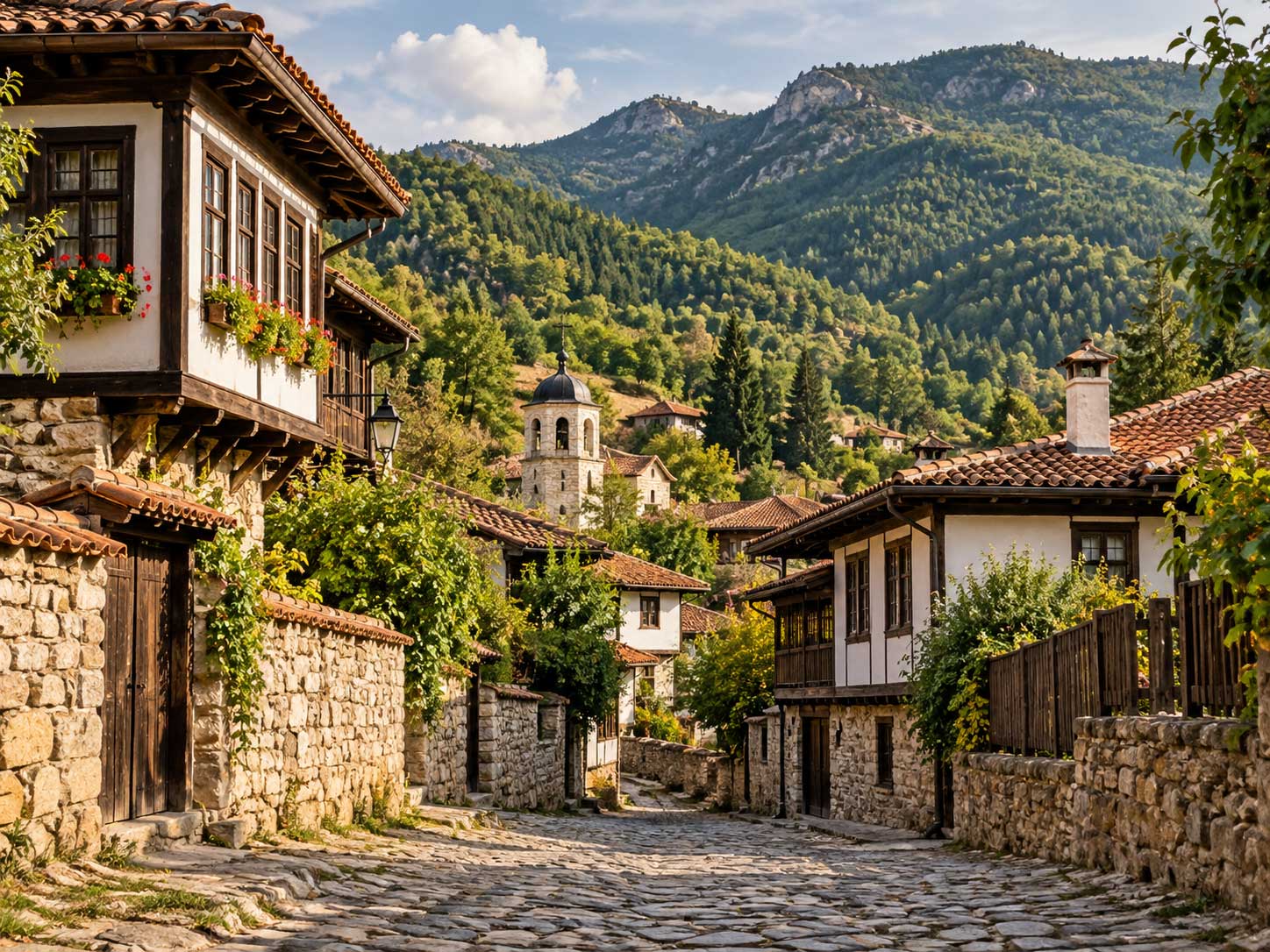
Much of historic Kotel was destroyed by a devastating fire in 1894, but the old Galata quarter survived and still gives visitors a glimpse of what the town once looked like. Its dark wooden houses, tiled roofs and narrow streets preserve some of the atmosphere of old Kotel.
Kotel also played an important role in Bulgaria’s cultural awakening. Museums and historic buildings around town tell the stories of local craftsmen, educators and revolutionaries, while the surrounding mountains make it easy to combine history with time outdoors.
Rather than feeling like an open-air museum, Kotel remains a living mountain town with a deep connection to Bulgaria’s past. That mix of Revival history, traditional crafts and Balkan Mountain scenery is what makes it such an interesting place to explore.
Kotel is a great choice for travelers who want to experience a quieter, more traditional side of Bulgaria.
Unlike the country’s larger historic towns, Kotel still feels closely tied to the surrounding mountains and local way of life. Its appeal comes from the mix of National Revival history, traditional crafts, historic architecture and beautiful Balkan Mountain scenery.
One of the main reasons to visit is the town’s cultural heritage. Kotel played an important role in Bulgarian education, craftsmanship and national identity during the Revival period, and you can still explore that history through its museums, old houses and local traditions.
The town is particularly well known for Kotel carpets and weaving, a craft passed down through generations and recognized for its geometric patterns, rich colors and distinctive designs.
Kotel also suits travelers who prefer places that feel calm and less crowded. You can spend time walking through historic neighborhoods, visit small museums, learn about traditional crafts and then enjoy the peaceful mountain scenery just beyond town.
For anyone interested in Bulgarian history, architecture and local culture, Kotel offers much more than a quick sightseeing stop. It is a place where the story of the Bulgarian Revival is still closely connected to the people, crafts and landscapes of the Balkan Mountains.
A Brief History of Kotel
Kotel’s roots reach back centuries, although the town we know today began to take shape during the 14th and 15th centuries. People from nearby villages and fortified settlements gradually moved into the protected mountain area, laying the foundations of the community that developed here. You can learn more about Kotel’s history and cultural heritage from Kotel Municipality.
Its location in the Eastern Balkan Mountains helped Kotel develop into an important local center. During the 18th and 19th centuries, trade and craftsmanship brought growing prosperity, with textiles, carpets and other handmade goods becoming especially important to the local economy.
This prosperity also supported education and cultural life. Kotel’s first secular school opened in 1812, and the town became closely connected with the Bulgarian National Revival. Important figures associated with Kotel include Sofroniy Vrachanski, Petar Beron, Neofit Bozveli and Georgi Rakovski, all of whom played significant roles in Bulgarian education, literature, church independence or the national liberation movement.
Kotel’s historic appearance changed dramatically in 1894, when a major fire destroyed much of the old town. The Galata quarter survived much of the destruction, which is why some of Kotel’s most atmospheric traditional wooden houses can still be seen there today. For more background, read the history and legends of Kotel.
The surviving architecture, museums and craft traditions make Kotel an especially interesting place for understanding how a small mountain settlement became an important cultural center during Bulgaria’s National Revival.
Revival Architecture in Kotel
One of the most distinctive things about Kotel is its connection to Bulgarian National Revival architecture.
Before the great fire of 1894, much of the town was made up of houses built from stone and wood, with tiled roofs, broad upper floors, wooden balconies and enclosed courtyards. Their design was practical as well as attractive, suited to the mountain climate and the everyday needs of local families.
The best place to experience this older side of Kotel today is the Galata quarter, where a number of historic houses survived. Walking through the neighborhood feels very different from visiting a reconstructed museum complex. These are real streets and homes, and the weathered timber, stone foundations and narrow lanes give the area an authentic, lived-in character.
The architecture also reflects the lifestyle of a prosperous mountain community. Many homes included space for storing goods, working with textiles and carrying out everyday household tasks, while the upper floors served as the main living areas.
Compared with the richly decorated Revival houses of places such as Plovdiv or Koprivshtitsa, Kotel’s surviving homes tend to feel more restrained and practical. Their stone foundations, timber upper floors and enclosed courtyards suit the mountain setting and give the older neighborhoods their distinctive character.
For travelers interested in traditional Bulgarian architecture, a slow walk through Kotel’s older streets is one of the best ways to appreciate the town beyond its museums.
Traditional Crafts and Kotel Carpets
Kotel has long been known as a town of skilled craftsmen, and traditional weaving remains one of the strongest parts of its cultural identity.
From Sheep Breeding to Textile Production
Sheep breeding was once an important livelihood in the region, providing the wool that supported local textile production. Over time, weaving developed into a highly respected craft, and Kotel became especially famous for its handwoven carpets and decorative textiles.
The craft was closely connected with everyday family life. Weaving was not simply about producing decorative objects; it was part of the local economy and a skill passed from one generation to the next.
What Makes Kotel Carpets Distinctive
Traditional Kotel carpets are known for their geometric patterns, bold colors and carefully balanced designs.
Each carpet required patience, precision and considerable skill. Many patterns were passed down through families, helping preserve a visual tradition that became strongly associated with the town.
The finished pieces often reflect the creativity and practical knowledge of the women who made them, turning an everyday craft into one of Kotel’s most recognizable cultural traditions.
See Traditional Carpets at the Galata School
Visitors who want to learn more about this heritage can visit the carpet-weaving exhibition in the Galata School, where historic examples of Kotel carpet art are displayed.
Seeing the carpets up close makes it easier to appreciate the detail involved in their patterns, weaving techniques and use of color. Some of the older surviving examples also offer a direct connection with the town’s craft traditions.
Kotel’s Craft Heritage Today
Kotel continues to celebrate its weaving traditions through cultural events and demonstrations.
One of the best-known local events is the Festival of Ethnicities, Colors and the Kotel Carpet, which brings together traditional crafts, music, food and performances.
For travelers interested in Bulgarian folk culture, Kotel carpets are much more than attractive souvenirs. They represent generations of mountain life, creativity and craftsmanship and remain one of the traditions most closely associated with the town. If this side of Bulgarian culture interests you, Etara is another fascinating place to explore traditional crafts and architecture.
Best Things to See in Kotel
Kotel may be a small mountain town, but there is plenty to explore if you are interested in Bulgarian history, traditional architecture and local culture.
Explore the Galata Quarter
Start with the Galata quarter, one of the best places to see surviving examples of Kotel’s traditional Revival-era architecture.
Much of the old town was destroyed by fire, but this neighborhood preserved a number of historic houses and still gives visitors a sense of what Kotel once looked like.
Take your time walking through the narrow streets rather than treating the area as a single attraction. The wooden houses, stone walls, tiled roofs and mountain backdrop are all part of its charm.
Visit the Kotel History Museum
The town’s historical museum is one of the best places to understand why Kotel played such an important role during the Bulgarian National Revival.
Its Kotel Revival Leaders exhibition explores the lives and work of important figures connected with the town, including Sofroniy Vrachanski, Neofit Bozveli, Petar Beron, Georgi Mamarchev and Georgi Rakovski.
The museum complex also includes the Pantheon of Georgi S. Rakovski, dedicated to one of the most important figures in Bulgaria’s national liberation movement.
See Traditional Kotel Carpets
The Galata School houses an exhibition devoted to Kotel’s long carpet-weaving tradition.
Even if textiles are not usually something you seek out while traveling, this exhibition is worth seeing. The carpets reveal another side of the town’s history and show the skill, patience and creativity behind a craft that supported generations of local families.
Visit the Natural History Museum
Kotel’s Natural History Museum focuses on the wildlife and landscapes of the Eastern Balkan Mountains.
Its collections include fossils, insects, birds, mammals, reptiles and other specimens from the region. The museum developed from the collection of Kotel-born teacher and naturalist Vasil Georgiev and offers a closer look at the biodiversity of the surrounding mountains.
See Kotel’s Historic Churches
Two important churches in town are Holy Trinity Church and Saints Peter and Paul Church.
Both are part of Kotel’s religious and architectural heritage, and their interiors include traditional woodcarving that adds another layer to the town’s craft history.
Together, these sights make Kotel especially rewarding for travelers who enjoy places where architecture, craftsmanship, history and mountain culture are closely connected.
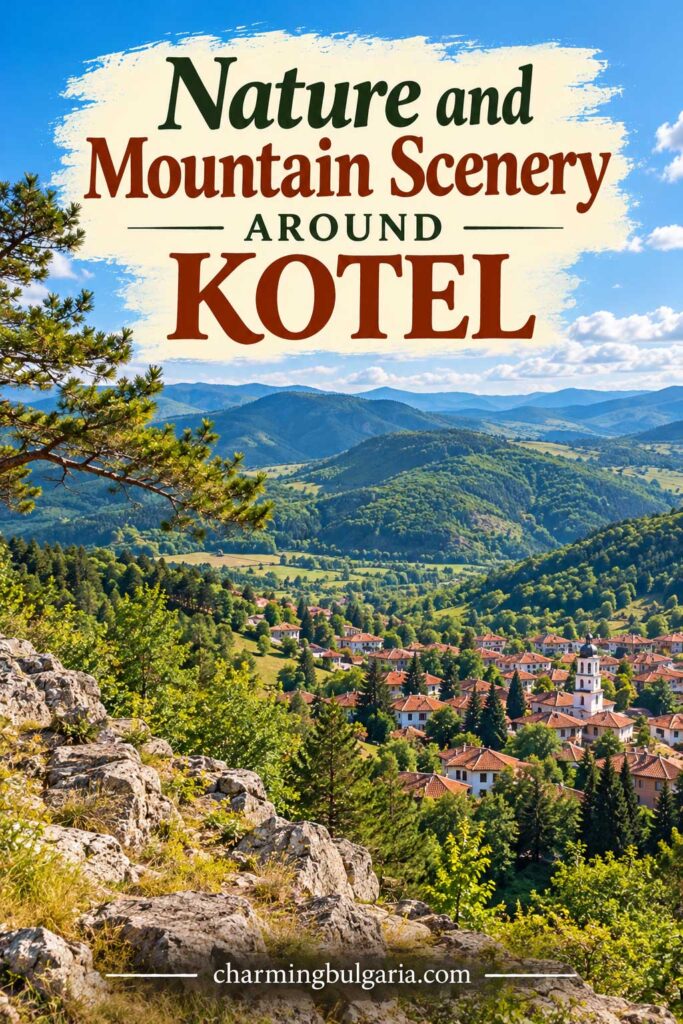
Nature and Mountain Scenery Around Kotel
Kotel is surrounded by the Eastern Balkan Mountains, and the landscape is one of the biggest reasons to spend more than a few hours in town.
Forested Hills and Mountain Views
Forested hills rise almost immediately beyond the houses, giving Kotel a peaceful setting that feels far removed from Bulgaria’s busier cities.
The scenery changes noticeably with the seasons. Spring brings fresh greenery and wildflowers, while autumn covers the surrounding slopes in warmer shades of yellow, orange and red.
Even without leaving town, the mountains form a beautiful backdrop to Kotel’s old houses and historic streets.
Walking and Hiking Around Kotel
There are plenty of opportunities for walking, hiking and exploring nature in the surrounding area.
Trails and country roads lead through forests, meadows and mountain terrain, while viewpoints around the region open up wider views across the Eastern Balkan Mountains.
You do not need to plan a demanding hike to enjoy the landscape. One of the easiest options is to spend the morning exploring Kotel’s historic center and then take a quieter walk outside town in the afternoon.
Wildlife and Biodiversity
The countryside around Kotel is also known for its rich natural environment.
Forests, meadows and rocky areas provide habitats for a variety of birds, mammals, reptiles, insects and wildflowers. This natural diversity is also reflected in the collections of Kotel’s Natural History Museum.
That close connection between town and landscape is part of Kotel’s appeal. You can spend the morning exploring Revival-era houses and museum collections, then be among forests, meadows and mountain views later the same day.
Best Time to Visit Kotel
Kotel can be visited throughout the year, but each season gives the town a different atmosphere. Because it sits in the Eastern Balkan Mountains, the weather tends to feel cooler and more distinctly seasonal than in Bulgaria’s lower-lying cities.
Spring
April through June is one of the nicest times to visit if you want mild temperatures, green hills and fewer crowds.
The surrounding forests and meadows come back to life, making spring especially good for combining museums and historic streets with walks in the countryside around town.
Summer
Summer brings longer days and plenty of time to explore Kotel and the surrounding region.
The mountain setting can feel more comfortable than Bulgaria’s hotter lowland areas, and this is also a convenient season for visiting nearby villages such as Zheravna and Medven.
If you plan to spend most of your time outdoors, early mornings and late afternoons are usually the most pleasant parts of the day.
Autumn
September and October are especially atmospheric in Kotel.
The forests around town begin to change color, creating a beautiful backdrop for the old wooden houses, red-tiled roofs and mountain streets. Autumn is an excellent choice for photography, scenic drives and relaxed walks through the historic neighborhoods.
Winter
Winter gives Kotel a much quieter and more traditional feel.
Cold weather and occasional snow can make the town’s wooden houses and mountain surroundings particularly picturesque. Some outdoor activities may be more limited, though, so it is worth keeping your plans flexible.
For travelers mainly interested in Revival architecture, traditional crafts and walking through Kotel’s historic streets, late spring and early autumn offer one of the best combinations of comfortable weather, attractive scenery and a relaxed atmosphere.
How to Get to Kotel
Kotel is located in Sliven Province in eastern Bulgaria, in the Eastern Balkan Mountains. Because of its mountain setting, reaching the town takes a little more planning than visiting places directly along Bulgaria’s major highways.
By Car
Driving is the easiest and most flexible option, especially if you want to combine Kotel with nearby villages.
Kotel is around 50 kilometers from Sliven by the route through Ichera and Gradets. Another road connects the two towns through the Petolachkata area, although that route is longer.
Having a car also makes it much easier to visit Zheravna, about 14 kilometers from Kotel, and Medven, roughly 12 kilometers to the southeast.
By Bus
Kotel has a local bus station with connections to Sliven and other destinations in the region, along with some longer-distance services. Timetables can change, so check the latest Kotel bus schedule before traveling, especially on weekends and public holidays.
Getting Around Kotel
Once you arrive, much of central Kotel can be explored on foot.
Walking is one of the best ways to experience the town because it gives you time to notice the traditional houses, quiet streets and small architectural details that are easy to miss from a car.
If you plan to explore Zheravna, Medven or other places in the surrounding mountains, having your own vehicle will give you much more freedom and make it easier to travel at your own pace.
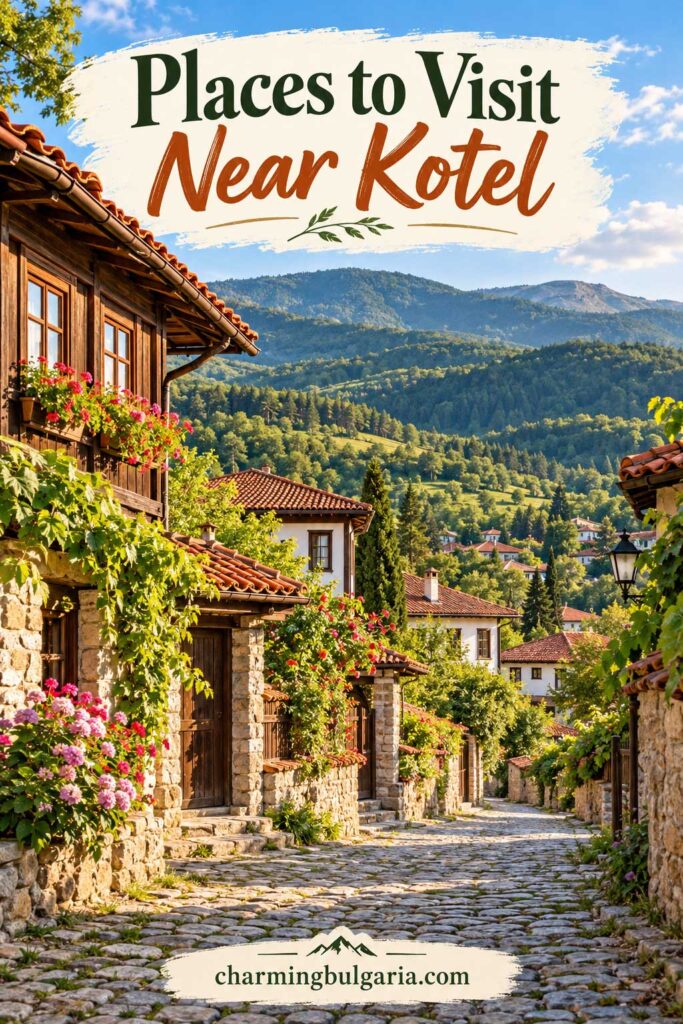
Places to Visit Near Kotel Bulgaria
Kotel is a convenient base for exploring several beautiful villages, mountain landscapes and historic places in this part of Bulgaria.
Zheravna
Zheravna is one of the easiest places to combine with a trip to Kotel. The village is known for its preserved Revival-era houses, narrow lanes and strong connection to Bulgarian folklore and history. Its dark wooden architecture and quiet streets make it a great choice for a half-day or full-day visit.
Medven
Medven is another traditional village worth adding to your route, especially if you are traveling by car. It is generally quieter than Zheravna and surrounded by beautiful mountain scenery, making it a good choice for travelers who prefer historic places that still feel peaceful and local.
Ichera
Ichera lies in the mountains between Kotel and Sliven and makes a pleasant stop if you are driving through the region.
The village is surrounded by forested hills and has a calm, rural atmosphere. It is especially easy to include if you are traveling between Sliven and Kotel and want to see another traditional mountain settlement along the way.
Sliven
For a larger town experience, head to Sliven.
Here you will find museums, historic streets, restaurants and access to the dramatic Blue Mountains above the town. Sliven can work well as a starting point for a Kotel trip or as an overnight stop before continuing deeper into the region.
Explore the Eastern Balkan Mountains
You can also build a wider itinerary around the Eastern Balkan Mountains, combining traditional villages, forest roads, scenic viewpoints and historic sites.
This part of Bulgaria is especially rewarding for slower travel. Rather than rushing between individual attractions, spend a few days moving between Kotel, Zheravna, Medven and the surrounding mountain landscapes. Farther west, Bozhentsi offers another beautifully preserved example of Bulgarian Revival architecture.
Traveling this way gives you a much deeper look at Bulgaria’s traditional architecture, crafts and rural culture than visiting Kotel as a quick stop on its own.
How Long to Spend in Kotel
Kotel can work as a day trip, but staying at least one night gives you a much better feel for the town and the surrounding mountains.
If You Only Have a Few Hours
If your time is limited, focus on the Galata quarter, the Kotel Revival Leaders exhibition, the carpet-weaving collection and a walk through the historic center.
Together, these sights cover some of the strongest parts of Kotel’s identity: Revival history, traditional architecture and local craftsmanship.
One Day and One Night
For a more relaxed visit, one full day and one night is a good choice.
This gives you enough time to explore the museums and older streets without rushing, enjoy a traditional meal and still leave room for a short walk or drive into the surrounding countryside.
Two Days in Kotel
With two days, Kotel becomes an excellent base for exploring more of the region.
Spend the first day discovering the town itself, then use the second for Zheravna, Medven or nearby natural attractions. The wider Kotel region includes mountain landscapes, caves, protected areas and small villages that are easy to combine into a short road trip.
Two or Three Nights for a Slower Trip
Travelers interested in photography, hiking, traditional villages or slow travel could comfortably spend two or three nights in the area.
Rather than treating Kotel as a quick stop between larger Bulgarian cities, staying longer gives you time to explore the surrounding villages and experience the quieter rhythm of the Eastern Balkan Mountains.
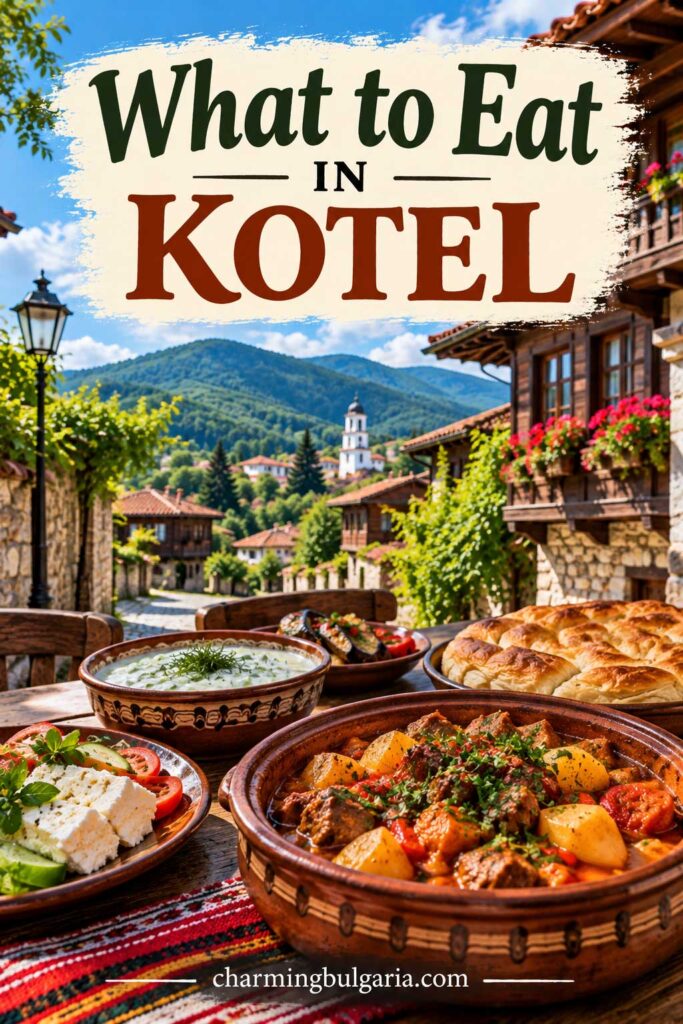
What to Eat in Kotel
Food is another good reason to slow down while visiting Kotel.
The local cuisine reflects the character of the Balkan Mountains, with hearty dishes, dairy products, grilled meats, beans, vegetables and homemade pastries appearing frequently on traditional menus.
Traditional Bulgarian Dishes to Try
Look for familiar Bulgarian classics such as banitsa, shopska salad, kavarma, kebapche and kyufte.
In colder weather, soups, stews and baked dishes are especially satisfying after spending time outside in the mountain air. These simple, filling foods fit naturally with the rural character of the region.
Dairy Products and Mountain Flavors
The wider Kotel area has a long tradition of sheep breeding, so white brined cheese, yogurt and other dairy products are an important part of local food culture.
You may also come across dishes that rely on seasonal vegetables, herbs and ingredients commonly used in Bulgarian home cooking.
Look for Regional and Seasonal Specialties
If you are eating at a smaller restaurant or family-run guesthouse, ask whether they prepare any local or seasonal dishes.
These are often more memorable than ordering something available throughout Bulgaria, especially when the food reflects the ingredients and traditions of the surrounding mountain region.
Take Time for a Slow Meal
A relaxed meal fits naturally into a day in Kotel.
After exploring museums, historic streets and traditional houses, sitting down for Bulgarian food is an easy way to experience another side of the town’s culture and enjoy the slower pace of life in the Eastern Balkan Mountains.
Where to Stay in Kotel
Accommodation in Kotel is fairly low-key, which suits the town well.
Accommodation in Kotel is fairly low-key, which suits the town well. You are more likely to find a family-run guesthouse or small hotel than a large resort, and that feels like a natural fit for Kotel’s relaxed mountain atmosphere.
Stay Near the Town Center
If you want to explore Kotel mostly on foot, staying close to the center is the most convenient option.
You will be within easier reach of museums, restaurants, historic streets and the older neighborhoods, which makes it simple to spend the day sightseeing without relying on a car.
Stay Outside the Center for More Peace and Scenery
Travelers with a car may prefer accommodation a little farther from the center.
These properties can offer a quieter setting, more space and better views of the surrounding hills. This can be a good choice if the mountain atmosphere is just as important to you as being close to the main sights.
Combine Kotel With Nearby Villages
If you plan to explore Zheravna, Medven and other nearby villages, you can also split your stay between Kotel and one of the smaller settlements.
This works especially well for travelers who want to experience more than one historic place and prefer a slower road-trip style itinerary.
Book Ahead During Busy Periods
Kotel does not have the same large accommodation capacity as Bulgaria’s major tourist destinations, so rooms can fill more quickly during festivals, summer weekends and holiday periods.
Booking ahead is a good idea if your dates are fixed.
For most visitors, one or two nights in Kotel is enough to explore the town comfortably while still leaving time for nearby villages and the surrounding mountain scenery.
Travel Tips for Visiting Kotel
Kotel is easy to enjoy without a complicated itinerary, but a few practical choices can make your visit more comfortable and rewarding.
Wear Comfortable Shoes
Some of the older streets around the Galata quarter are uneven and best explored at a relaxed pace.
Comfortable walking shoes are a good idea, especially if you plan to combine the historic neighborhoods with short walks in the surrounding countryside.
Check Museum Hours Before You Go
Kotel has several worthwhile cultural attractions, including its history museum, natural history museum and carpet-weaving exhibition.
Opening days and hours can change seasonally or around holidays, so check the official Kotel Municipality website for current museum and visitor information before planning your day.
Bring a Car if You Want to Explore the Region
Central Kotel is easy to explore on foot, but a car is very useful if you want to visit Zheravna, Medven or the surrounding mountains.
Zheravna is about 14 kilometers from Kotel, while Medven is roughly 12 kilometers to the southeast. Having your own vehicle also makes it easier to stop at viewpoints and smaller villages along the way.
Leave Time for the Old Streets
Do not plan your visit entirely around museums and specific attractions.
Some of the most memorable moments in Kotel come from simply wandering through the older neighborhoods, noticing the wooden houses, stone lanes, tiled roofs and mountain views.
Check the Local Events Calendar
Kotel hosts cultural events connected with folklore, traditional crafts and carpet weaving.
One of the best-known is the Festival of Ethnicities, Colors and the Kotel Carpet, which brings together music, crafts, food and cultural performances. Dates vary, so check the local calendar if you hope to visit during an event.
Combine Kotel With Nearby Villages
Kotel works particularly well as part of a small road trip rather than as an isolated stop.
A route through Kotel, Zheravna and Medven gives you three different perspectives on Revival architecture, mountain life and traditional Bulgarian culture.
Most importantly, do not rush your visit. Kotel’s charm is less about checking off major landmarks and more about experiencing its historic streets, traditional crafts and mountain setting at an unhurried pace.
Is Kotel Worth Visiting?
Yes—especially if you enjoy traditional Bulgarian architecture, local crafts, mountain scenery and National Revival history.
Kotel is not a destination built around one major landmark. Its appeal comes from the combination of historic neighborhoods, museums, weaving traditions and the surrounding Eastern Balkan Mountains.
The Galata Quarter Is a Highlight
The Galata quarter is one of the strongest reasons to visit Kotel.
The neighborhood preserves more than 100 Revival-era houses, including traditional wooden homes with stone foundations, enclosed courtyards and carved architectural details. Walking through the area gives you a much clearer sense of what old Kotel once looked like. You can learn more about the historic Galata quarter on the official Kotel Municipality website.
Kotel Has a Strong Craft Tradition
Kotel is also one of Bulgaria’s historic centers of carpet weaving.
Traditional Kotel carpets remain closely associated with the town, and historic examples can be seen at the carpet-weaving exhibition in the Galata School.
It Works Well as Part of a Wider Trip
Another advantage is how easily Kotel can be combined with nearby places such as Zheravna and Medven.
Together, these destinations offer a deeper look at Revival architecture, traditional crafts and mountain life in this part of Bulgaria.
If you prefer slower destinations with history, local character and fewer crowds, Kotel is well worth adding to your Bulgaria itinerary.
Frequently Asked Questions About Kotel Bulgaria
Where is Kotel located?
Kotel is located in Sliven Province in eastern Bulgaria, in the Eastern Balkan Mountains. The town is surrounded by forested hills and sits within easy reach of places such as Sliven, Zheravna and Medven.
What is Kotel famous for?
Kotel is best known for its Bulgarian National Revival heritage, traditional carpet weaving, historic wooden houses and mountain setting.
The town is also connected with several important Bulgarian educators, revolutionaries and cultural figures, which gives it a significant place in the country’s Revival history.
Is Kotel worth visiting?
Yes. Kotel is especially rewarding for travelers interested in history, traditional architecture, crafts and quieter destinations away from Bulgaria’s busiest tourist areas.
How much time do you need in Kotel?
You can see the main sights in one day, but one or two nights allows you to explore the museums and historic neighborhoods at a more relaxed pace.
Staying longer also makes it easier to visit nearby villages such as Zheravna and Medven.
What are the best things to see in Kotel?
Some of the main highlights include the Galata quarter, Kotel’s historical exhibitions, the traditional carpet-weaving collection, the Natural History Museum and the town’s historic churches.
Can you visit Zheravna from Kotel?
Yes. Zheravna is about 14 kilometers from Kotel, making it one of the easiest nearby villages to add to your trip.
The two destinations work particularly well together if you are interested in Revival architecture and traditional Bulgarian culture.
Is Kotel easy to explore on foot?
Yes. Much of central Kotel can be explored on foot.
Comfortable shoes are recommended because some of the older streets and lanes can be uneven.
What is the best time to visit Kotel?
Late spring and early autumn are excellent choices for comfortable walking weather and attractive mountain scenery.
Summer is also convenient for exploring the surrounding villages, while winter offers a quieter atmosphere and the possibility of snow.
Do you need a car in Kotel?
You do not need a car to explore central Kotel, but having one makes it much easier to reach Zheravna, Medven and other places in the surrounding mountains.
Is Kotel good for a road trip?
Yes. Kotel fits very well into a road trip through this part of Bulgaria.
A route combining Kotel, Zheravna, Medven and Sliven gives you a good mix of Revival architecture, traditional villages, mountain scenery and local history.
Why Kotel Is Worth Adding to Your Bulgarian Itinerary
Kotel is best enjoyed slowly.
Its old wooden houses, weaving traditions, small museums and surrounding mountain scenery reveal a side of Bulgaria that still feels closely tied to everyday life, craftsmanship and the Bulgarian National Revival.
The historic streets are not overly polished or staged, and that is part of Kotel’s appeal. The town still feels lived in, local and closely connected to the mountains around it.
Take time to wander through the Galata quarter, learn about Kotel’s weaving traditions, visit the museums and leave room in your itinerary for nearby Zheravna and Medven.
Together, these places offer a memorable introduction to the architecture, traditions and rural culture of the Eastern Balkan Mountains. For a different mountain culture altogether, explore Shiroka Laka in the Rhodopes.
For travelers looking beyond Bulgaria’s major cities and resorts, Kotel is a rewarding stop filled with history, craftsmanship and mountain character.
More Charming Places to Explore in Bulgaria
If you enjoy Kotel, several other historic towns and villages offer a similar mix of Revival architecture, local traditions and beautiful mountain scenery.
Zheravna – A Step Back in Time – Explore one of Bulgaria’s best-preserved Revival villages, known for its wooden houses, quiet lanes and strong connection to Bulgarian history.
Etara – Traditional Bulgarian Crafts and Architecture – See historic workshops, water-powered machinery and demonstrations of traditional Bulgarian crafts.
Visiting several of these places is a great way to see how Bulgaria’s mountain communities developed their own styles of architecture, craftsmanship and local culture while preserving traditions that still shape them today.