10 Best Places to Visit in Bulgaria You Shouldn’t Miss

- September 7, 2023
- 1970
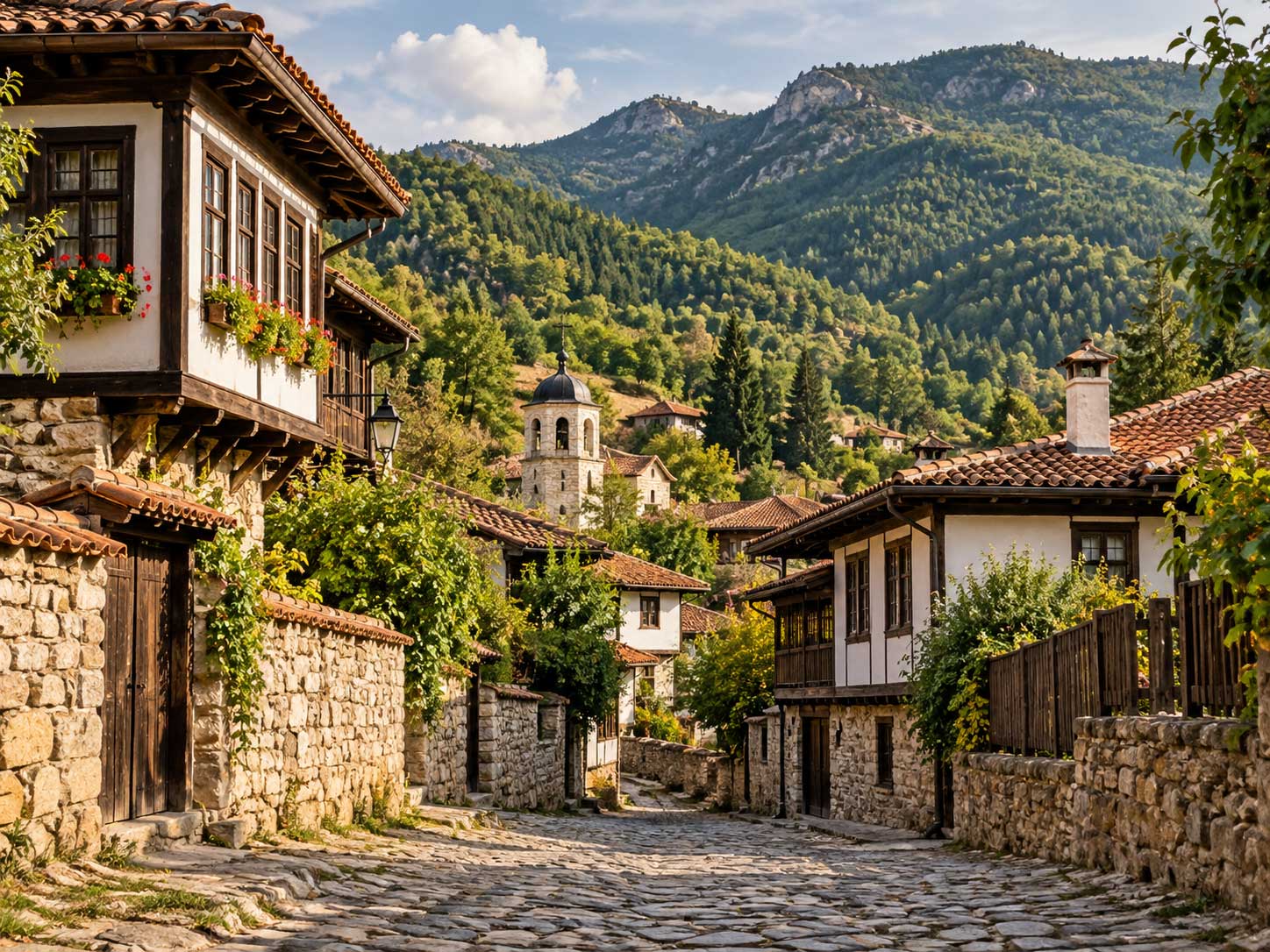
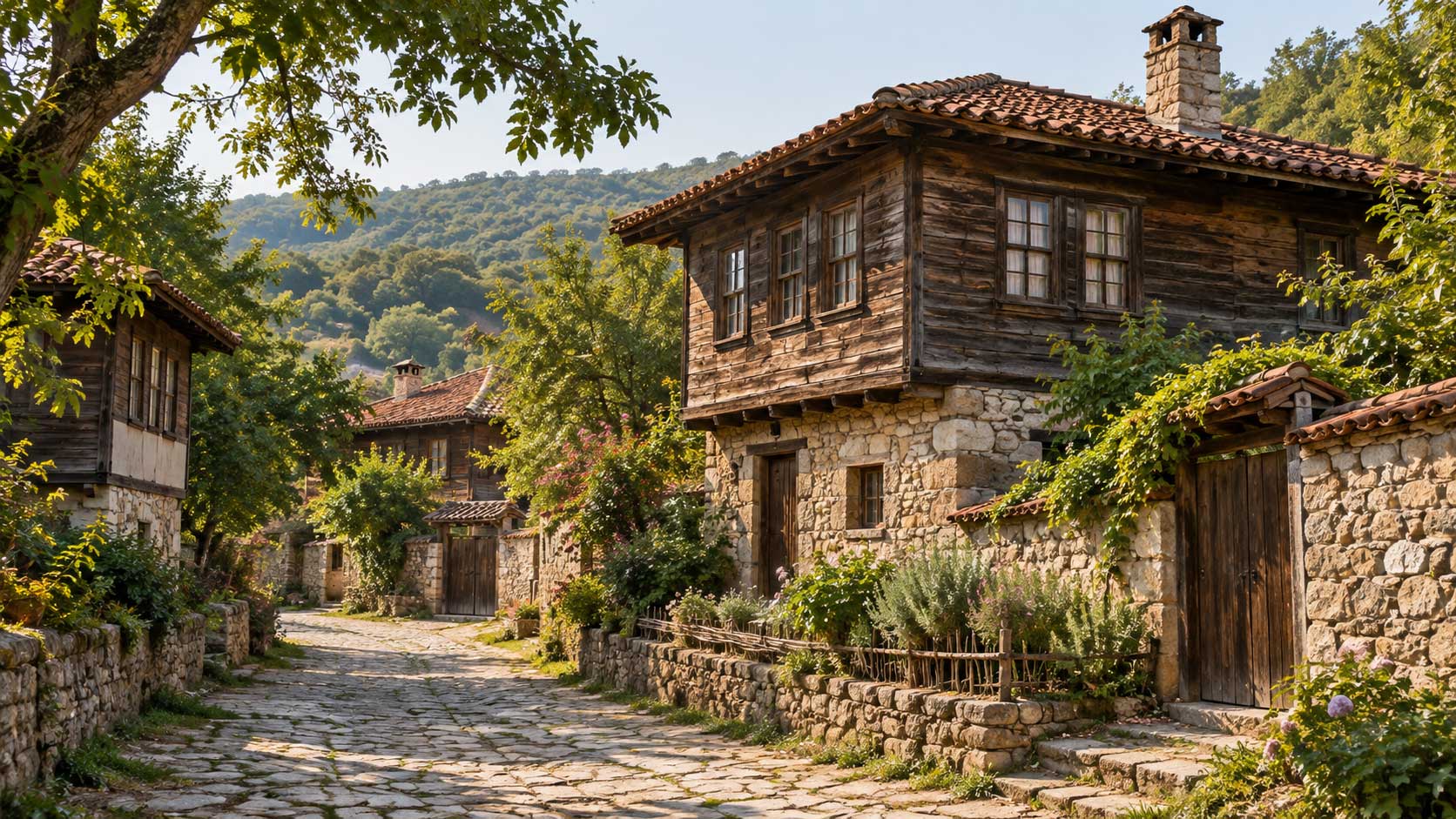
- Bulgarian Villages
Bulgaria may be one of Europe’s less talked-about travel destinations, but it has an incredible variety of places to explore. Within a few hours, you can travel from medieval fortresses and centuries-old monasteries to mountain lakes, traditional villages, and the sandy beaches of the Black Sea.
Some of the best places to visit in Bulgaria are famous landmarks that attract visitors from around the world. Others are quieter destinations where you can experience local traditions, admire historic architecture, or simply enjoy the natural beauty of the countryside.
Whether you’re planning your first trip to Bulgaria or returning to discover somewhere new, these ten destinations offer a wonderful introduction to the country’s history, culture, and landscapes.
Bulgaria is a fascinating, beautiful, difficult country, and I fell in love with it. – Garth Greenwell
1. Etar Open-Air Ethnographic Museum – Discover Traditional Bulgarian Crafts
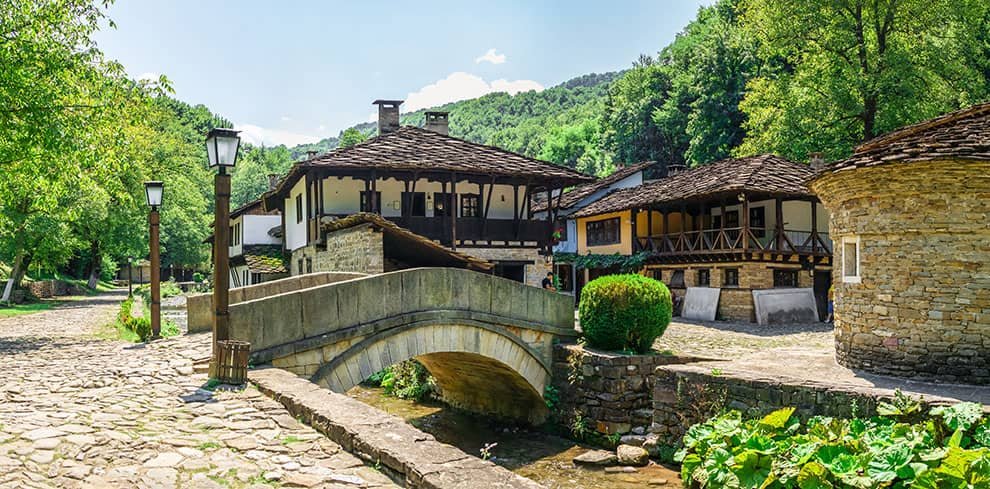
Just outside Gabrovo, at the foot of the Balkan Mountains, the Etar Open-Air Ethnographic Museum offers a fascinating glimpse into traditional Bulgarian life.
Unlike a typical museum, Etar feels like a small historic settlement. Cobblestone paths wind between old-fashioned workshops, wooden buildings, and water-powered machinery, while skilled craftspeople demonstrate techniques passed down through generations.
What Makes Etar Special?
One of the most interesting features of Etar is its collection of working traditional workshops. Visitors can watch artisans practicing pottery, woodcarving, metalworking, and other crafts that were once essential to everyday life.
The sound of flowing water is part of the experience. Historic water-powered equipment demonstrates how local craftspeople used natural energy long before modern machinery became common.
You can also browse handmade souvenirs and sample traditional Bulgarian treats.
Tips for Visiting Etar
Allow at least two hours to explore the museum, although you may want longer if you enjoy watching craft demonstrations.
Etar is also an excellent stop when exploring Gabrovo, the nearby Sokolski Monastery, or the historic village of Bozhentsi, where traditional Bulgarian Revival houses and peaceful cobblestone streets offer another glimpse into the region’s past.
For opening hours, admission prices, craft demonstrations, and upcoming events, visit the Etar Museum official website.
For travelers interested in Bulgarian culture and traditional craftsmanship, Etar deserves a place among the best places to visit in Bulgaria, especially when combined with nearby Gabrovo and Bozhentsi.
2. Rila Monastery – Bulgaria’s Most Famous Monastery
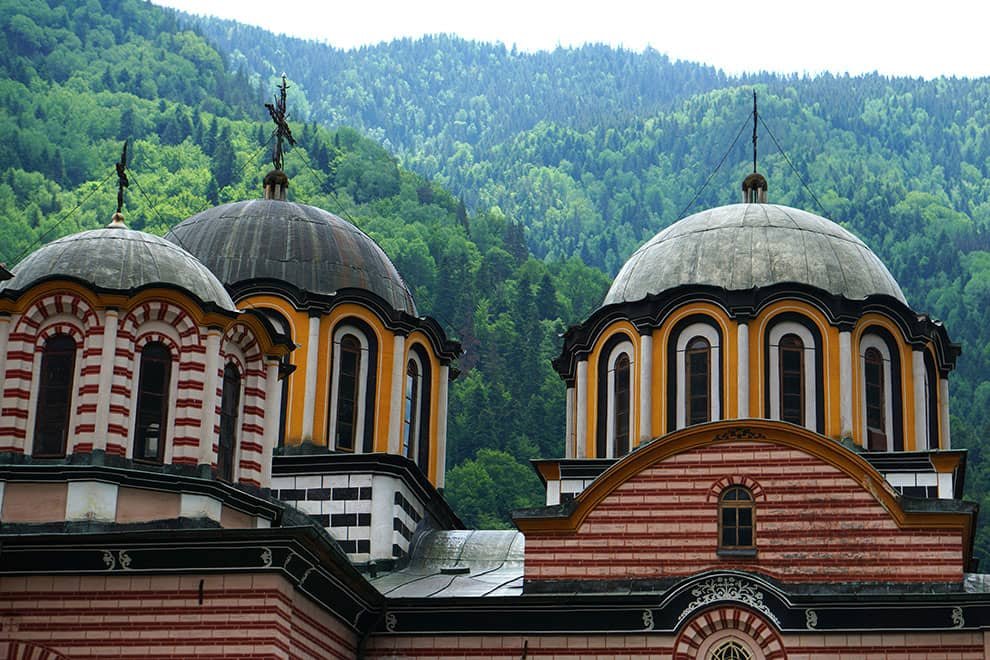
Hidden in the forested Rila Mountains, Rila Monastery is one of Bulgaria’s most recognizable landmarks and one of the country’s most important religious and cultural sites.
The monastery’s history dates back to the 10th century and Saint Ivan of Rila, a hermit who became one of Bulgaria’s most revered religious figures. Over the centuries, Rila Monastery developed into an important center of spiritual life, education, and Bulgarian culture.
Recognized as a UNESCO World Heritage Site, the monastery continues to attract visitors with its remarkable architecture, religious artwork, and beautiful mountain setting.
History and Architecture of Rila Monastery
The monastery’s main architectural complex covers approximately 8,800 square meters, with a spacious courtyard surrounded by residential buildings, arcades, and wooden balconies.
One of its oldest surviving structures is Hrelyo’s Tower, a medieval defensive tower traditionally dated to 1335. Much of the monastery’s present appearance, however, dates from its reconstruction during the 19th century, when it became an outstanding example of Bulgarian National Revival architecture.
The monastery’s architecture is especially memorable for its contrasting black-and-white patterns, colorful exterior frescoes, and traditional wooden balconies. These features reflect the artistic character of Bulgaria’s National Revival period and give the complex its unmistakable appearance.
At the heart of the complex stands the Church of the Nativity of the Virgin, famous for its richly decorated exterior and beautiful religious artwork.
What to See at Rila Monastery
Walking through the monastery’s entrance, you’ll find yourself in a spacious courtyard surrounded by colorful arcades and wooden balconies. The contrast between the dark-and-light stonework and the surrounding mountain scenery is particularly striking.
Take your time exploring the courtyard and admiring the detailed frescoes decorating the exterior of the main church. Inside, the richly ornamented iconostasis and religious paintings reveal the artistic traditions preserved here for generations.
If you enjoy history, the monastery’s museum collections are also worth exploring. They contain religious artifacts, manuscripts, and objects associated with the monastery’s long cultural heritage.
Before leaving, spend a few moments enjoying the peaceful surroundings. The forested mountains provide a beautiful backdrop to one of Bulgaria’s most important historical landmarks.
Tips for Visiting Rila Monastery
Rila Monastery is approximately 120 kilometers south of Sofia, making it a popular day trip from the capital.
Visitors should dress respectfully because the monastery remains an active religious site. Photography restrictions may apply inside the church and museum areas.
If you have extra time, explore the nearby mountain trails or visit the Cave of Saint Ivan of Rila.
Official information is available through the Rila Monastery website.
With its centuries-old history, colorful frescoes, and peaceful mountain setting, Rila Monastery is easily one of the best places to visit in Bulgaria for travelers interested in the country’s religious and cultural heritage.
3. Alexander Nevsky Cathedral – Sofia’s Magnificent Golden-Domed Landmark
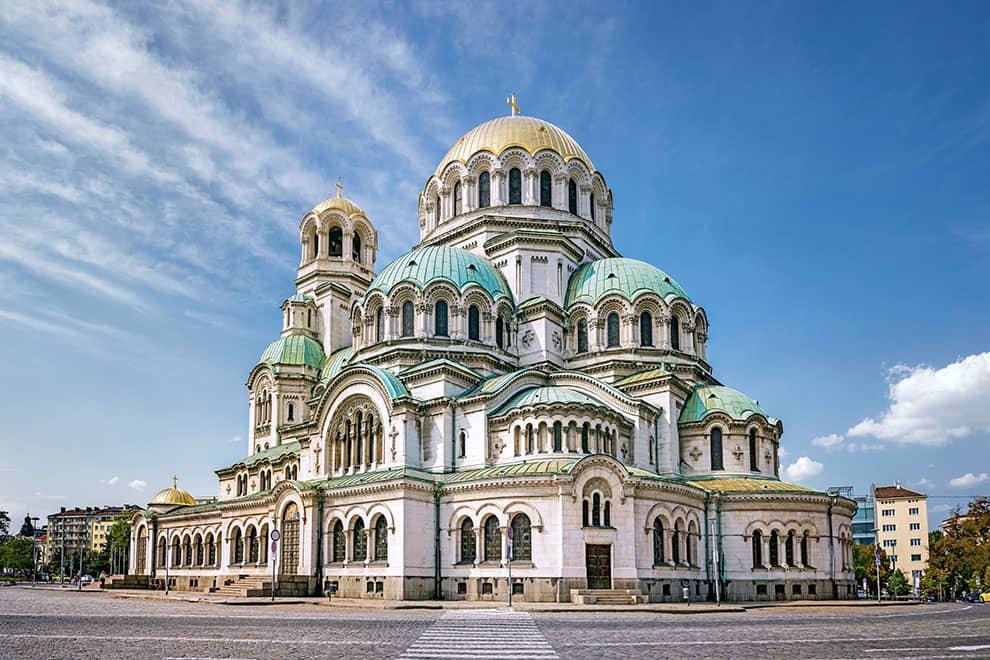
Standing in the heart of Sofia, St. Alexander Nevsky Cathedral is one of the first landmarks many visitors recognize in Bulgaria’s capital.
Built in the Neo-Byzantine style, the cathedral serves as the patriarchal cathedral of the Bulgarian Orthodox Church. Its golden domes, monumental proportions, and richly decorated exterior make it one of Sofia’s most distinctive buildings.
Despite its grand appearance, the cathedral remains an active place of worship, giving visitors an opportunity to experience both its architectural beauty and its religious significance.
History and Architecture of Alexander Nevsky Cathedral
The cathedral was constructed in the late 19th and early 20th centuries as a memorial to soldiers who lost their lives during the Russo-Turkish War of 1877–1878, which led to Bulgaria’s liberation from Ottoman rule.
The building was designed by Russian architect Alexander Pomerantsev, with Alexander Smirnov and Alexander Yakovlev contributing to its construction and decoration.
Its Neo-Byzantine design features marble columns, elaborate frescoes, religious mosaics, and a magnificent golden central dome that has become one of Sofia’s most recognizable landmarks.
Another remarkable feature is the cathedral’s collection of 12 bells, cast in Russia. Their combined weight is estimated at approximately 23–25 metric tons, with the largest weighing nearly 12 tons.
What to See Inside Alexander Nevsky Cathedral
Stepping inside, visitors are greeted by a vast interior filled with religious artwork, decorative stonework, and impressive chandeliers.
The cathedral’s interior features paintings and mosaics created by prominent artists, reflecting the artistic and spiritual traditions of Eastern Orthodox Christianity.
The crypt also houses a collection of Orthodox icons, although exhibition access and opening arrangements may vary.
Even for visitors who are not particularly interested in religious history, the cathedral offers a fascinating opportunity to appreciate the craftsmanship and artistic ambition behind one of Bulgaria’s most important monuments.
Tips for Visiting Alexander Nevsky Cathedral
The cathedral is located in central Sofia, within walking distance of several other important attractions.
Nearby landmarks include Saint Sophia Church, the National Assembly building, and the Monument to the Unknown Soldier.
Early morning is a wonderful time to photograph the cathedral’s golden domes, particularly when the surrounding square is quieter.
As this is an active Orthodox church, visitors should dress respectfully and observe any photography restrictions inside.
Before visiting, check the official Alexander Nevsky Cathedral website for worship schedules and visitor information.
4. Tsarevets Fortress – Explore Medieval Veliko Tarnovo

Perched above a bend in the Yantra River, Tsarevets Fortress was once the political and religious heart of medieval Bulgaria.
Located in Veliko Tarnovo, it served as the main stronghold of the Bulgarian rulers during the Second Bulgarian Empire, when Tarnovo was the country’s capital from the late 12th to the late 14th century.
Today, visitors can explore its restored walls, fortified gates, and archaeological remains while enjoying sweeping views over the surrounding hills and old town.
Discover the History of Tsarevets
Behind the fortress walls stood an entire medieval complex, including the royal palace, the patriarchal residence, churches, homes, and administrative buildings. These structures supported both the Bulgarian royal court and the religious authorities who governed from Tarnovo.
The palace included ceremonial halls and private chambers used by the Bulgarian rulers, while the surrounding buildings supported everyday life within the fortified capital.
Today, visitors can walk along the restored walls, explore the archaeological remains, and climb toward the Patriarchal Cathedral at the summit. Although much of the medieval city survives only as ruins, the fortress still gives a strong impression of Tarnovo’s former importance.
Restoration and Modern Significance
Restoration of Tsarevets began in the 1930s, followed by major conservation and reconstruction projects during the second half of the 20th century. Significant work was carried out ahead of Bulgaria’s 1,300th anniversary celebrations in 1981, helping transform the fortress into one of the country’s most important historical attractions.
Today, the fortress is one of the country’s most visited historical attractions and an important symbol of medieval Bulgarian statehood.
Enjoy the Views Over Veliko Tarnovo
One of the best reasons to visit Tsarevets is the scenery.
From the fortress walls, you can admire the Yantra River, the surrounding hills, and the colorful houses of Veliko Tarnovo.
Plan to spend at least two hours exploring the fortress, especially if you enjoy photography.
For anyone fascinated by medieval history, Tsarevets remains one of the best places to visit in Bulgaria, especially when paired with a walk through Veliko Tarnovo’s historic streets.
Afterward, wander through the old town, visit the historic Samovodska Charshiya street, or explore the nearby village of Arbanasi, famous for its historic merchant houses, beautifully decorated churches, and views toward Veliko Tarnovo.
5. Pomorie – A Relaxing Black Sea Town With a Famous Salt Lake
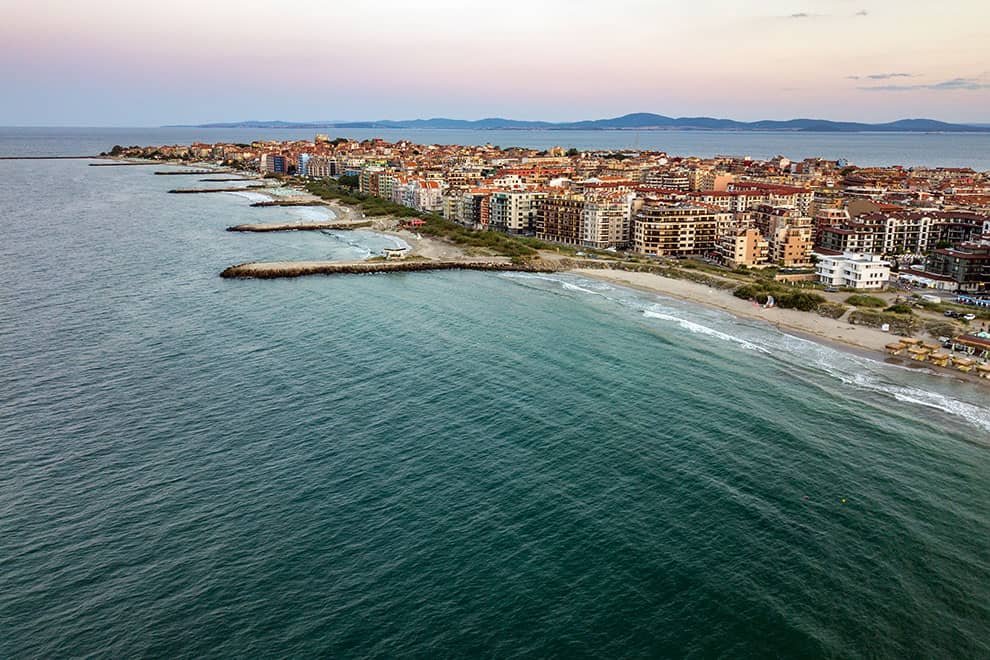
Pomorie is a seaside town with a character of its own. Set on a narrow peninsula along Bulgaria’s southern Black Sea coast, it combines sandy beaches, traditional coastal life, and a long history connected with fishing and salt production.
Known in antiquity as Anchialos, Pomorie developed from an ancient Greek settlement into an important coastal community. Today, visitors come not only for the sea but also for Pomorie Lake, its traditional saltworks, and the mineral-rich mud used in local wellness treatments.
Compared with some of the larger Black Sea resorts, Pomorie offers a quieter atmosphere, particularly outside the busiest summer months.
Explore Pomorie Lake
Pomorie Lake is a shallow coastal lagoon separated from the Black Sea by a narrow strip of land. Beyond its long history of salt production, it provides an important habitat for waterbirds and migratory species traveling along the Via Pontica route.
Visitors interested in nature can explore designated observation areas and learn about the traditional methods used to harvest salt.
Pomorie is also known for its therapeutic mud treatments, which have contributed to the town’s reputation as a wellness destination.
Things to Do in Pomorie
Beyond the lake, Pomorie has beaches, seaside promenades, traditional restaurants, and a small historic quarter.
The town’s Museum of Salt offers insight into an industry that has shaped the local community for generations.
History lovers should also visit the Ancient Domed Tomb of Pomorie, a remarkable Roman-era monument built using architectural traditions associated with ancient Thrace. Dating to approximately the 2nd–4th centuries AD, it is believed to have served as a family mausoleum and a place for religious rituals. Its unusual circular chamber and central hollow column make it one of the most interesting archaeological sites along Bulgaria’s southern Black Sea coast.
Pomorie is especially pleasant during late spring and early autumn, when the weather is generally comfortable and the summer crowds are smaller.
6. Shipka Memorial Church – History and Architecture in the Balkan Mountains
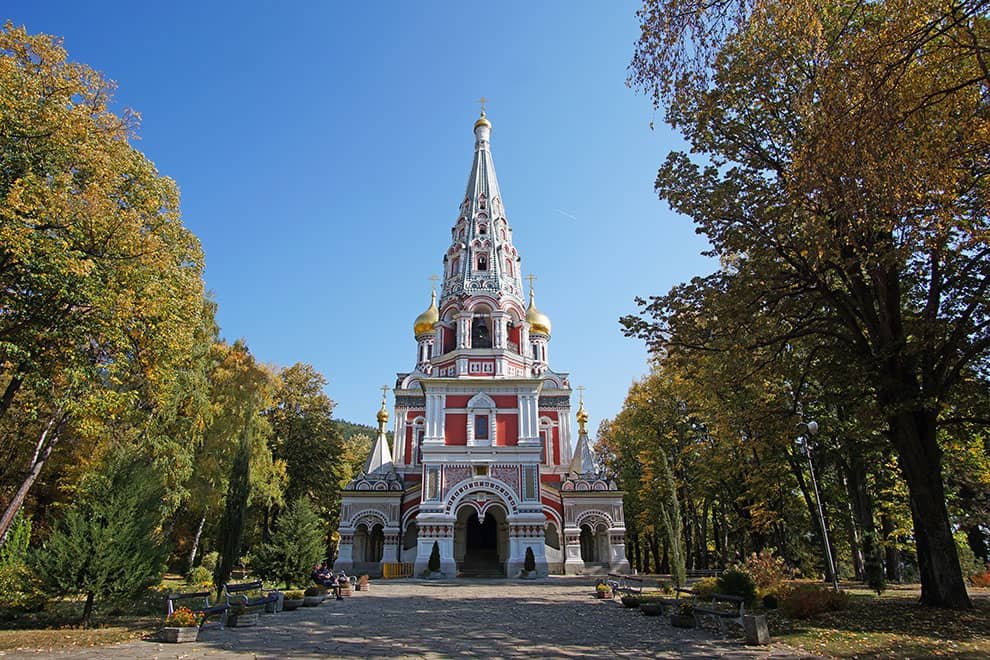
Near the town of Shipka, at the southern foot of the Balkan Mountains, stands one of Bulgaria’s most distinctive churches.
The Shipka Memorial Church, also known as the Memorial Temple of the Nativity of Christ, is instantly recognizable by its golden onion-shaped domes and colorful architectural details.
Constructed between 1885 and 1902, the church honors soldiers who lost their lives during the Russo-Turkish War of 1877–1878.
History and Architecture of Shipka Memorial Church
The church was designed by architect Antoniy Tomishko, with later involvement from Alexander Pomerantsev.
Its architectural style draws inspiration from 17th-century Russian church design, featuring decorative arches, richly ornamented facades, and elegant golden domes.
The memorial commemorates the soldiers who fought in the battles around Shipka Pass, among the most significant military engagements of the Russo-Turkish War.
Inside, visitors can admire religious artwork and a solemn atmosphere that reflects the church’s commemorative purpose.
Combine Your Visit With Shipka Pass
The church is an excellent stop when traveling through central Bulgaria.
Nearby Shipka Pass is associated with some of the most important battles of the Russo-Turkish War.
The Monument of Freedom, situated higher in the mountains, offers sweeping views over the surrounding landscape.
You can also combine your visit with Kazanlak and the famous Valley of the Roses, particularly during the rose-harvesting season.
If you enjoy traditional Bulgarian architecture and local history, consider extending your journey toward Kotel, a historic mountain town known for its crafts, weaving traditions, and Bulgarian Revival heritage.
7. Devetashka Cave – One of Bulgaria’s Most Spectacular Natural Wonders
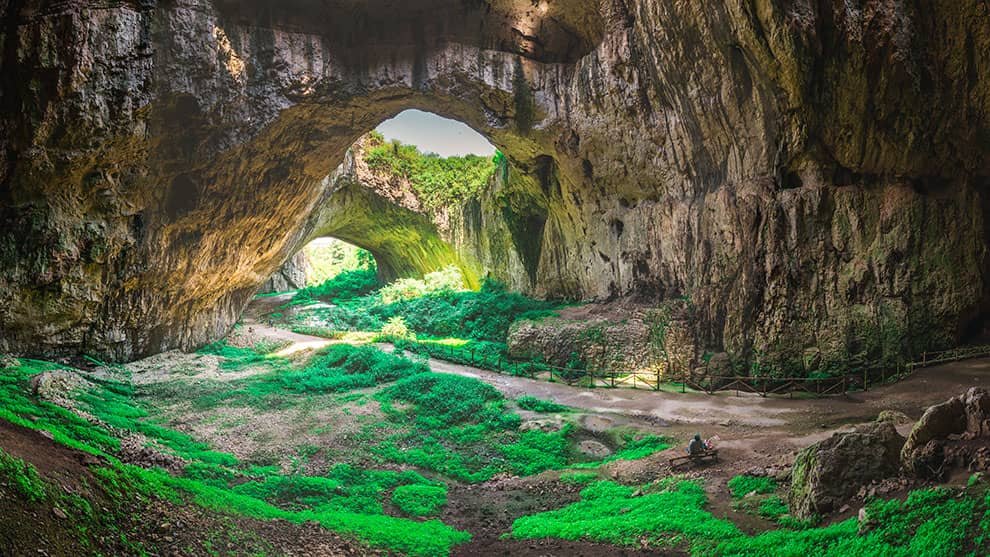
Devetashka Cave is one of those places that feels almost unreal when you first see it.
Located approximately two kilometers from the village of Devetaki in northern Bulgaria, this enormous limestone cave is famous for its towering entrance, vast chambers, and natural openings in the ceiling.
Sunlight streams through these openings, illuminating patches of greenery and creating a dramatic contrast between the dark rock and the bright sky.
Why Is Devetashka Cave So Special?
Unlike many caves where visitors move through narrow underground passages, Devetashka has an enormous open chamber that creates a sense of space and scale.
The cave extends for roughly two kilometers and was formed through karst processes, as water gradually dissolved the surrounding limestone.
Its natural skylights make it especially beautiful on sunny days, when shafts of light reach the cave floor.
Beyond its natural beauty, Devetashka Cave is also an important archaeological site. Evidence of human occupation from different prehistoric periods has been discovered here, offering valuable insights into how early communities lived and used the cave for shelter.
Wildlife and Bat Conservation
Devetashka Cave is an important refuge for protected bat species, and parts of the cave are closed during sensitive periods to protect the animals.
According to Lovech Municipality, the water gallery is restricted from November 1 to April 1, while the dry gallery is restricted from May 25 to July 31. The spectacular daylight-filled entrance chamber is normally accessible throughout the year.
Before traveling, check the official Lovech tourism website for the latest visitor information and any temporary closures.
Tips for Visiting Devetashka Cave
Devetashka Cave is accessible from the Lovech region and can be combined with a visit to the nearby Krushuna Waterfalls.
Wear comfortable shoes because the ground can be uneven or slippery.
8. Rhodope Mountains – Traditional Villages and Beautiful Mountain Scenery
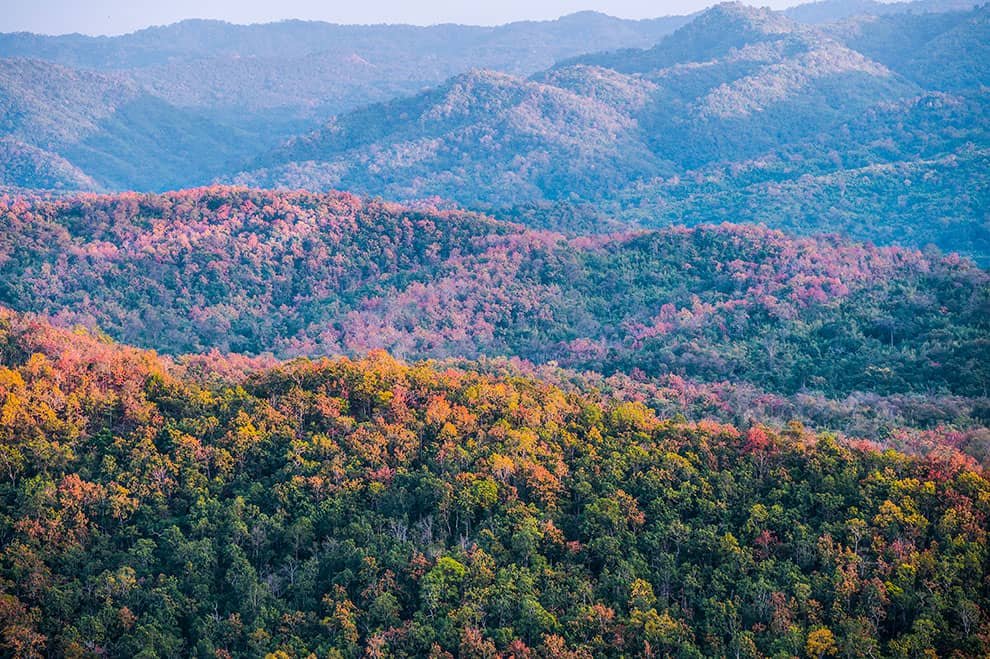
The Rhodope Mountains are among Bulgaria’s most enchanting regions, known for their forested hills, deep valleys, traditional villages, and rich folklore.
Stretching across southern Bulgaria and into Greece, the Rhodopes offer a slower, more peaceful travel experience than many of the country’s busiest destinations.
The highest peak in the Rhodopes is Golyam Perelik, reaching approximately 2,191 meters above sea level.
This is a place to enjoy winding mountain roads, homemade food, scenic viewpoints, and villages where local traditions remain an important part of everyday life.
Discover the Villages of the Rhodopes
Some of the Rhodope Mountains’ most memorable destinations are their traditional villages, where stone houses, narrow streets, and mountain scenery reflect a way of life shaped by the region’s geography and culture.
Shiroka Laka is especially well known for its Bulgarian Revival architecture and musical heritage. The village of Gela is another interesting stop, particularly for travelers who enjoy mountain landscapes and local folklore.
Further south, Smilyan is famous for its beans, which have become an important part of the region’s culinary identity. Nearby Devin and Smolyan also provide convenient bases for exploring the surrounding mountains.
Traditional Rhodope music remains an important part of local culture, especially the deep, distinctive sound of the kaba gaida, a type of Bulgarian bagpipe.
Nature and Outdoor Adventures
The Rhodope Mountains have abundant water resources, including mountain springs, streams, and rivers.
Much of the region lies within the Maritsa River drainage basin, while its forests support a rich variety of plant and animal life.
Popular natural attractions include the Wonderful Bridges rock formations, Trigrad Gorge, and Yagodina Cave.
Pamporovo is one of the region’s best-known winter resorts, while the surrounding mountains offer excellent opportunities for hiking during the warmer months.
Unlike Bansko, which is located in the Pirin Mountains, Pamporovo lies within the Rhodope range.
Experience Traditional Rhodope Culture
One of the greatest pleasures of visiting the Rhodopes is discovering local food and hospitality.
Traditional dishes include patatnik, a potato-based specialty, and dishes prepared with the famous Smilyan beans.
For travelers who want to experience Bulgaria beyond its major cities, the Rhodopes are an excellent choice.
If you prefer traditional villages, homemade food, and quieter mountain landscapes, the Rhodopes are among the best places to visit in Bulgaria beyond the country’s major cities and famous landmarks.
9. Old Town Nessebar – Ancient History on the Black Sea
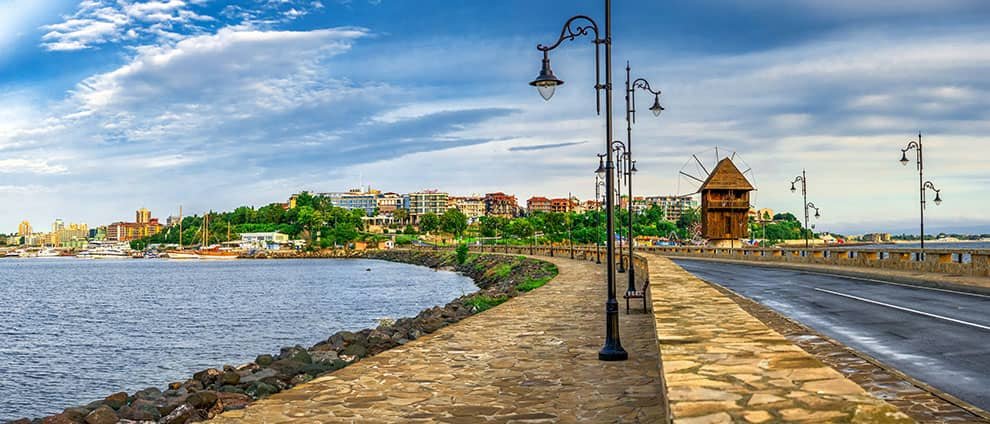
Nessebar is one of the most atmospheric historic towns on Bulgaria’s Black Sea coast.
Its old town occupies a small peninsula connected to the mainland by a narrow causeway.
With cobblestone streets, medieval churches, traditional wooden houses, and views of the sea, Nessebar feels very different from the modern resorts nearby.
The Ancient City of Nessebar was added to the UNESCO World Heritage List in 1983, recognizing its exceptional historical and architectural significance.
More Than 3,000 Years of History
Nessebar’s history stretches back more than 3,000 years.
Originally associated with a Thracian settlement, the town later became an important Greek colony known as Mesambria.
Over the centuries, it developed under Roman, Byzantine, and medieval Bulgarian rule.
These different civilizations left behind a remarkable collection of archaeological and architectural monuments.
Explore Nessebar’s Historic Churches
Nessebar is particularly famous for its medieval churches.
Among its most notable landmarks are the Church of Christ Pantocrator, the Church of Saint Sophia, and the Church of Saint John the Baptist.
The surviving churches display different architectural styles, from early Christian basilicas to richly decorated Byzantine structures.
Traditional houses with stone ground floors and wooden upper stories add to the town’s distinctive character.
Enjoy the Seaside Atmosphere
Nessebar is not only a destination for history lovers.
Its waterfront restaurants, small shops, and coastal views make it a lovely place to spend an afternoon or evening.
Visit early in the morning if you prefer quieter streets, particularly during July and August.
You can also combine Nessebar with a beach holiday along the southern Black Sea coast.
Learn more through UNESCO’s Ancient City of Nessebar listing.
10. Seven Rila Lakes – An Unforgettable Mountain Hiking Experience
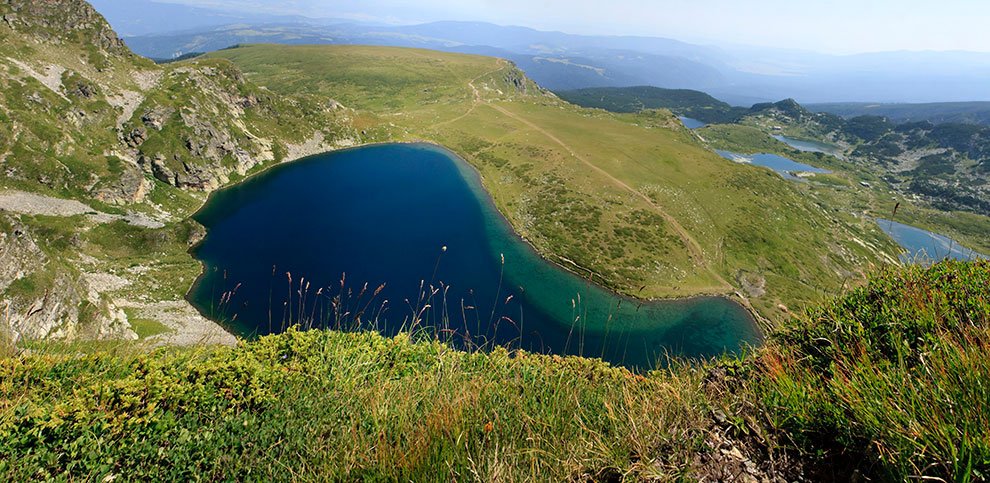
High in the northwestern Rila Mountains, the Seven Rila Lakes are among Bulgaria’s most beautiful natural attractions. This group of glacial lakes sits between approximately 2,095 and 2,535 meters above sea level, surrounded by rocky peaks and alpine meadows.
On clear summer days, the water reflects the surrounding mountains, while hiking trails lead visitors between the lakes and toward panoramic viewpoints overlooking the entire area.
What Makes the Seven Rila Lakes Unique?
Each lake has a name inspired by its shape or appearance.
The seven lakes are known as Salzata (The Tear), Okoto (The Eye), Babreka (The Kidney), Bliznaka (The Twin), Trilistnika (The Trefoil), Ribnoto (The Fish Lake), and Dolnoto Ezero (The Lower Lake).
They are arranged at different elevations and connected by streams and small waterfalls.
The highest lake, Salzata, sits at approximately 2,535 meters above sea level.
The hiking routes provide different perspectives of the lakes, with higher viewpoints offering particularly impressive panoramas.
Hiking the Seven Rila Lakes
The lakes are a popular hiking destination, especially from late June through September, depending on snow and trail conditions.
Many visitors use the chairlift from the Pionerska area toward Rila Lakes Hut to reduce the initial climb.
However, the hike still involves uneven mountain terrain and significant elevation changes.
Wear proper hiking shoes, bring water, and prepare for sudden changes in weather.
For the best experience, start early and avoid weekends when the trails can become crowded.
These destinations highlight just how varied the best places to visit in Bulgaria can be, from historic monasteries and medieval fortresses to coastal towns and high-mountain lakes. Choosing when to travel can make a big difference to your experience.
Best Time to Visit Bulgaria
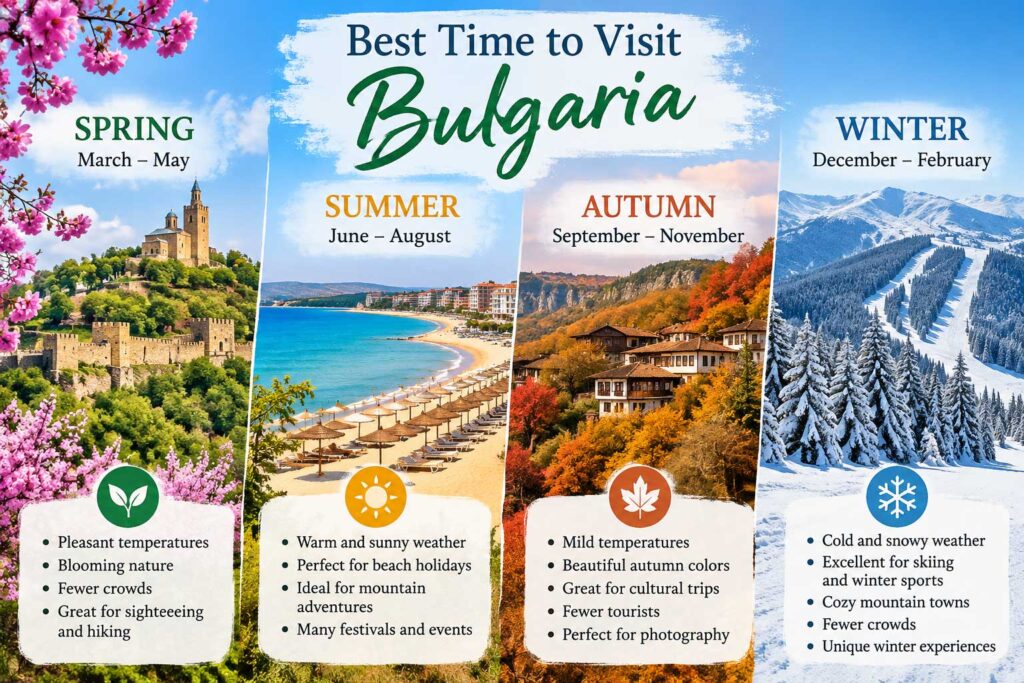
Bulgaria is a year-round destination, but the best time to visit depends on what you want to experience.
Spring: Historic Towns and Green Landscapes
Spring brings green landscapes, wildflowers, and pleasant sightseeing weather.
It’s an especially beautiful season for exploring historic towns, monasteries, and countryside destinations.
Summer: Mountains and Black Sea Beaches
Summer is ideal for the Black Sea coast and high-altitude hiking, although popular beaches and mountain trails can become crowded during July and August.
Autumn: Colorful Forests and Quiet Villages
Autumn is one of the loveliest times to explore the Balkan and Rhodope Mountains.
The forests turn golden, the temperatures become more comfortable, and many destinations feel quieter.
Autumn is also a wonderful season to explore traditional mountain villages such as Zheravna and Medven, where historic wooden houses and colorful forests create a particularly peaceful atmosphere.
Winter: Ski Resorts and Snowy Landscapes
Winter offers opportunities for skiing, snowy mountain scenery, and atmospheric city breaks.
However, access to high mountain trails can be limited by snow and difficult weather conditions.
How Many Days Do You Need to Explore Bulgaria?
If you’re hoping to explore several of the best places to visit in Bulgaria, seven to ten days is a good starting point. You won’t see everything, but you’ll have enough time to combine major attractions without spending your entire holiday traveling.
A short trip of three or four days is best focused on Sofia, Rila Monastery, and one additional destination.
With a full week, you could explore Sofia and the Rila Mountains before continuing to Plovdiv or Veliko Tarnovo.
Travelers interested in Bulgarian history can also include Koprivshtitsa, a colorful historic town known for its preserved Revival-era houses, museums, and connections to Bulgaria’s national liberation movement.
If you have ten to fourteen days, consider adding the Rhodope Mountains, central Bulgaria, and the Black Sea coast.
Renting a car provides the most flexibility, especially for reaching mountain villages, caves, and attractions outside major cities.
Frequently Asked Questions About Visiting Bulgaria
What is the most beautiful place to visit in Bulgaria?
Bulgaria has many beautiful destinations, but the Seven Rila Lakes, Rhodope Mountains, Rila Monastery, and historic town of Nessebar are among the most memorable. The best choice depends on whether you prefer natural scenery, historic architecture, or coastal landscapes.
Is Bulgaria worth visiting for tourists?
Absolutely. Bulgaria offers a remarkable combination of mountains, beaches, ancient ruins, medieval fortresses, traditional villages, and historic cities. It is also often more affordable than many popular Western European destinations.
What should I not miss on my first trip to Bulgaria?
For a first visit, consider Sofia, Rila Monastery, Plovdiv, Veliko Tarnovo, and at least one mountain destination. If you’re traveling during summer, adding Nessebar or another Black Sea town is worthwhile.
Can you visit Bulgaria without renting a car?
Yes. Major cities such as Sofia, Plovdiv, Varna, and Burgas are connected by public transportation. However, renting a car makes it much easier to explore remote villages, caves, mountain viewpoints, and smaller attractions.
Is one week enough to visit Bulgaria?
One week is enough to experience several highlights, especially if you concentrate on one or two regions. For a more relaxed trip that includes both the mountains and the Black Sea coast, ten to fourteen days is preferable.
Why Bulgaria Deserves a Place on Your Travel List
Bulgaria has a way of surprising visitors. You might arrive expecting a few historic landmarks and beautiful mountains, only to discover ancient towns, remarkable monasteries, traditional villages, and landscapes that feel far removed from the busy tourist routes of Europe.
What makes traveling here particularly rewarding is the opportunity to experience so many different sides of the country. You can explore the medieval walls of Tsarevets, admire the golden domes of Alexander Nevsky Cathedral, hike above the Seven Rila Lakes, or spend a quiet afternoon wandering through a small mountain village.
And while these ten destinations are among the best places to visit in Bulgaria, they’re only the beginning.
The best places to visit in Bulgaria aren’t limited to its famous tourist attractions. Some of the most rewarding experiences come from discovering smaller communities, local traditions, and landscapes that rarely appear on typical travel itineraries.
Leave room in your itinerary for unexpected stops, conversations with locals, and places that weren’t originally on your list. Sometimes those unplanned experiences become the most memorable part of a trip.
More Beautiful Places to Discover in Bulgaria
Although these ten destinations offer an excellent introduction, Bulgaria has many smaller towns and villages that deserve attention.
If you enjoy historic architecture, traditional culture, and peaceful countryside escapes, consider exploring some of these charming places:
- Koprivshtitsa – Colorful Bulgarian Revival houses, historic museums, and cobblestone streets.
- Bozhentsi – A beautifully preserved village near Gabrovo.
- Arbanasi – Historic houses and richly decorated churches near Veliko Tarnovo.
- Kotel – Traditional crafts, mountain scenery, and Bulgarian Revival history.
- Medven – A quiet mountain village with traditional houses and a relaxed atmosphere.
- Zheravna – One of Bulgaria’s most atmospheric historic villages.
These smaller destinations are particularly rewarding for travelers who prefer to slow down and experience the character of a place.