
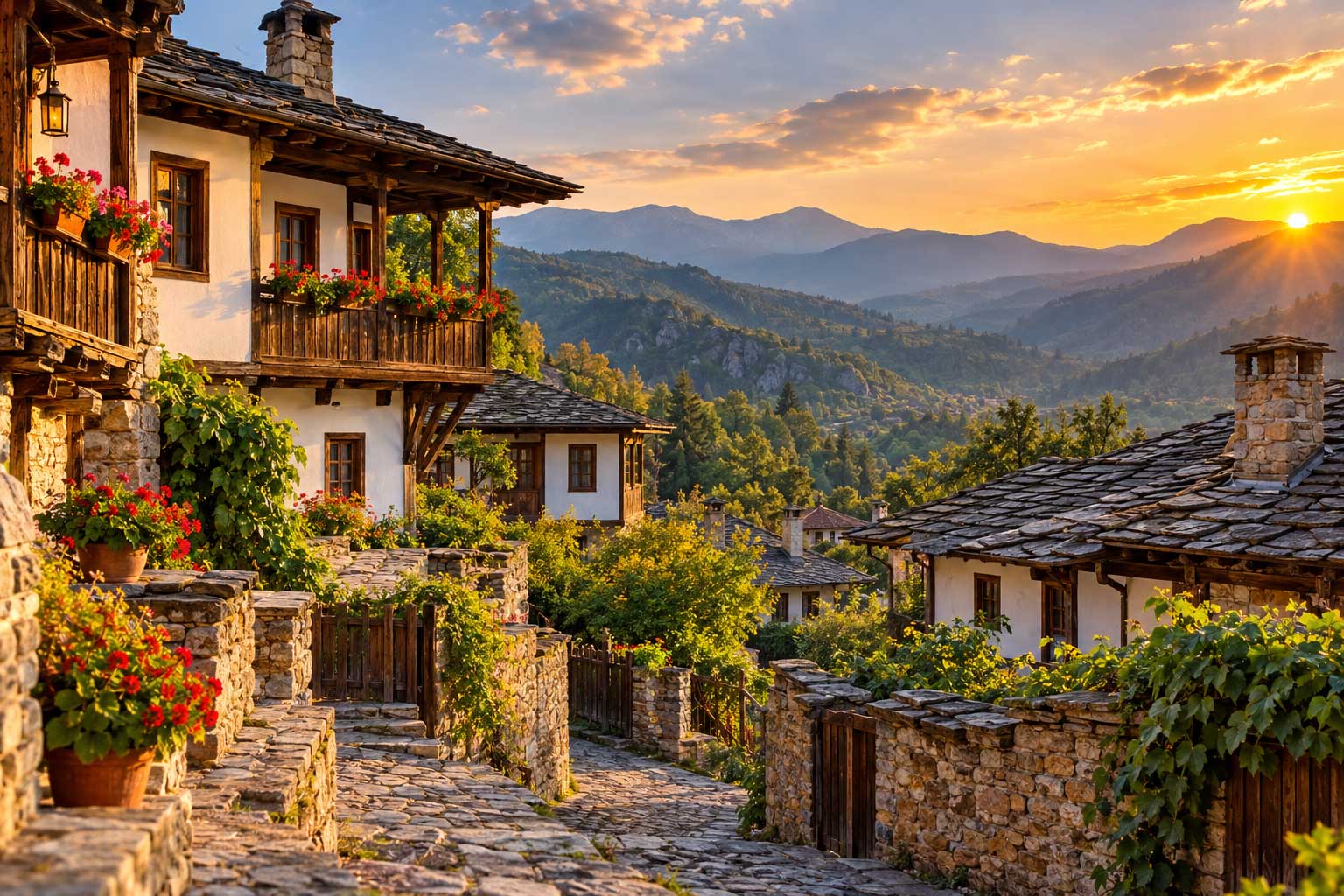
Best Bulgarian Villages for Photography

- May 8, 2026
- 17
- Historic Villages
Bulgaria’s most memorable photographs are not always found at its famous landmarks.
Leave the main highways behind and you begin to find cobblestone lanes, weathered wooden houses, stone roofs, tiny churches, old fountains, wooden gates, and villages tucked between mountains, forests, and valleys.
This quieter side of Bulgaria is incredibly rewarding to photograph.
Some villages sit high in the Rhodope Mountains, while others are hidden among the Balkan Mountains or deep inside Strandzha. In places such as Kovachevitsa, Leshten, Shiroka Laka, Zheravna, and Bozhentsi, traditional architecture still shapes the character of the entire settlement. Many are known for preserved Revival-period houses and cultural heritage, something also highlighted by Bulgaria’s official tourism portal.
But the best village photographs are not always the obvious ones.
Sometimes it is smoke rising from a chimney, flowers hanging over a wooden balcony, an empty cobbled lane, laundry moving in the mountain breeze, or the last sunlight catching an old tiled roof that stays with you.
This guide explores some of the best Bulgarian villages for photography, what makes each one visually distinctive, and the scenes worth slowing down for beyond the usual postcard views.
Most of the places here are villages, although I have also included Koprivshtitsa and Melnik—technically small towns—because both are among Bulgaria’s most photogenic historic settlements.
We will begin in the Western Rhodopes with Kovachevitsa, where steep cobbled lanes, stone houses, dark timber, and mountain views make almost every turn worth stopping for.
1. Kovachevitsa – Stone Streets and Rhodope Mountain Architecture
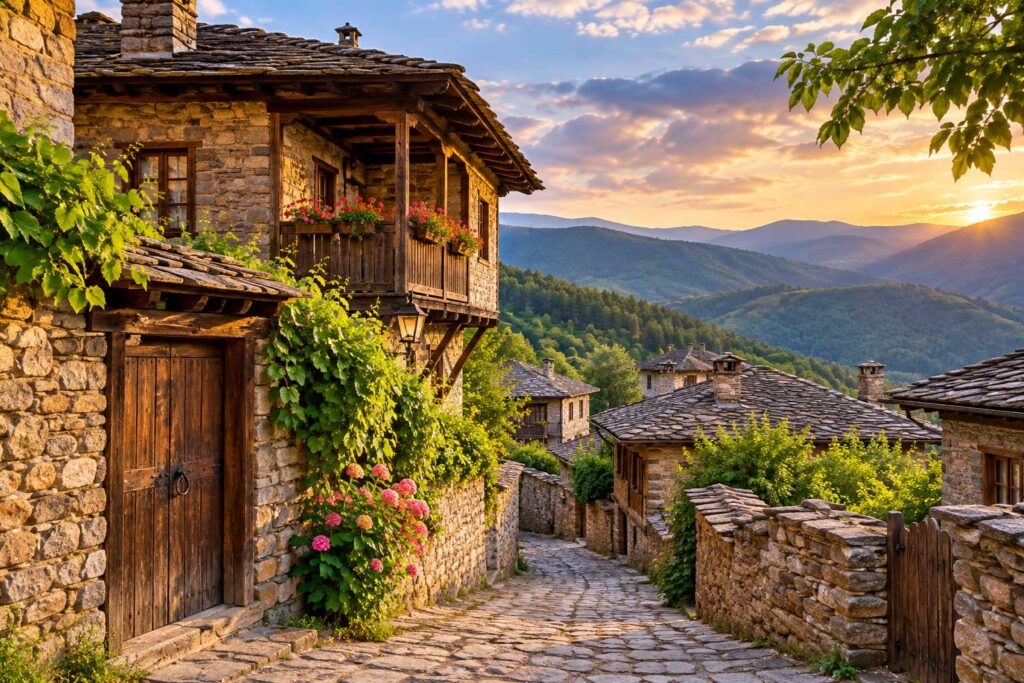
Kovachevitsa is one of the best places to start if you want to photograph traditional Bulgaria.
Set in the Western Rhodopes near Gotse Delchev, the village is known for its preserved stone-and-wood houses, steep cobbled lanes, broad wooden verandas, and heavy stone-slab roofs. Many of the buildings date back generations, giving Kovachevitsa the kind of architectural character that is difficult to recreate elsewhere. Its importance as an architectural and historic settlement is also documented in the Bulgarian Ministry of Tourism’s guide to rural and slow travel.
Why Kovachevitsa Is So Photogenic
What makes Kovachevitsa especially rewarding is how quickly the view changes as you walk.
One moment you are looking across the surrounding Rhodope hills; a few steps later, the frame may be filled with rough stone walls, dark wooden balconies, uneven paving, old gates, and rooftops overlapping down the slope.
Because the village follows steep terrain, many streets climb sharply between the houses. That naturally creates leading lines and lets you photograph the architecture from above, below, and across the hillside instead of always facing it straight on.
The contrast between the materials and the surrounding landscape is part of what makes Kovachevitsa so visually distinctive. Gray stone, dark timber, white plaster, and the green Rhodope landscape all sit naturally together without the scene feeling overly polished.
Best Photography Ideas in Kovachevitsa
It is tempting to photograph every historic house in full, but some of the strongest images come from much smaller scenes.
Look for a weathered wooden window set into a stone wall, a cobbled lane bending out of sight, flowers hanging over an old fence, or several rooftops stepping down the hillside toward the mountains.
The higher parts of the village are worth exploring too.
From above, individual houses begin to merge into a wider pattern of stone roofs, trees, narrow lanes, and surrounding hills. These broader views create a completely different feeling from the close street scenes below.
Do not forget to turn around as you climb. In Kovachevitsa, some of the best compositions appear behind you rather than in the direction you were walking.
Best Time to Photograph Kovachevitsa
Early morning is particularly rewarding.
The streets are quieter, the light is softer, and long shadows can bring out the texture of the cobbles, stone walls, and wooden façades.
Late afternoon is another excellent time, especially when warmer light begins catching the upper floors, balconies, and rooftops.
Autumn may be the most atmospheric season, as the forests around the village turn yellow, orange, and red. Winter creates an entirely different mood, particularly after snow settles across the dark roofs and narrow streets.
Kovachevitsa is not a place to photograph from a checklist.
Give yourself time to wander, follow lanes without knowing exactly where they lead, and stop when a doorway, roofline, patch of light, or mountain view catches your attention.
That same visual character has also made the village attractive to filmmakers. Bulgaria’s Ministry of Tourism notes that more than twenty films have used Kovachevitsa as a setting.
Planning to spend more time here? Our complete Kovachevitsa travel guide covers the village’s architecture, mountain setting, and what to see while you are there.
2. Leshten – Mountain Views and Traditional Rhodope Houses
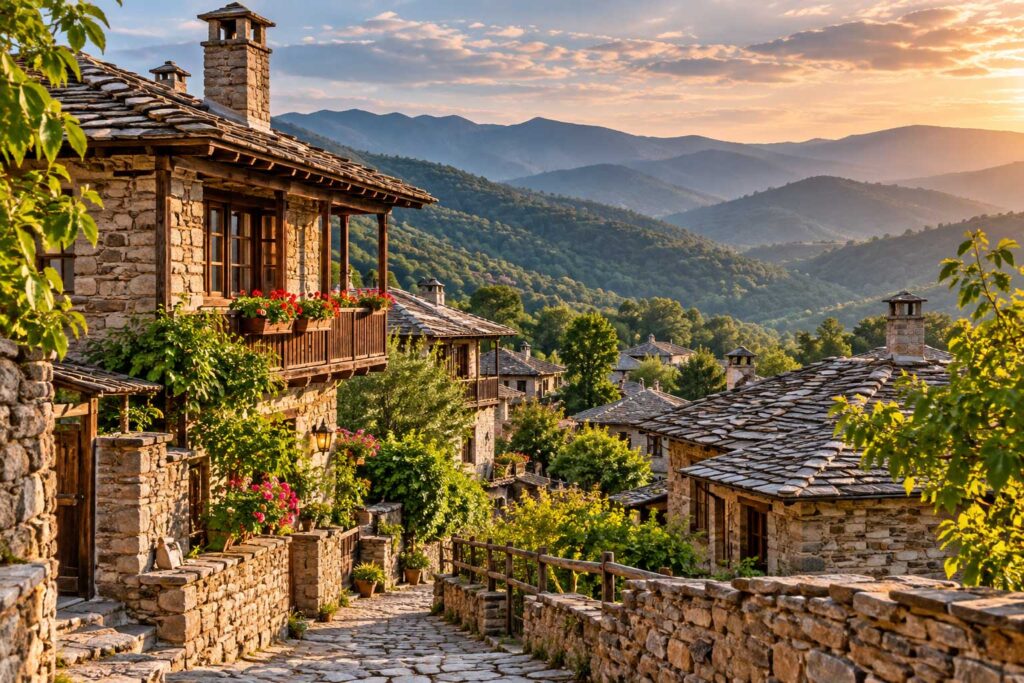
Only a short drive from Kovachevitsa, Leshten offers another beautiful setting for village photography, but the atmosphere is noticeably different.
Set in the Western Rhodopes, around 15 kilometers from Gotse Delchev, the village is known for its restored Revival-era houses, cobbled lanes, stone walls, wooden balconies, and views toward the Pirin Mountains. Leshten’s combination of restored traditional houses and mountain scenery is also highlighted by Bulgaria’s official tourism portal.
What makes Leshten special is the way traditional houses and mountain scenery constantly overlap.
Why Leshten Is Great for Photography
Unlike villages built around one compact street, Leshten spreads across the hillside.
Houses appear at different heights, allowing rooftops, balconies, trees, stone walls, and distant mountains to fall naturally into layers. From one position you may be photographing a narrow cobbled lane; a few minutes later, you can be looking across rooftops toward Pirin.
Many traditional buildings combine white plaster with dark timber, stone foundations, wooden balconies, and heavy roofs. In softer light, those different materials create plenty of texture without making the scene feel visually crowded.
The mountain backdrop is what really separates Leshten from many other historic villages.
Rather than treating the landscape as something behind the village, try making it part of the photograph.
What to Photograph in Leshten
Start in the older lanes and resist the temptation to photograph every house straight from the front.
Look instead for several rooftops overlapping along the slope, a balcony partly hidden by a tree, or a narrow street disappearing between stone walls.
Then move higher.
From some parts of Leshten, the village begins to open toward the mountains. A longer focal length works particularly well here because it can visually bring the distant Pirin ridges closer to the rooftops.
These layered compositions often tell more about Leshten than a photograph of one building by itself.
Spring adds flowering fruit trees around the houses, while autumn introduces warm color into the surrounding vegetation. Even a few branches in the foreground can make an otherwise simple village view feel more complete.
Look for the Quiet Details
Leshten is also a place where small details are worth slowing down for.
A weathered wooden gate can be more interesting than an entire façade. A chimney rising above uneven roofs may create a cleaner composition than a wide panorama.
Watch for stacked firewood beneath balconies, worn stone steps, old shutters, flowers beside walls, wooden doors, traditional chimneys, and narrow footpaths slipping between houses.
These are the details that make the village feel lived in rather than simply preserved.
Best Time to Photograph Leshten
Early morning is best for quieter lanes and softer light, while late afternoon works beautifully when warm sunlight reaches the rooftops and Pirin fades into blue-gray layers behind the village.
Autumn adds rich color around the darker roofs and white façades, while winter simplifies the scene with snow, stone, timber, and chimneys.
3. Shiroka Laka – Bridges, Rhodope Houses and Mountain Streets
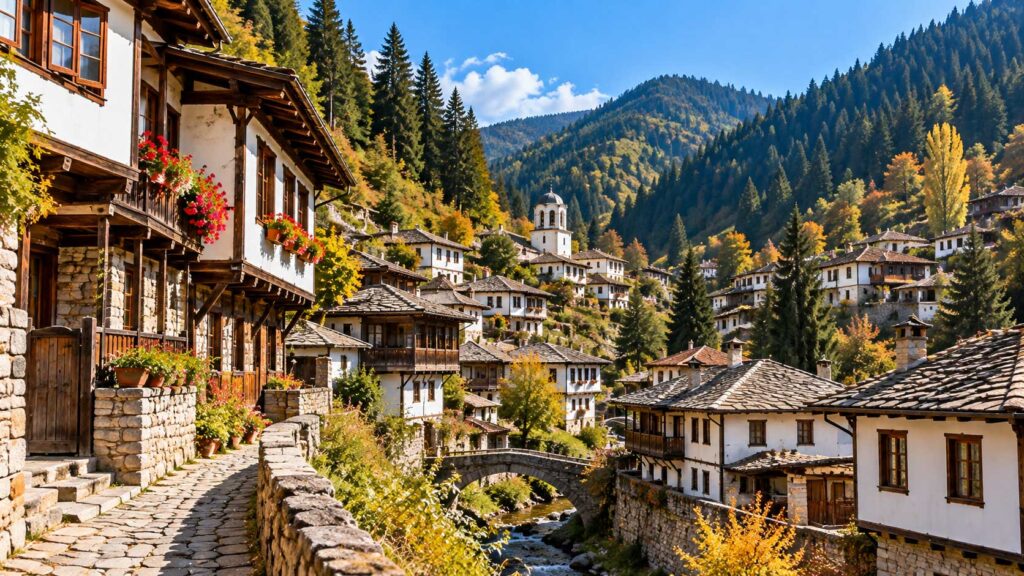
Shiroka Laka is one of the most recognizable villages in the Rhodope Mountains, and it offers a different photographic experience from both Kovachevitsa and Leshten.
The village stretches through a narrow mountain valley, with traditional whitewashed houses climbing the slopes above the road and river. Stone roofs, dark wooden details, cobbled lanes, bridges, and forested hills give almost every part of Shiroka Laka a strong sense of place.
Its traditional architecture is also recognized by Bulgaria’s official tourism portal, which includes Shiroka Laka among the country’s settlements known for Bulgarian Revival-period heritage.
One of Shiroka Laka’s strengths is how quickly the scenery changes within a relatively small area. You can move from close architectural details to elevated views over the rooftops without traveling far.
Why Shiroka Laka Is So Photogenic
Much of Shiroka Laka’s character comes from the way the houses follow the steep terrain.
Traditional Rhodope homes appear almost stacked above one another, with white façades contrasting against dark timber, stone foundations, and heavy roofs. The narrow valley keeps these layers close together, which makes them particularly effective in photographs.
Water and bridges add another element.
From the right position, you can use a bridge or the river as part of the foreground while traditional houses rise behind it toward the wooded slopes. These layered scenes are among the easiest ways to capture what makes Shiroka Laka visually different from other Bulgarian villages.
Best Photography Ideas in Shiroka Laka
Begin around the center, but do not stay only on the main street.
Follow the roads and paths beside the river and look for places where a bridge, water, houses, and mountains can fit naturally into the same composition.
Then start looking upward.
Because so many homes are built above street level, roofs, balconies, chimneys, stone walls, and stairways overlap from almost every angle. A house that looks ordinary from directly in front may become far more interesting when photographed from farther down the street with several rooftops layered behind it.
Smaller details are worth watching for too: a wooden balcony above a stone wall, an old doorway beneath a deep roof, smoke rising between houses, or a narrow lane climbing out of sight.
These quieter scenes often say more about Shiroka Laka than a single wide photograph.
Photograph the Village from Different Heights
One of the biggest advantages of photographing Shiroka Laka is the change in elevation.
Walk above the main road and the village begins to open beneath you.
From higher ground, clusters of white houses and dark roofs appear against the forested Rhodope slopes. A longer lens works particularly well here because it can compress several layers of rooftops and hills into a tighter frame.
Then return to street level.
Photographing the same village from both perspectives gives you two completely different stories: one showing how Shiroka Laka fits into the mountains, and another showing what it feels like to walk through its narrow streets.
Include Everyday Village Life
Shiroka Laka is not simply a preserved collection of historic buildings.
People still live here, and those everyday details can bring far more character to your photographs.
You may notice firewood stacked beside a house, smoke drifting from a chimney, a cat stretched across a stone wall, residents walking along the street, or someone talking with a neighbor outside a gate.
These moments help the village feel lived in rather than staged.
If someone is clearly going to be the main subject of a photograph, asking permission is always the more respectful approach.
Best Time to Photograph Shiroka Laka
Early morning is particularly good for street photography.
The village is quieter, the light is softer, and the shadows between buildings help bring out the depth of the narrow streets.
Late afternoon works well for broader views, especially when sunlight begins catching parts of the surrounding slopes while other sections of the village fall into shade.
Autumn brings yellow and orange into the forests above the rooftops, while winter may be the most dramatic season. Snow covering the stone roofs and surrounding hills emphasizes the contrast between white façades, dark timber, and the mountain landscape.
Spring offers something softer: greener hillsides, cooler light, and generally quieter streets.
Shiroka Laka is not a place where you need to chase one famous viewpoint.
Walk the bridges, climb the side streets, look back over the rooftops, and keep changing your position.
The village seems to rearrange itself every few meters, and that is exactly what makes it so rewarding to photograph.
For more on the village itself, see our complete guide to Shiroka Laka, its traditional houses, music, and Rhodope culture.
4. Zheravna – Wooden Revival Houses and Golden Mountain Light
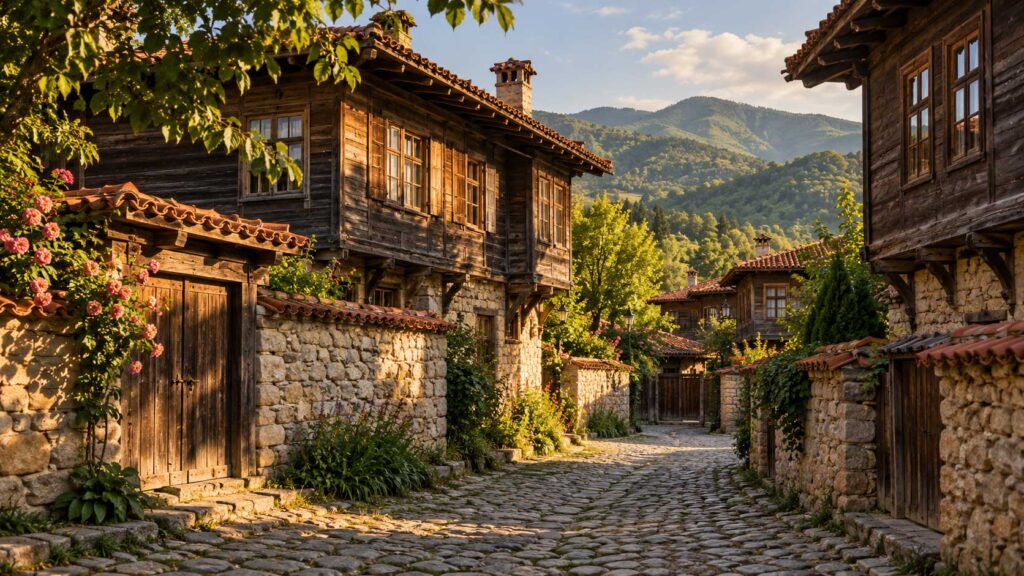
If Kovachevitsa is defined by stone, Zheravna is a village where wood takes center stage.
Set in the eastern Balkan Mountains, near Kotel, Zheravna is an architectural reserve known for its beautifully preserved Bulgarian National Revival houses. Dark timber façades, clay-tiled roofs, stone walls, enclosed courtyards, and cobbled lanes give the village a warmer and more intimate character than many of the Rhodope settlements.
Some of its historic houses date back several centuries, and their age is visible in the weathered wood, uneven foundations, deep overhanging floors, and heavy gates that line the old streets.
That weathered texture is a huge part of Zheravna’s appeal.
Why Zheravna Is Great for Photography
The wooden architecture immediately catches your attention, but what makes Zheravna especially rewarding is how naturally everything fits together.
Houses rarely stand alone.
A typical scene might include a cobbled lane curving past a stone wall, a dark wooden upper floor extending above the street, vines climbing across a balcony, and mature trees filling the space between rooftops.
Nothing feels overly arranged.
Wood, stone, clay tiles, gardens, and narrow streets share similar earthy tones, making even ordinary corners of the village surprisingly photogenic.
Photograph the Cobbled Streets
One of the best ways to experience Zheravna with a camera is simply to follow the old lanes without worrying too much about reaching a particular landmark.
Instead of standing directly in front of a historic house, move farther down the street and let the cobbles lead toward it.
Curving lanes work particularly well because they reveal only part of what is ahead. A wooden façade might appear beyond a stone wall, while the rest of the street disappears around a bend.
Vertical frames are useful when a narrow lane rises between tall houses. Wider compositions work better when several homes, trees, walls, and rooftops come together in the same scene.
And as you walk, keep looking back. The strongest view is not always the one directly ahead.
Look Closer at the Woodwork
Zheravna becomes even more interesting when you stop photographing entire buildings and start noticing individual details.
Weathered shutters, carved beams, heavy gates, wooden balconies, old doors, clay roof tiles, and rough stone foundations can all become subjects of their own.
The deep upper floors of some houses create strong areas of light and shadow. Rather than avoiding that contrast, use it.
A patch of sunlight hitting an old window or doorway can reveal the grain of the wood far better than completely even light.
These smaller photographs are also what distinguish Zheravna from other historic villages. The age of the timber, scratches on a gate, or faded color around a window can tell as much of the story as a wide street scene.
Use Gates, Walls and Trees as Natural Frames
Zheravna is particularly good for photographs that feel as though you are looking into the village rather than simply standing in front of it.
An open wooden gate may reveal part of a courtyard and house beyond it. Branches can frame a tiled roof, while a darker doorway or passage can draw attention toward a brighter scene behind it.
These layers give photographs more depth and often make them feel more intimate.
Many houses are still private homes, however, so stay on public lanes unless you have permission to enter a courtyard or property.
Best Time to Photograph Zheravna
Late afternoon suits Zheravna particularly well.
Warm light brings out the brown, amber, and reddish tones of old timber and clay roof tiles, while longer shadows add depth to the façades and cobbled streets.
Early morning offers a different mood, with quieter lanes and softer light before the village becomes busier.
Autumn may be the most photogenic season of all.
Yellow and orange leaves sit beautifully against the dark wooden houses, while fallen leaves across the cobbles add another layer of texture.
Winter changes the village completely. Snow simplifies the color palette and makes the dark timber, tiled roofs, stone walls, and bare branches stand out more strongly.
Zheravna is protected for its architectural heritage, but its appeal goes beyond individual historic houses.
It is the way the entire village comes together — wooden façades, cobbled lanes, old gates, gardens, shadows, and warm mountain light — that makes it such a rewarding place to photograph.
You rarely need to search very hard for a composition.
Sometimes turning down the next quiet lane is enough.
5. Bozhentsi – Quiet Lanes, Stone Roofs and Timeless Village Scenes
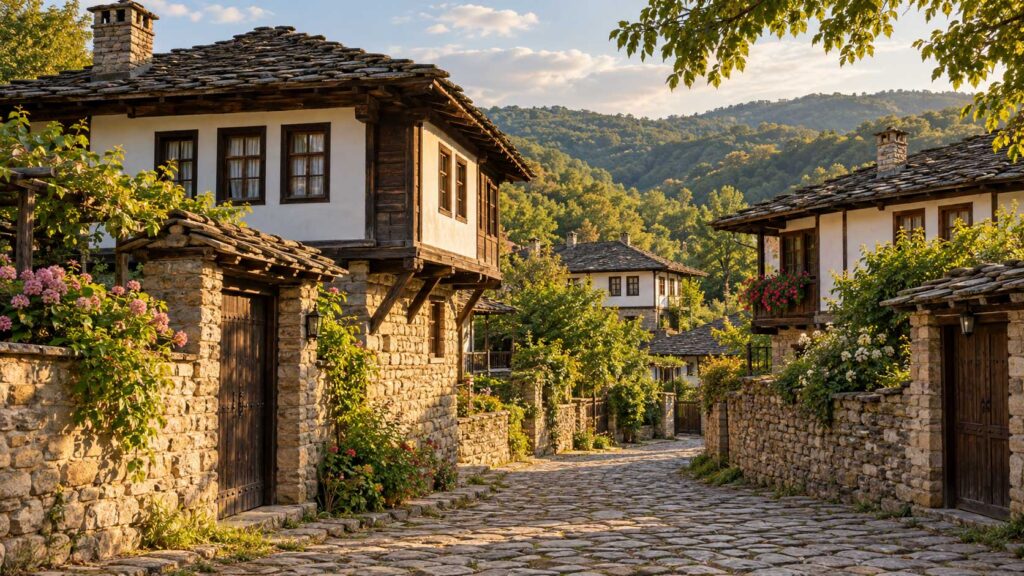
Bozhentsi feels almost made for slow photography.
Set in the Balkan Mountains near Gabrovo, the village is known for its preserved National Revival architecture, narrow cobbled lanes, whitewashed houses, wooden balconies, stone walls, and peaceful courtyards.
Compared with some of Bulgaria’s more dramatic mountain villages, Bozhentsi feels softer and more intimate.
There are no towering peaks dominating every view and no single viewpoint you need to chase. Its appeal is quieter: a curved lane, an old gate, a moss-covered roof, flowers beside a white wall, or the way several houses appear gradually between trees.
Bozhentsi rewards anyone willing to slow down and notice the smaller details.
Why Bozhentsi Is So Photogenic
The village has a remarkably consistent visual character.
White plaster, dark timber, stone paving, weathered roofs, wooden fences, and greenery repeat throughout the old streets, creating scenes that often feel balanced before you have even raised the camera.
Many lanes curve gently between houses and walls, so you rarely see everything at once.
A rooftop may appear above a garden wall. A wooden balcony might hang over part of the street. An old gate can briefly reveal a courtyard before the road disappears around another bend.
That gradual sense of discovery is one of Bozhentsi’s greatest photographic strengths.
Let the Streets Become the Subject
In Bozhentsi, the streets themselves can be just as interesting as the historic houses.
Look for cobbled lanes leading toward a doorway, climbing between buildings, or vanishing behind a stone wall.
Try lowering the camera slightly so the uneven paving becomes part of the foreground. The texture of the cobbles can lead the eye naturally deeper into the frame.
A wooden fence, overhanging balcony, flowering branch, or old wall can add enough detail to turn an otherwise simple street into a much stronger composition.
You do not always need to show the whole village.
Sometimes one empty lane says more about Bozhentsi than the widest possible view.
Build the Photograph in Layers
Bozhentsi works particularly well when you look for several layers within the same frame.
A stone wall or wooden gate can sit in the foreground, a traditional house farther back, and trees or hills behind it.
These small separations create depth and make the scene feel more immersive.
Doorways and gates are especially useful.
An open gate may reveal only part of a courtyard and house beyond it, while a darker doorway can frame a patch of sunlight or greenery in the distance.
Rather than removing these obstacles from the photograph, use them to create the feeling that you are discovering the village gradually.
Notice the Small Details
Some of the most memorable images in Bozhentsi may come from things you would barely notice if you were walking quickly.
Look at the old wooden shutters and handmade fences. Notice stone steps worn smooth over time, flowers growing beside whitewashed walls, moss gathering along roof tiles, and shadows stretching across the cobbled lanes.
Traditional fountains, wooden balconies, gates, chimneys, and small courtyard details can all become photographs on their own.
These quieter images are useful because they show what makes Bozhentsi different without relying on another full view of a historic house.
Best Time to Photograph Bozhentsi
Early morning suits Bozhentsi especially well, when the lanes are quiet and soft light brings out the textures of stone, timber, and whitewashed walls.
Autumn adds warmth around the houses, while snow gives the village an almost monochrome quality in winter, with dark beams, gates, and stone walls standing out against the white streets and rooftops.
6. Arbanasi – Historic Houses, Churches and Wide Views Near Veliko Tarnovo
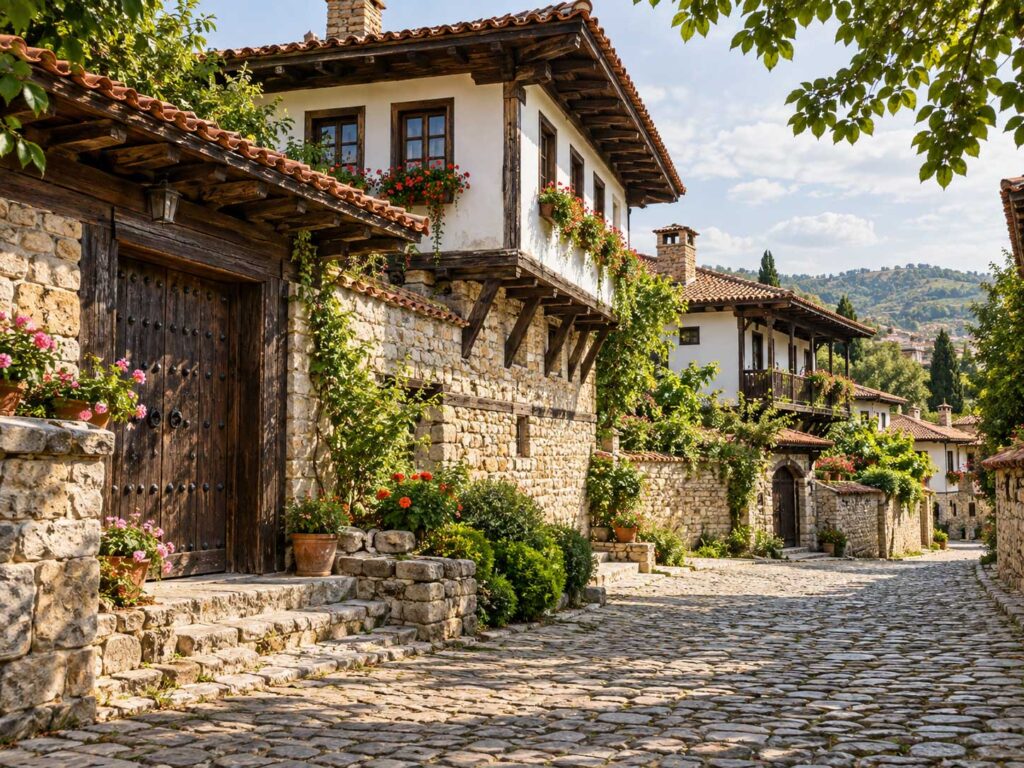
Arbanasi is one of the easiest historic villages to add to a trip around Veliko Tarnovo, but it deserves more than a quick stop between attractions.
Set on a plateau only a few kilometers from the old Bulgarian capital, the village is known for its fortified-looking houses, high stone walls, enclosed courtyards, historic churches, monasteries, and red-tiled roofs.
Arbanasi feels noticeably different from the mountain villages earlier in this guide.
Instead of seeing entire houses immediately, you often catch only fragments: a roof above a wall, a wooden upper floor behind a gate, a church dome between trees, or a glimpse into a shaded courtyard.
That sense of partial discovery is a big part of what makes the village interesting.
Why Arbanasi Is Different
Traditional homes in Arbanasi were built with privacy and protection in mind, and many are hidden behind substantial stone walls.
That changes the way you approach photography.
Rather than always looking for a clean, unobstructed view of a building, use those walls as part of the composition.
A rough stone surface in the foreground can lead toward an old gate. A tiled roof appearing above the wall can create a simpler, more graphic image. Trees rising from a courtyard can hint at what lies beyond without revealing everything.
The combination of pale stone, dark timber, red roof tiles, and mature greenery gives Arbanasi a warmer palette than many Rhodope villages.
Explore the Quieter Lanes
Some of the best photographs are found away from the busiest visitor areas.
Walk into the smaller streets and look for lanes bordered by stone walls, traditional houses rising behind them, and paths curving gently out of sight.
Arbanasi works particularly well when you allow the architecture to reveal itself gradually.
Instead of placing a house directly in the center of the frame, let a wall, road, gate, or shadow guide the eye toward it.
Even a simple lane can become a strong photograph when the textures of stone, wood, and roof tiles begin to overlap.
Photograph the Historic Churches
Arbanasi is especially interesting if you enjoy photographing religious architecture.
The best-known example is the Church of the Nativity, famous for the extensive frescoes covering much of its interior.
The Regional Museum of History in Veliko Tarnovo describes it as the earliest and most richly decorated church in Arbanasi, with wall paintings dating back to the late 16th century.
From the outside, the building is comparatively restrained. Inside, the visual experience changes completely, with walls and ceilings filled with religious scenes and painted details.
That contrast gives photographers two very different subjects within the same place.
If interior photography is permitted when you visit, work carefully in the lower light and avoid flash unless it is explicitly allowed. Photography rules can change, so check before shooting inside churches or using a tripod.
Let the Walls Work for You
The high stone walls are one of Arbanasi’s defining features, so there is little reason to photograph around them.
Use them.
An open gate can frame part of a courtyard. A roof appearing just above a wall can create a clean composition. Shadows from trees and buildings can introduce strong shapes during brighter parts of the day.
You can also wait for someone to walk through the scene.
A single person moving along a long stone wall gives the photograph scale and breaks up an otherwise static architectural composition.
Look Beyond the Village Streets
Arbanasi’s elevated position gives you another advantage: broader views across the surrounding countryside.
From parts of the village and nearby roads, the landscape opens toward Veliko Tarnovo and the hills beyond.
These scenes can be especially effective in hazy morning or evening light, when distant ridges appear as softer layers.
A longer lens works well here because it can visually bring those hills closer together and isolate smaller sections of the landscape.
It also gives you a completely different type of photograph from the enclosed streets and courtyards inside the village.
Best Time to Photograph Arbanasi
Early morning is the easiest time to photograph Arbanasi, with quieter streets and softer light around the stone walls and historic houses.
Late afternoon adds warmth to the roofs and courtyards, while spring and autumn bring the most color to the surrounding gardens and trees.
If you are exploring this part of central Bulgaria, our guide to the best villages near Veliko Tarnovo can help you connect several historic places into the same trip.
7. Koprivshtitsa – Colorful Revival Houses and Cobbled Streets
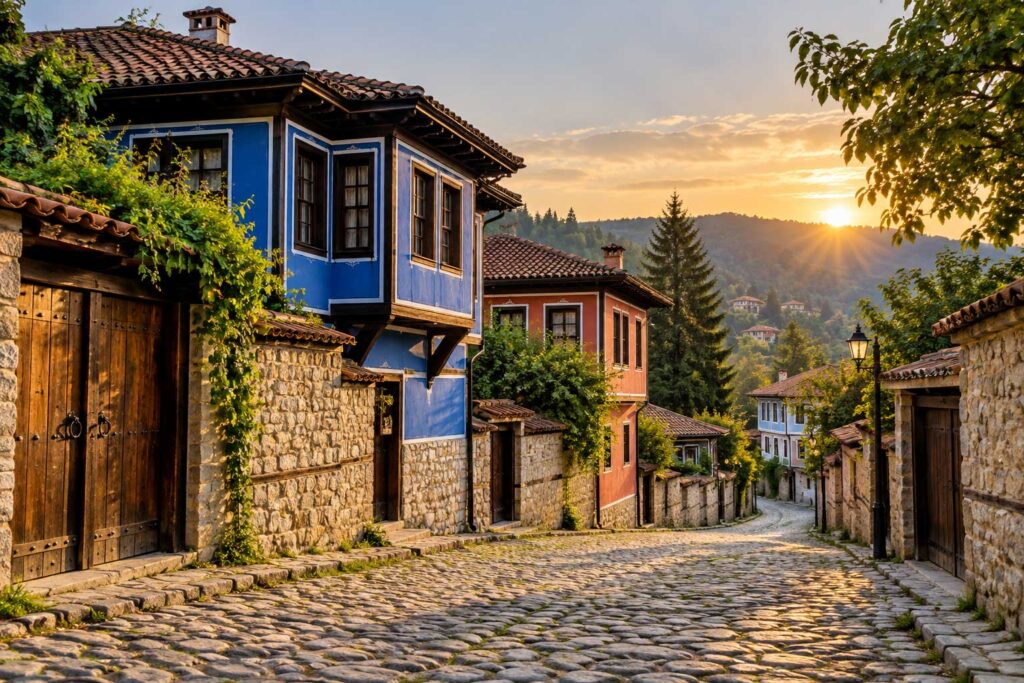
If you want more color in your photography, Koprivshtitsa is one of the best places in Bulgaria to find it.
Technically a small town rather than a village, Koprivshtitsa fits naturally into this guide because its historic center still feels intimate and remarkably well preserved. Set in the Sredna Gora mountains, it is famous for its Bulgarian Revival architecture, cobbled streets, stone bridges, old courtyards, and brightly painted houses.
Compared with settlements dominated by gray stone and dark timber, Koprivshtitsa immediately feels different.
Blue, yellow, ochre, red, and pale pink façades appear between stone walls and wooden gates, often softened by flowers, fruit trees, and leafy gardens.
That combination makes Koprivshtitsa one of the most visually varied historic places in Bulgaria.
Why Koprivshtitsa Is So Photogenic
Color is the obvious attraction, but it works because of everything surrounding it.
Bright façades are balanced by dark wooden beams, weathered gates, gray stone walls, and uneven cobblestones. Nothing feels excessively polished, and the older streets still provide enough texture to keep photographs from looking overly decorative.
You can photograph an entire row of colorful houses and then turn your attention to a single painted window, carved gate, shadow across a wall, or balcony filled with flowers.
The small bridges and waterways running through parts of town add yet another visual element, particularly when the surrounding houses appear behind them.
Photograph the Historic Houses
Several of Koprivshtitsa’s best-known Revival houses now operate as museums, and their exteriors are among the most recognizable architectural scenes in town.
But avoid treating them only as isolated landmarks.
Step farther back and include part of the street, courtyard wall, gate, garden, or neighboring building. These surroundings help show how the houses fit into Koprivshtitsa rather than making them look like individual museum pieces.
Partial sunlight can work especially well.
A brightly painted façade emerging from shadow often has more depth than one photographed under completely even light, while wooden details become much more noticeable where light and shade meet.
Let the Cobbled Streets Lead You
Koprivshtitsa’s streets are almost as photogenic as its houses.
The uneven cobblestones bring texture into the foreground, while gently curving lanes naturally pull the eye toward colorful façades farther ahead.
Try photographing from slightly lower than eye level so more of the street enters the frame.
On quieter lanes, even a single person walking away from the camera can add scale and make the scene feel lived in rather than perfectly arranged.
And do not worry about keeping every line perfectly straight.
The slight irregularity of the streets and old buildings is part of the town’s character.
Use the Bridges and Water
The small stone bridges offer a welcome change from architectural photographs.
Instead of making the bridge the entire subject, use it to connect different layers of the scene.
You might place water or vegetation in the foreground, the bridge in the middle distance, and several colorful houses behind it.
After rain, wet stones and occasional reflections can add even more color.
Autumn is especially good for these scenes, when fallen yellow and orange leaves gather around the water and along the cobbled banks.
Look Beyond the Bright Façades
It is easy to become focused entirely on color, but some of Koprivshtitsa’s best details are much subtler.
Look for carved wooden windows, old iron hardware, faded gates, traditional roof tiles, worn stone steps, painted trim, chimneys, and flowers growing beside rough walls.
Sometimes the most effective photograph may contain only two or three colors rather than the entire rainbow of façades around town.
Those smaller details also help build a more complete visual story of Koprivshtitsa instead of returning home with dozens of similar wide shots.
Best Time to Photograph Koprivshtitsa
Early morning is ideal for quieter streets and clean architectural scenes before more visitors arrive.
Late afternoon brings warmer light to the already colorful façades and can make yellow, orange, and red houses appear especially rich.
Spring adds blossoms and fresh greenery around the courtyards, while summer gives you long evenings for wandering through the old streets.
Autumn may be the most visually dramatic season.
Golden leaves mix naturally with the painted houses, stone walls, and surrounding Sredna Gora landscape.
Winter creates almost the opposite effect. Snow removes much of the surrounding color and allows the bright façades to stand out even more strongly against white streets and rooftops.
Koprivshtitsa is one of the easiest places in this guide to spend an entire day photographing without feeling that you are repeating yourself.
One street may be about color, the next about architecture, and another about bridges, gardens, or tiny details.
That variety is what makes Koprivshtitsa one of Bulgaria’s most rewarding places to explore with a camera.
8. Delchevo – A Hillside Village with Sweeping Mountain Views
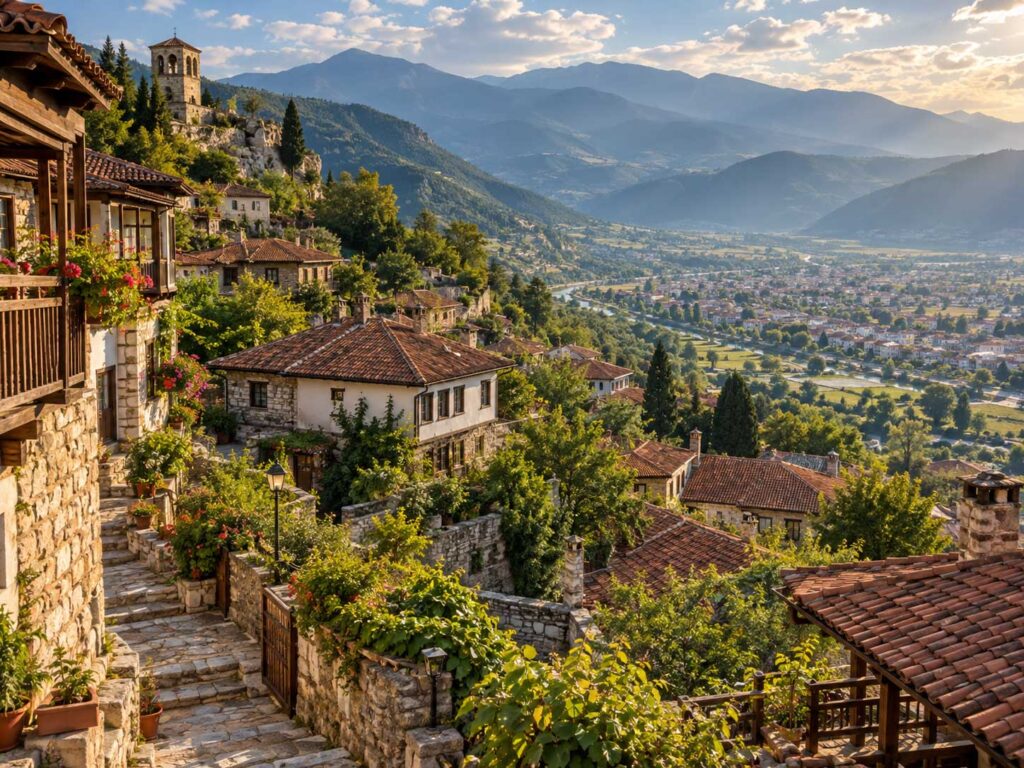
High above Gotse Delchev, on the southern slopes of the Pirin Mountains, Delchevo offers a completely different kind of village photography.
Its biggest advantage is elevation.
The village climbs along the mountainside, with traditional houses appearing one above another and broad views opening across the valley toward the Rhodopes and the area around Gotse Delchev.
Delchevo is also known for its preserved 18th- and 19th-century houses, narrow cobbled streets, stone foundations, wooden upper floors, and buildings recognized as cultural monuments.
That combination of old architecture and enormous surrounding landscape is what makes Delchevo memorable.
Why Delchevo Is So Photogenic
Almost nothing in Delchevo feels flat.
Walk uphill and houses rise sharply above the road. Turn around a few minutes later and the ground seems to disappear beneath you, revealing rooftops, fields, distant hills, and layers of mountains beyond.
That constantly changing perspective gives you far more variety than you might expect from a relatively small village.
One photograph can focus entirely on a wooden balcony and stone wall. Another, taken only a short distance away, can show half the village scattered across the slope with mountains stretching across the horizon.
The architecture adds plenty of texture too: whitewashed walls, wooden balconies, stone lower floors, tiled and stone roofs, grapevines, courtyards, old gates, and uneven steps all work naturally with the surrounding landscape.
Photograph the Village Against the Mountains
A longer lens is especially useful in Delchevo.
Instead of trying to squeeze the entire panorama into one wide photograph, isolate several rooftops or houses and place the distant mountains behind them.
The longer focal length visually pulls those background ridges closer, making the village appear more tightly connected to the landscape.
Look for simple compositions.
A few rooftops beneath a large mountain backdrop can often communicate the scale and location of Delchevo better than a frame filled with every house you can see.
Haze can actually help here.
Several fading layers of hills in the distance create depth and give the landscape a softer, almost painted appearance.
Follow the Steep Lanes
Once you move between the houses, the photography changes completely.
Some streets climb steeply enough that the buildings seem stacked above one another. Photograph uphill and the lane itself naturally leads toward balconies, roofs, and houses higher on the slope.
Then turn around.
Looking downhill often reveals fragments of the valley through gaps between buildings, giving you the chance to combine an intimate village foreground with a much wider landscape behind it.
Watch for grapevines hanging over walls, worn stone steps, wooden gates, stacked firewood, chimneys, flowers on balconies, and small courtyards.
These foreground details can transform an ordinary mountain view into something that feels unmistakably connected to Delchevo.
Look Beyond the Historic Architecture
Delchevo is still a living village, and not every worthwhile photograph needs to feature a preserved house.
Gardens, tools leaning against walls, laundry drying outside, outdoor tables, stacked wood, animals around doorways, and residents moving through the streets can add another layer to the story.
These details help show how the village actually feels rather than presenting it only as a collection of old buildings.
As always, if someone is clearly the main subject of your photograph, asking permission is the respectful approach.
Best Time to Photograph Delchevo
Late afternoon is particularly rewarding.
As the sun drops lower, light and shadow begin moving across the surrounding slopes, revealing the shape of the valley much more clearly.
Do not leave as soon as the village falls into shade.
The distant mountains may continue catching warm light for several minutes, creating a beautiful contrast between cooler rooftops in the foreground and brighter ridges beyond.
Early morning offers something different.
When haze or mist settles below the village, rooftops can appear above softer layers of atmosphere, especially from the higher streets.
Autumn is one of the strongest seasons for photography in Delchevo, when yellow, orange, and red foliage begins surrounding the traditional houses.
Spring brings a greener and softer landscape, while winter can simplify the entire scene with snow and muted colors.
Delchevo does not have the instant recognition of Koprivshtitsa or Shiroka Laka, and that is part of what makes it enjoyable to photograph.
There is no single image everyone arrives trying to recreate.
You can climb, wander, look back across the rooftops, and discover your own relationship between the village and the mountains around it.
In Delchevo, the view changes almost every time the road changes height.
9. Dolen – Stone Houses and a Less-Visited Rhodope Village
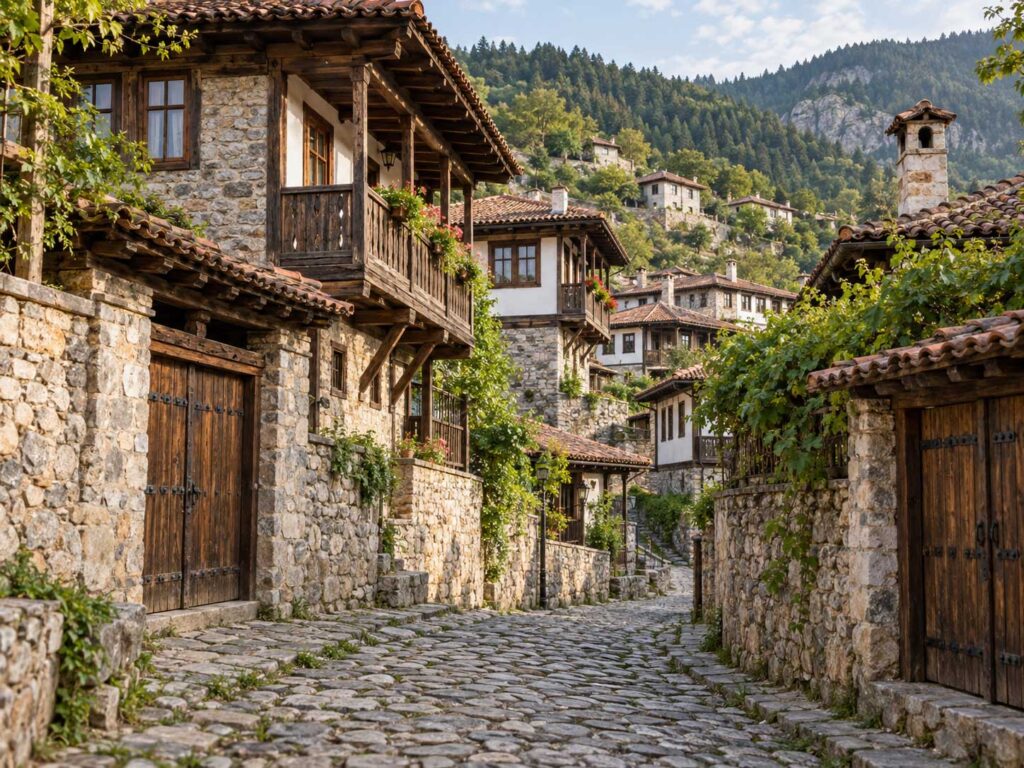
Dolen is one of the best choices for photographers who want the atmosphere of an old Rhodope village without the same level of recognition as Kovachevitsa or Shiroka Laka.
Set in the Western Rhodopes, Dolen is an architectural reserve known for its stone-and-wood houses, narrow cobbled streets, white façades, small windows, wooden balconies, and heavy stone-slab roofs. The Bulgarian Ministry of Tourism also highlights the village for its preserved character and numerous houses recognized as cultural monuments.
Dolen is also connected with an important living cultural tradition: UNESCO inscribed the Visoko multipart singing of Dolen and Satovcha on its Representative List of the Intangible Cultural Heritage of Humanity in 2021.
That quieter reputation is part of the appeal.
Dolen feels less like a place built around famous viewpoints and more like a village you discover slowly, one lane at a time.
Why Dolen Is So Photogenic
Texture is everywhere.
Rough stone walls sit beneath white upper floors. Dark wooden balconies extend over narrow streets. Heavy roofs overlap one another, while vines and greenery soften walls, courtyards, and gates.
The architecture is unmistakably Rhodopean, but Dolen has a slightly rougher and more irregular feel than some better-known villages.
That works beautifully in photographs.
A turn in the road may reveal several houses at different heights, with a stone wall in the foreground and rooftops stepping away behind it. The village rarely feels perfectly ordered, and that is exactly what gives it character.
Make the Stone Roofs Part of the Story
One of Dolen’s most distinctive features is its traditional roofing.
Many old houses are covered with thick stone slabs rather than modern tiles, creating rooftops with uneven edges, deep texture, and muted gray tones.
From a slightly higher viewpoint, these roofs can become the photograph.
Instead of isolating one building, look for several overlapping together. Chimneys, trees, white walls, and dark timber break up the repeated stone surfaces and create patterns that are almost abstract from above.
These wider roofscape photographs are some of the best ways to show Dolen’s architectural character without relying on a single landmark.
Explore the Narrow Streets
At street level, the village feels much more enclosed.
Some lanes are narrow enough that houses rise immediately on both sides, making a wide-angle lens useful for showing how closely the buildings sit together.
Look for cobbled streets that bend or disappear behind a wall.
Wooden balconies above the lane, rough retaining walls, small windows, worn stone stairways, old gates, vines, chimneys, and even grass growing between the cobbles can all become part of the frame.
None of these details needs to be dramatic on its own.
Together, they create the unmistakable feeling of Dolen.
Step Back and Photograph the Whole Village
After spending time between the houses, find a position where you can look across more of the settlement.
From higher ground, the stone roofs begin to blend together, with the church tower, trees, and wooded Rhodope slopes rising behind them.
This wider view helps explain what close street photographs cannot: how naturally Dolen sits inside the surrounding landscape.
There is no sharp visual break between village and countryside.
Roofs, gardens, trees, walls, and hills gradually merge into one another.
Cloudy Weather Can Be Better Than Sunshine
Dolen does not need perfect blue skies.
In fact, overcast weather may suit it better.
Soft light reduces the contrast between white façades and dark timber, while damp conditions deepen the tones of stone roofs and cobbled streets.
After rain, the paving can become darker and slightly reflective, adding another layer of texture.
These conditions often create a moodier and more authentic photograph than harsh midday sun.
Best Time to Photograph Dolen
Early morning is ideal for quieter streets and softer light.
It is also easier to preserve detail in both pale walls and darker wooden sections before stronger sunlight reaches the village.
Late afternoon works well for broader views, particularly when individual roofs begin catching warm light while neighboring houses remain in shade.
Spring brings fresh green vegetation against the gray stone architecture.
Autumn adds warmer tones to the surrounding hills, while winter creates perhaps the strongest contrast of all: dark timber, gray stone, white walls, and snow-covered roofs.
Dolen is a good reminder that the best Bulgarian villages for photography are not always the most famous.
Sometimes the absence of one iconic viewpoint is exactly what makes a place more rewarding.
You are free to wander, notice the smaller details, and come away with photographs that feel more personal than familiar.
10. Brashlyan – Traditional Strandzha Architecture and Forest Atmosphere
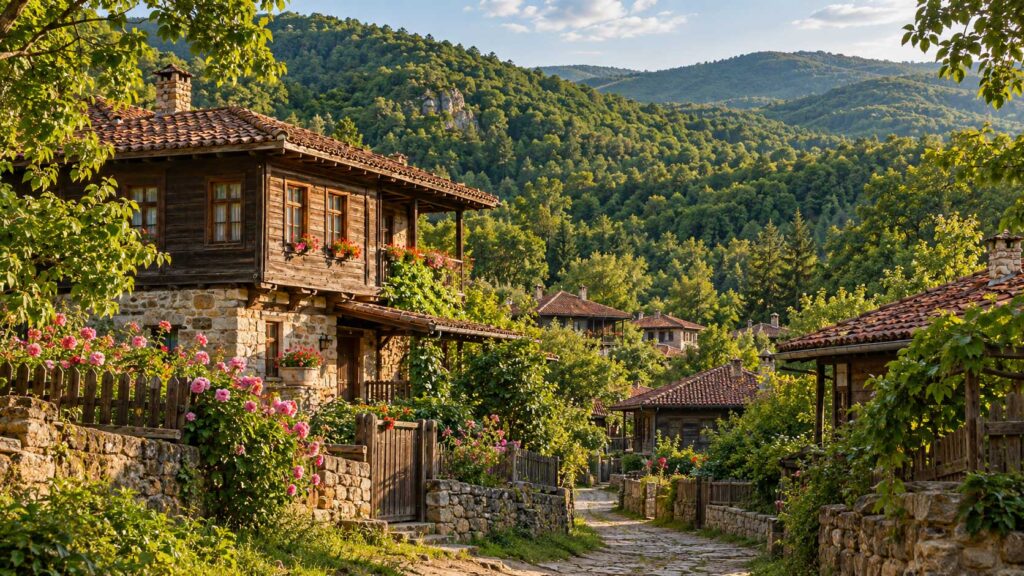
For a completely different photographic mood, head south toward Brashlyan in the Strandzha Mountains.
This small village feels far removed from Bulgaria’s better-known Revival towns. Instead of broad mountain panoramas or brightly painted façades, Brashlyan is defined by stone foundations, dark timber, tiled roofs, narrow lanes, orchards, wooden fences, and the dense Strandzha forest pressing in around the settlement.
The atmosphere is quieter and slightly more mysterious.
Brashlyan works especially well if you are drawn to rural details, soft light, old architecture, and places that seem to blend into the surrounding landscape.
Why Brashlyan Is So Photogenic
Brashlyan is not built around one famous house or viewpoint.
Its strength is the village as a whole.
Traditional homes sit among gardens, fruit trees, stone walls, and patches of woodland, while the surrounding forest is rarely far from view.
That makes nature part of almost every photograph.
In spring and early summer, fresh leaves can partly hide houses behind layers of green. By autumn, the same streets take on warmer shades of yellow, brown, and orange.
Even ordinary corners can become atmospheric when architecture and vegetation begin to overlap.
Focus on the Traditional Houses
Many older homes combine stone lower floors with timber-framed upper levels, giving Brashlyan a darker and more rustic architectural character than villages dominated by white plaster.
Look closely at the materials.
Weathered beams, uneven walls, tiled roofs, small windows, old gates, and rough stonework all reveal the age of the buildings.
Do not feel that you need a completely unobstructed view.
A house partly hidden behind a fruit tree can be more interesting than one photographed directly from the front. Branches, leaves, fences, and garden walls help show how naturally these homes sit within the landscape.
Follow the Village Lanes
Brashlyan’s streets suit slow photography.
Look for lanes bordered by wooden fences and low stone walls, especially where the road bends beneath trees or disappears behind a house.
These scenes often work because they leave part of the village unseen.
A road vanishing into shade creates curiosity, while tall trees above it help emphasize how enclosed Brashlyan can feel.
Including a little grass, stone, or road in the foreground can also pull the viewer deeper into the scene without making the composition feel forced.
Notice the Everyday Details
Some of Brashlyan’s strongest photographs may come from things that are easy to overlook.
Stacked firewood beside a wall, an old cart near a shed, a garden gate leaning slightly out of line, moss gathering along roof tiles, or smoke rising above a house can tell you far more about village life than a perfectly framed façade.
Fruit trees, wells, traditional fences, worn tools, fountains, vegetable gardens, and small farm buildings all add to that sense of place.
These details make Brashlyan feel lived in rather than preserved only for visitors.
Let the Weather Set the Mood
Brashlyan does not need bright sunshine.
Cloudy weather may actually suit it better.
Soft light brings out detail in dark timber and pale plaster without creating harsh contrast, while damp stone and roads often appear richer after rain.
Fog or low mist in the Strandzha forest can transform the village completely.
A tiled roof disappearing behind wet branches or a quiet road fading into mist can feel far more memorable than the same scene under a clear midday sky.
If you like darker, more atmospheric rural scenes, imperfect weather can actually work in your favor here.
Best Time to Photograph Brashlyan
Spring brings fresh greenery, flowering gardens, and softer colors.
Summer makes the village feel almost enclosed by foliage, although early morning and late afternoon are usually easier for photography than the brighter middle of the day.
Autumn may be the most atmospheric season, when the Strandzha forest begins turning yellow, ochre, and brown around the houses.
Winter strips away much of the greenery and reveals more of the architecture. After snowfall, dark timber, bare trees, fences, and tiled roofs stand out against a much simpler landscape.
Early morning works particularly well in almost any season.
The lanes are quiet, the light is gentle, and the village feels even more removed from the busier parts of Bulgaria.
Brashlyan belongs on this list for a different reason than most of the other villages.
There are no enormous mountain peaks competing for attention and no brightly painted houses demanding to be photographed.
Instead, the appeal is subtler.
An old fence, a weathered house, a shaded lane, and the deep Strandzha forest can be enough to create the entire photograph.
Strandzha is particularly good for travelers who enjoy places well outside the usual tourist circuit, and several more appear in our guide to 12 hidden villages in Bulgaria most tourists miss.
11. Melnik – Sandstone Pyramids, Historic Houses and Dramatic Streets
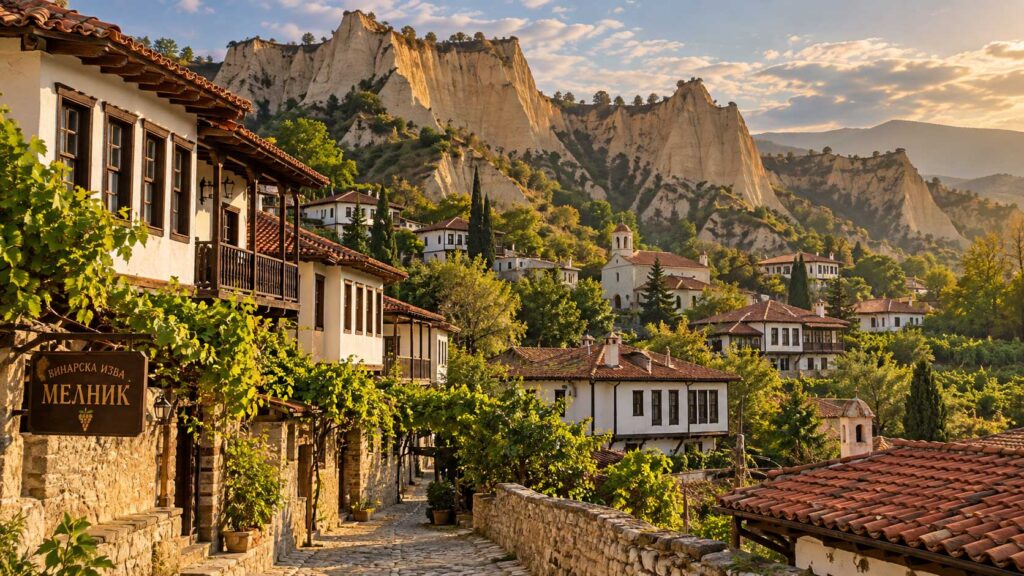
Melnik is technically a town rather than a village, but it absolutely belongs in a guide to Bulgaria’s most photogenic historic settlements.
Set at the southwestern edge of the Pirin Mountains, Melnik combines traditional Bulgarian architecture with one of the most unusual landscapes in the country: the pale Melnik sandstone pyramids rising behind the rooftops.
The Bulgarian Ministry of Tourism describes Melnik as the country’s smallest town and highlights both its historic houses and distinctive sandstone formations.
That relationship between the town and its unusual landscape is what makes Melnik so memorable.
Why Melnik Is So Good for Photography
Very few places in Bulgaria combine architecture and geology so dramatically.
Whitewashed houses, dark wooden balconies, stone foundations, and red-tiled roofs sit beneath steep pale cliffs carved into ridges and narrow formations.
From the right angle, the sandstone appears to rise almost directly from behind the houses.
That contrast makes photographs unmistakably Melnik.
You can spend part of the day working with narrow streets and architectural details, then walk a short distance and suddenly find yourself photographing a landscape that looks completely different from the rest of Bulgaria.
Photograph the Houses Against the Sandstone
One of the strongest ways to photograph Melnik is to combine both sides of its identity in the same frame.
Look for positions where traditional houses sit below the sandstone formations rather than photographing each subject separately.
A slightly longer focal length can work especially well.
It visually pulls the cliffs closer to the rooftops, making the town appear almost enclosed by the surrounding terrain.
The colors also work naturally together: pale sandstone, reddish roofs, white façades, and dark timber create enough contrast without making the photograph feel overly busy.
Leave the Main Street Behind
Melnik’s central street offers plenty of obvious subjects, but some of the best viewpoints appear once you begin climbing away from it.
Follow the narrower lanes toward the higher parts of town.
As you gain elevation, rooftops begin appearing below you and the sandstone formations become more dominant. From these positions, it is much easier to understand how tightly Melnik sits inside its unusual landscape.
Turn around often as you walk.
A view that seemed ordinary from below may become much stronger once several rooftops, walls, and cliffs begin overlapping behind you.
Look Closer at the Architecture
The sandstone may dominate the wider views, but Melnik is also worth photographing at a much smaller scale.
Weathered wooden balconies, red clay tiles, stone foundations, courtyard entrances, old doors, traditional windows, vines, and uneven plaster all reveal another side of the town.
Narrow passages between buildings can work particularly well because they naturally frame brighter sections of the street beyond.
Rather than trying to photograph every historic house in full, look for combinations of texture and color.
A dark wooden balcony above a pale wall or vines crossing weathered plaster can sometimes create a stronger image than the entire building.
Bring the Vineyards Into the Story
Wine is closely connected with Melnik and the surrounding region, and vineyards add another layer to the landscape.
Rows of vines can create strong lines through the foreground, especially when the sandstone hills or mountains appear behind them.
This becomes particularly effective in autumn.
As the vineyards change color, their warmer yellows and reds begin to echo the tones of tiled roofs and sunlit sandstone.
Photographing the vineyards also helps move the visual story beyond the historic center and show how Melnik fits into the wider landscape around it.
Save Time for the Sandstone Pyramids
The formations deserve more than a quick photograph from town.
In strong midday light, the pale rock can appear relatively flat. As the sun drops lower, shadows begin revealing the ridges, gullies, and irregular shapes much more clearly.
Late afternoon is especially effective.
Wide photographs can show the scale of the formations, while a longer lens lets you isolate individual pinnacles, deep shadows, scattered trees, and patterns in the rock.
Some of these tighter compositions can feel almost abstract.
Best Time to Photograph Melnik
Late afternoon and golden hour are difficult to beat.
Warmer light works beautifully with the sandstone, red roofs, timber details, and vineyards, while lower sun creates much stronger relief across the cliffs.
Early morning is better for quieter street photography before the center becomes busier.
Spring brings fresh green vegetation against the pale rock, while autumn may offer the richest overall palette, particularly when the vineyards begin changing color.
Winter creates a much more subdued Melnik, with bare vines, quieter streets, and occasional snow bringing stronger contrast to the surrounding formations.
Melnik is also one of the places where carrying both a wider and a longer lens genuinely pays off.
A wider view helps inside the narrow streets. A telephoto lens becomes far more useful once you begin combining rooftops, vineyards, cliffs, and distant ridges.
Most historic Bulgarian settlements give you architecture first and landscape second.
Melnik gives you both at once.
Turn toward the streets and you have old Bulgaria. Turn toward the hills and the scenery suddenly looks almost otherworldly.
12. Gela – Rhodope Meadows, Mountain Peaks and Traditional Village Life
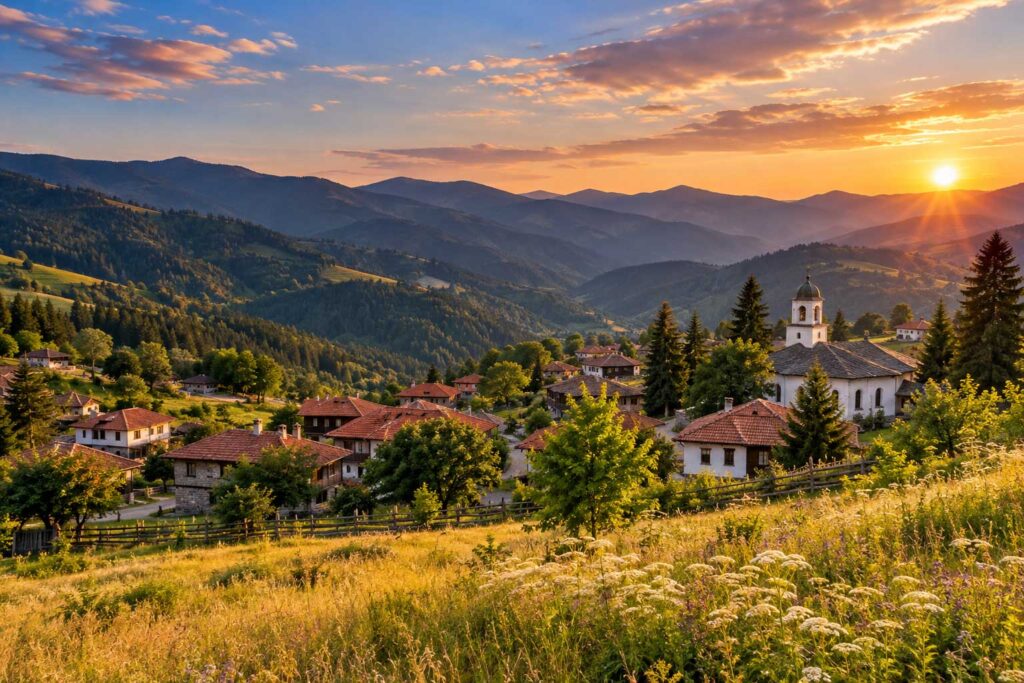
If you want to step away from tightly packed historic streets and photograph Bulgaria’s mountain landscape on a much larger scale, Gela is one of the strongest villages in this guide.
Set high in the Rhodope Mountains, only a few kilometers from Shiroka Laka, Gela spreads across open slopes surrounded by broad meadows, pine forests, scattered houses, and distant ridges.
According to Smolyan Municipality, the village sits at roughly 1,400–1,500 meters above sea level, beneath Karlak and Orpheus peaks.
Gela feels completely different from Kovachevitsa, Zheravna, or Bozhentsi.
Here, the focus shifts from old façades and narrow lanes to entire hillsides, isolated houses, grazing animals, forests, changing weather, and enormous stretches of mountain sky.
Why Gela Is So Photogenic
Gela has space.
The village is scattered across the landscape rather than compressed into one compact historic center. Houses appear between open fields and meadows, while dark forests and layers of Rhodope ridges rise behind them.
That openness changes the way you photograph the village.
Instead of trying to fit buildings tightly into the frame, you can let them become small elements within a much larger landscape.
A single house surrounded by grass may be enough.
A barn beneath a forested ridge, a church against the mountains, or a few rooftops scattered across a hillside can communicate Gela’s character better than a photograph packed with detail.
Photograph Gela in Layers
Some of the strongest views come from slightly higher ground.
Look across the settlement rather than concentrating on individual houses.
A longer lens can isolate a small group of buildings and visually bring the distant hills closer, creating natural layers of meadow, village, forest, and mountains.
These compressed landscapes work particularly well when haze separates one ridge from another.
You do not always need perfectly clear weather.
A little atmosphere in the distance can actually give the photograph much more depth.
Let the Meadows Fill the Foreground
Gela’s open meadows are one of its greatest photographic advantages.
Instead of pointing the camera directly toward the mountains, give the foreground some room.
A footpath through the grass, an old fence, a solitary tree, hay drying in a field, wildflowers, or grazing animals can lead the eye naturally into the wider landscape.
In spring and early summer, the grass can be intensely green.
Later in the season, the same fields shift toward warmer yellow and golden tones, completely changing the character of the photograph.
Watch the Weather Move Across the Mountains
Mountain weather is part of photographing Gela.
Clouds can move quickly across the Rhodopes, casting large patches of light and shadow over the hills.
One slope may be brightly illuminated while another disappears into shade.
After rain, mist sometimes settles between the ridges or drifts through the forest, simplifying the landscape and making individual houses or trees stand out more clearly.
Do not automatically put the camera away when the sky turns gray.
In Gela, changing weather can produce some of the best conditions of the day.
Look for Small Scenes in a Huge Landscape
Not every photograph needs to show the entire mountain range.
A small house alone in a meadow can say just as much about Gela.
So can a shepherd crossing an open field, horses beneath a distant ridge, hay beside an old barn, smoke rising from a chimney, a pine tree emerging from morning fog, or wildflowers growing beside a quiet village road.
These simple scenes work because there is room around them.
They communicate the scale, openness, and quietness of the Rhodopes without trying to include everything at once.
Stay for the Evening Light
Gela is particularly rewarding late in the day because so much of the landscape remains open to the sky.
As the sun drops lower, the terrain begins to reveal itself through alternating areas of warm light and deep shadow.
Meadows glow briefly. Forests become darker. Individual ridges separate from one another.
Stay after sunset too.
During blue hour, the landscape becomes cooler and quieter, with dark mountain silhouettes surrounding small pockets of light from houses below.
The mood is completely different from golden hour but can be just as beautiful.
Best Seasons for Photography in Gela
Spring is ideal for vivid green meadows, fresh foliage, and flowering trees.
Summer brings long days and the fullest mountain landscape.
Autumn introduces warmer tones into the grass and forests, making it excellent for wider scenes.
Winter may be the most dramatic season of all.
Once snow covers the open fields, individual houses, fences, trees, tracks, and forest edges become much easier to isolate against the white landscape.
Gela’s greatest strength is that photography does not stop when you leave the village streets.
The meadows, forests, walking routes, ridges, and surrounding mountains are all part of the same visual story.
You can begin the morning among the houses, spend the day exploring the slopes, and finish with the Rhodopes stretching across the horizon in the last light.
In Gela, the village is only part of the photograph. The landscape around it is the real stage.
13. Kosti – Wooden Houses and the Deep Strandzha Forest
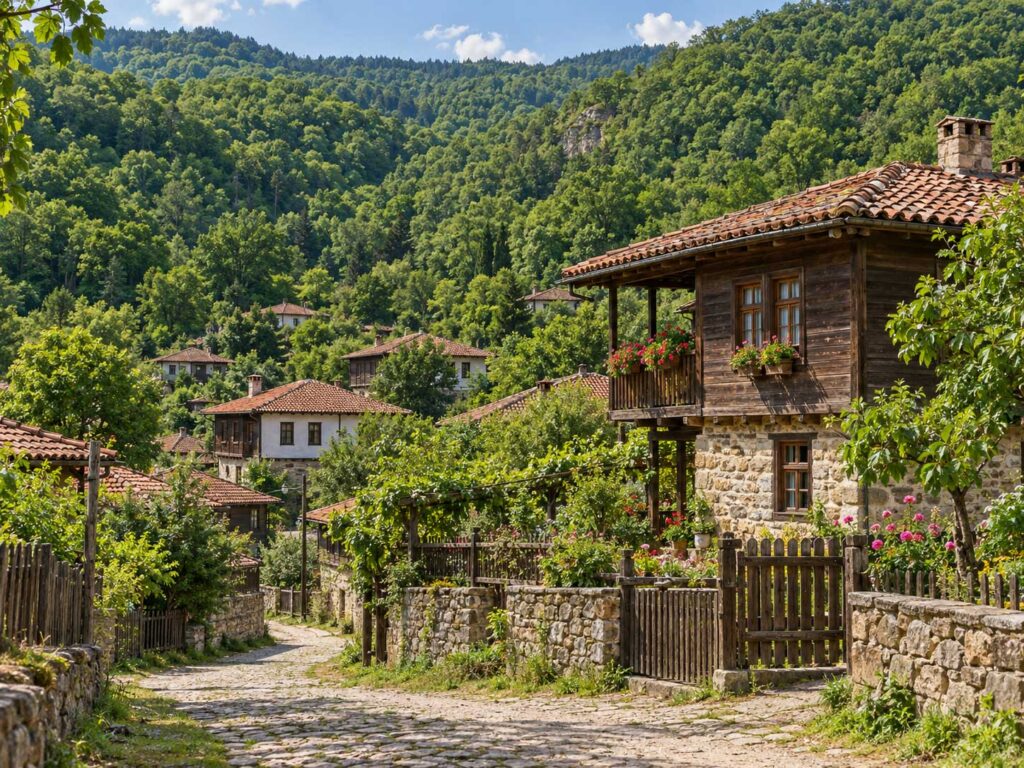
Kosti feels worlds away from Bulgaria’s better-known mountain villages.
Hidden deep in Strandzha, close to the Veleka River and surrounded by dense forest, the village is especially interesting for photographers drawn to old wooden houses, rural details, quiet streets, and landscapes that seem almost swallowed by nature.
Several surviving homes preserve an architectural style once characteristic of the Greek villages of this part of Strandzha, and Strandzha Nature Park describes them as large two-story houses with agricultural spaces below and upper floors clad in thick oak boards.
Only a limited number of these traditional houses remain, which makes them some of the most distinctive subjects in Kosti.
Why Kosti Is So Photogenic
Kosti does not have the polished appearance of a heavily restored architectural reserve.
That is part of its strength.
Old houses sit among vegetable gardens, fruit trees, sheds, fences, and thick vegetation. Timber has darkened with age, roofs are weathered, and the surrounding forest is rarely far from view.
Nothing feels overly arranged.
Those imperfections are a big part of Kosti’s character.
The village also feels inseparable from the landscape around it. Trees lean into streets, vegetation grows around walls and outbuildings, and wooded hills rise behind the rooftops.
Look for the Old Wooden Houses
The surviving traditional houses should be among your main subjects.
Their heavy oak construction gives them a darker and rougher appearance than the whitewashed Revival houses seen elsewhere in Bulgaria.
Rather than concentrating only on entire buildings, look closely at how the materials meet.
The grain of old timber, worn shutters, deep eaves, rough stone lower floors, red-tiled roofs, faded gates, and vines creeping around walls can all become photographs of their own.
Some of the older houses were built with very few openings, another unusual feature connected with this local architectural tradition.
These details are what make Kosti visually different from almost every other place in this guide.
Photograph the Village Inside the Forest
One of Kosti’s greatest strengths is the way the settlement blends into Strandzha Nature Park.
Walk toward the edges of the village and look back.
Red roofs begin to disappear among layers of trees, while wooded hills fill much of the background.
The architecture becomes only one part of the composition rather than dominating it.
A longer lens works well here because it can isolate several rooftops against the forest and compress the different layers of trees behind them.
The result feels much less like a conventional village photograph and much more like a settlement hidden inside the landscape.
Bring the Veleka River Into the Story
The wider area around Kosti gives you even more to work with.
The Veleka River and surrounding forest landscapes add a completely different mood from the village streets.
If you are creating a fuller photography story, move beyond the houses.
Begin with timber architecture and rural details, then continue toward river vegetation, forest roads, shaded clearings, and rolling Strandzha hills.
That progression helps show Kosti as more than a collection of traditional buildings.
It places the village within one of Bulgaria’s wildest and greenest regions.
Photograph the Church
The Church of Saints Cyril and Methodius offers a useful contrast to the darker wooden architecture.
Its lighter façade, tiled roof, and bell tower stand out more clearly, especially when framed by trees or nearby houses.
Instead of photographing it only straight from the front, step farther back and let branches, gates, or surrounding rooftops enter the frame.
This helps the church feel like part of the village rather than an isolated landmark.
Let the Forest Frame the Scene
Kosti is particularly good for using the landscape itself as a natural frame.
Tree branches can surround a house.
Leaves may partly hide a roof.
A darker area of forest can frame a brighter building or patch of road.
Rather than seeing the vegetation as something blocking the photograph, use it to reinforce what makes the village special.
Kosti feels as though it exists inside the forest, not simply beside it.
Best Time to Photograph Kosti
Spring brings some of the richest greens, especially after rain.
Summer makes the vegetation dense and the streets deeply shaded, so early morning and late afternoon usually produce the most manageable light.
Autumn may be the most atmospheric season.
Yellow, orange, and brown leaves begin surrounding the dark wooden houses and red roofs, while misty mornings can make the forest feel even more enclosed.
Wet roads, dark timber, low fog, and disappearing trees can create a mood that would be difficult to reproduce under a bright blue sky.
Winter strips away much of the foliage and reveals more of the village structure, allowing the old houses, fences, and roofs to stand out more clearly.
Kosti is unlikely to give you the perfectly arranged postcard streets of Koprivshtitsa.
That is exactly why it belongs among the best Bulgarian villages for photography.
Its appeal is more raw: aged timber, quiet homes, deep forest, river landscapes, and a village slowly blending into the wild surroundings of Strandzha.
If you prefer atmosphere over perfection, Kosti may be one of the most memorable places on the entire route.
14. Balgari – Fire-Dancing Traditions and Strandzha Village Life
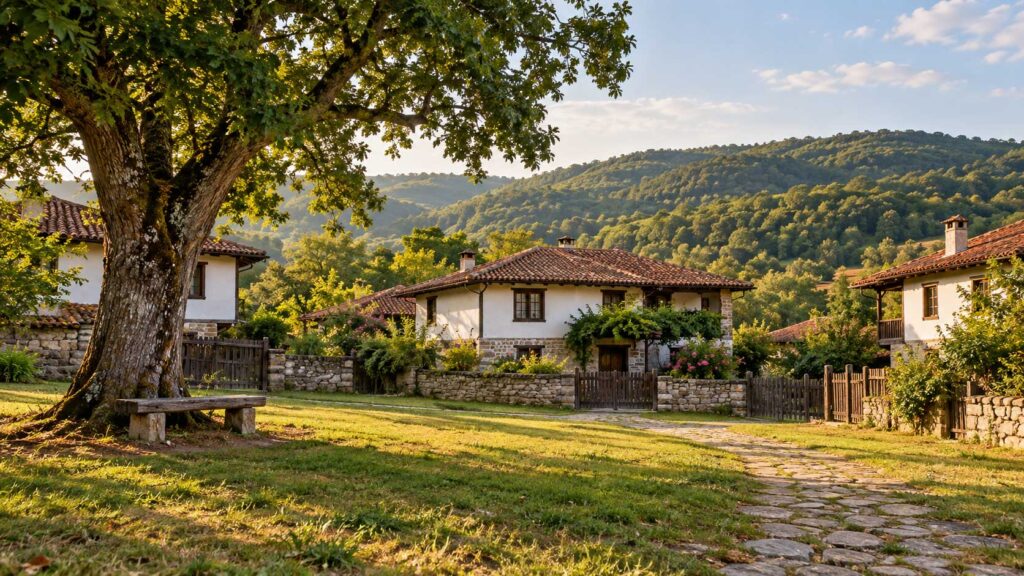
Few Bulgarian villages give photographers the chance to document rural life, traditional clothing, music, religious ritual, and one of the country’s most distinctive living traditions in the same place.
Deep in the Strandzha Mountains, Balgari is closely associated with Nestinarstvo, the traditional fire-dancing ritual connected with the annual celebration of Saints Constantine and Helena.
UNESCO inscribed Nestinarstvo on the Representative List of the Intangible Cultural Heritage of Humanity in 2009. The traditional Panagyr in the village takes place on June 3 and 4, with religious ceremonies, sacred icons, music, a procession, and an evening fire dance over glowing embers.
Balgari offers something completely different from every other place in this guide.
Why Balgari Is Different for Photographers
Most of the places on this list are primarily about architecture or landscape.
Balgari adds living cultural tradition.
On an ordinary morning, it can feel like a quiet Strandzha village surrounded by forest, with tiled roofs, gardens, wooden fences, and almost empty streets.
During the Panagyr, the atmosphere changes completely.
Residents, musicians, participants, and visitors gather as the rituals unfold through the village, eventually leading toward the fire-dancing ceremony after dark.
Those two sides of Balgari create very different photographic stories.
Visit at another time of year and the focus may be rural life and Strandzha atmosphere. Visit during the celebration and people, movement, music, faith, and tradition become central to the photographs.
Photograph the Village Before the Ceremony
If you come for Nestinarstvo, do not wait until nightfall to begin photographing.
Walk through Balgari earlier in the day.
Look for old houses, tiled roofs, garden gates, wooden fences, fruit trees, quiet streets, and the forest surrounding the village.
These calmer scenes establish where the ritual takes place.
Later, when musicians, icons, crowds, smoke, and fire enter the story, those daytime photographs provide valuable contrast.
They also help you document Balgari as a real village rather than reducing it to one famous evening tradition.
Photograph the Whole Nestinarstvo Tradition
The fire walking is visually spectacular, but it is only one part of Nestinarstvo.
UNESCO describes the fire dance as the culmination of a broader ritual involving sacred icons, religious ceremonies, a procession to a holy spring, drum and bagpipe music, and the gathering around the embers.
Following that larger sequence can tell a much stronger story than concentrating only on bare feet crossing the embers.
Watch for the icons being carried through the village, musicians accompanying the procession, traditional clothing, people gathering, hands holding religious objects, expressions in the crowd, and smoke beginning to rise as daylight fades.
Those quieter moments explain what is happening around the fire.
Capturing the Fire Dance
Photographing the actual fire walking can be challenging because the scene contains two extremes: very bright embers surrounded by deep darkness.
If your camera allows manual exposure control, pay attention to the highlights in the fire rather than trying to brighten the entire scene.
Allowing parts of the background to remain dark can actually strengthen the photograph.
The glowing embers, illuminated faces, traditional clothing, smoke, and surrounding night already create natural drama.
A faster shutter speed can freeze a dancer crossing the coals, while a slightly slower exposure can introduce movement into clothing, feet, smoke, or sparks.
Neither approach is automatically better.
They simply tell the moment differently.
Look Beyond the Fire
Some of the most memorable photographs may happen just before or after someone steps onto the embers.
A musician waiting at the edge of the gathering, a participant holding an icon, smoke drifting through the crowd, someone standing quietly in traditional clothing, or faces illuminated by the fire can sometimes communicate more than the obvious action shot.
Watch the edges of the scene.
Look at hands, expressions, instruments, icons, shadows, and the people observing what is happening.
This is where documentary photography becomes more interesting.
Instead of photographing only the event, you begin photographing the atmosphere surrounding it.
Photograph the Ritual Respectfully
Nestinarstvo is not simply an evening show staged for visitors.
It is a living cultural and religious tradition closely connected with the identity of Strandzha. UNESCO describes it as an important expression of the region’s cultural heritage, incorporating ritual, music, dance, clothing, and community participation.
That makes photographic etiquette especially important.
Do not block processions or step into spaces participants need to use. Follow instructions from organizers or local authorities, and avoid flash when it is prohibited or likely to interfere with the ceremony.
If you want to make a close portrait of someone outside the public ritual, ask permission.
The goal should be to document what is happening without interrupting it.
Photograph Balgari on an Ordinary Day Too
Balgari is still worth visiting even when there are no glowing embers in the village square.
Outside the celebration, its quieter Strandzha identity returns.
Old homes, gardens, tiled roofs, forest roads, wooden fences, and everyday village details become the main subjects.
Like Kosti and Brashlyan, Balgari can look particularly good under softer light.
A cloudy morning, mist between the trees, or damp streets after rain often suits the village better than harsh midday sun.
Without the crowds of the Panagyr, you can also spend more time noticing the relationship between the settlement and the forest surrounding it.
Best Time to Photograph Balgari
If your main goal is documenting Nestinarstvo, the traditional Panagyr on June 3 and 4 is the most significant time to visit. UNESCO specifically identifies those dates with the celebration in Balgari.
Because access, schedules, crowd arrangements, and photography restrictions can change, check current local information before planning your visit around the ceremony.
For ordinary village and landscape photography, spring brings deep Strandzha greens, while autumn adds yellow, orange, and brown to the surrounding forest.
Early mornings are especially good for quieter streets and softer light.
But when the village gathers after dark and the fire is reduced to a circle of glowing embers, Balgari becomes something completely different from the other places in this guide.
You are no longer photographing only a picturesque Bulgarian village.
You are documenting a living Strandzha tradition that has survived through generations — and that makes Balgari one of the most extraordinary places for cultural photography in Bulgaria.
15. Shiroki Dol – Quiet Rural Scenes and Rila Mountain Views
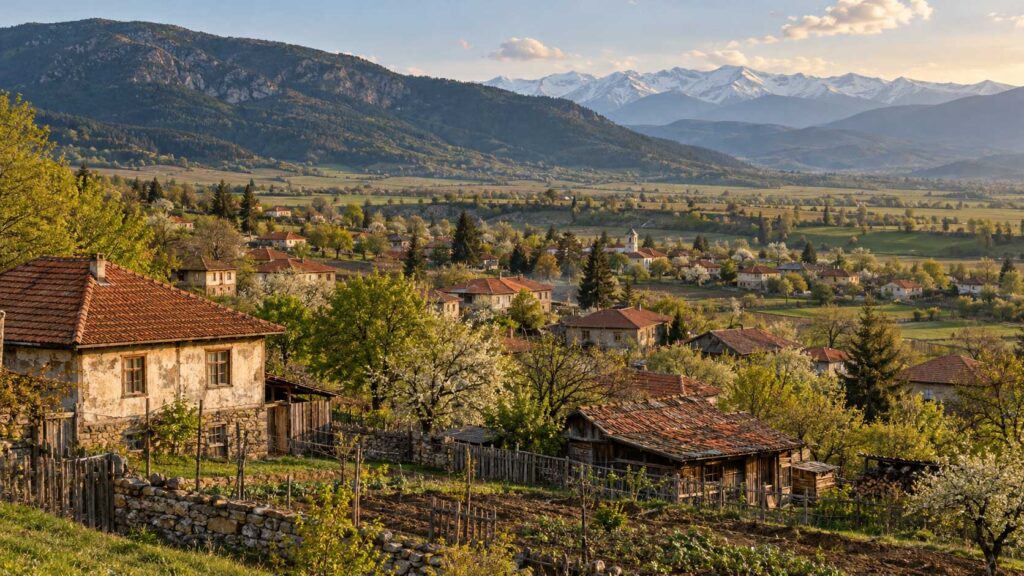
Shiroki Dol is not the kind of Bulgarian village where every street is lined with perfectly restored Revival houses.
That is exactly why it can be so interesting to photograph.
Located near Samokov at the foot of Plana Mountain, Shiroki Dol sits at roughly 870 meters above sea level and opens toward broad views of the Rila Mountains. According to the Tourist Information Center of Samokov, the village is about 8 kilometers from Samokov.
Shiroki Dol feels far less curated than Bulgaria’s better-known architectural villages.
Here, photography is about ordinary rural life: red-tiled roofs, gardens, vegetable plots, quiet roads, old fences, fields, farm buildings, and the enormous presence of Rila in the distance.
Why Shiroki Dol Is Interesting for Photography
The landscape is the biggest reason to bring a camera.
Rather than photographing one famous building, you are looking for the relationship between the village and the mountains around it.
A few rooftops beneath a distant snowy ridge can be more effective than a close photograph of an individual house.
Fields and gardens create space around the buildings, while the mountains give even simple village scenes a sense of scale.
Shiroki Dol is especially good for quieter, documentary-style images rather than obvious postcard views.
Explore the Older Part of the Village
The older part of Shiroki Dol spreads through the valley around the local waterways and feels particularly suited to slower exploration.
Do not focus only on individual houses.
Look at how narrow roads curve between gardens, how red roofs appear behind fruit trees, and how barns, fences, fields, and distant hills overlap in the same frame.
A weathered house beside an orchard may not seem dramatic at first.
But add a strip of mountain in the distance, a rough wooden fence in the foreground, and soft morning light, and the scene begins to say much more about rural Bulgaria.
Put Rila Behind the Village
One of the strongest photographs you can make here is also one of the simplest.
Find a position slightly above the village and look back toward the houses with Rila rising behind them.
A moderate telephoto lens works particularly well.
Instead of showing an enormous amount of sky and empty foreground, it visually pulls the mountain range closer to the rooftops and compresses the landscape into several clear layers:
fields → village → foothills → Rila.
When the higher peaks are covered with snow, the contrast becomes even stronger.
Small houses and barns in the foreground suddenly emphasize just how large the mountains are.
Photograph Everyday Village Life
Shiroki Dol is especially rewarding if you enjoy photographing scenes that most visitors would normally pass without noticing.
A tractor moving slowly along a road, someone tending a garden, chickens near a fence, laundry drying beside a house, stacks of firewood, smoke from a chimney, or a dog sleeping near a gate can all become part of the story.
These are ordinary parts of village life, and that is precisely what makes them worth noticing.
They show a version of Bulgaria that is easy to miss when traveling quickly between famous monasteries, historic towns, and mountain resorts.
If a person becomes the clear subject of your photograph, ask permission whenever possible.
Follow the Village Toward the Fields
Shiroki Dol often becomes more interesting photographically near its edges.
As the houses thin out, gardens begin giving way to fields, barns, trees, and open views.
This transition between village and countryside creates some of the cleanest compositions.
A single barn beneath a mountain ridge can work beautifully.
So can a solitary tree beside a road, a fence crossing an open field, or several rooftops appearing at the bottom of a much larger landscape.
Waterways around the village can add another element, especially where bridges, riverbank vegetation, or reflections break up the surrounding fields.
Look for Rural Details
Shiroki Dol is also worth photographing up close.
Weathered fences, garden tools, orchard trees, hay, old sheds, tiled roofs, woodpiles, worn gates, and vegetable gardens can all help build a more complete picture of the village.
These smaller subjects work especially well when combined with one wider mountain view.
Together, they show both sides of Shiroki Dol: everyday life on the ground and the dramatic landscape surrounding it.
Best Time to Photograph Shiroki Dol
Early morning is particularly good.
Roads are quieter, the light is softer, and haze may create several layers between the village and distant Rila.
Late afternoon works well for broader views, especially when warm sunlight begins touching the fields and rooftops while the mountains remain cooler in the distance.
Spring brings green fields, blossoms, and fresh vegetation.
Summer offers long evenings and active gardens.
Autumn introduces warmer colors around orchards and surrounding hills.
Winter may be the most dramatic season, especially when snow covers the higher Rila peaks while the village below remains partly visible.
Shiroki Dol is not the place to visit if your only goal is perfectly preserved historic architecture.
Visit it for something different.
It gives you everyday Bulgarian village life set against one of the country’s most impressive mountain backdrops.
And sometimes those ordinary places — without famous viewpoints or postcard streets — produce the photographs that feel the most personal.
How to Photograph Bulgarian Villages: Practical Tips for Better Photos
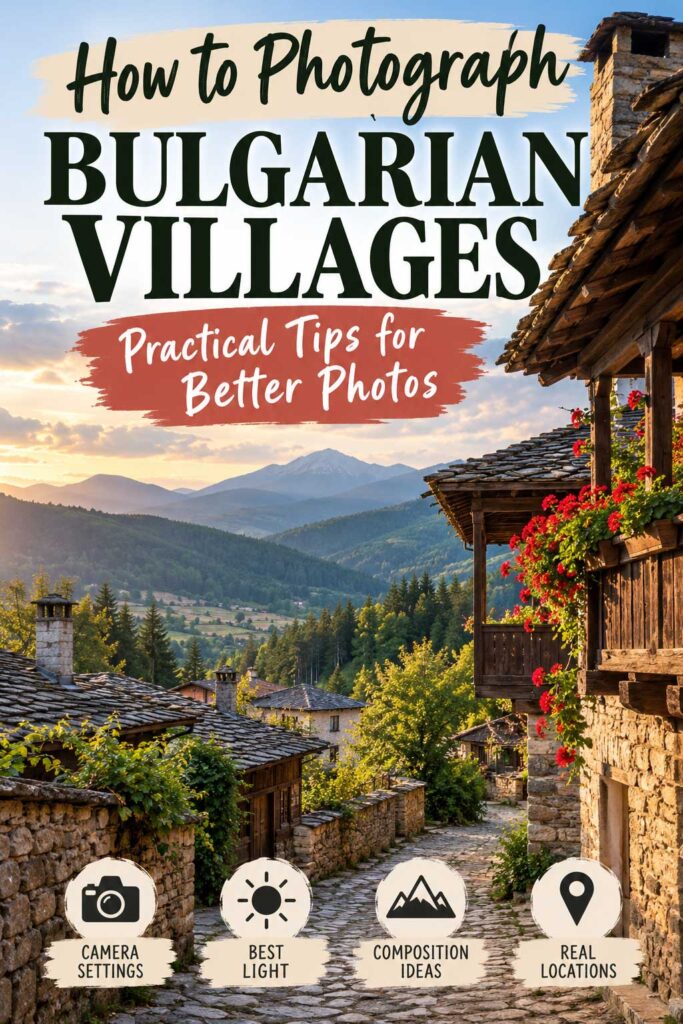
Photographing Bulgarian villages is rarely about finding one perfect viewpoint.
The biggest advantage you can give yourself is time.
Walk the same street in both directions. Look behind you. Climb a little higher when the terrain allows it. Stop at the edge of the village and look back toward the rooftops. Pay attention to details that were easy to miss when you first arrived.
Many of the best photographs appear only after you stop trying to find them quickly.
Visit Early or Stay Late
Early morning is usually the easiest time for quieter streets, softer light, and occasional mist around mountain villages.
Late afternoon brings warmer tones to timber, stone, tiled roofs, and surrounding hills. It is also when the shape of the landscape often becomes more visible as light and shadow move across the slopes.
Midday can be harsher, especially in summer, but it is not useless. Narrow lanes, shaded courtyards, churches, architectural details, and interiors can all work well when the sun is high.
Go Beyond the Famous View
There is nothing wrong with photographing the classic scene you came to see, but do not stop there. Once you have it, keep walking and see what else the village reveals.
The image you remember most may be a wooden gate half hidden by vines, laundry moving above a quiet lane, smoke rising between rooftops, flowers beside an old doorway, or someone working in a garden.
Look for the small signs of everyday life as well as the historic architecture.
Those details are often what turn a collection of attractive photographs into a story about a place.
Let the Streets Guide the Composition
Cobbled lanes are one of the most useful features of Bulgarian village photography.
A road curving between houses naturally pulls the eye deeper into the frame, while steep streets can emphasize the way mountain settlements climb across the landscape.
Try photographing from slightly lower down when the paving itself is interesting.
Vertical frames often work well in narrow lanes, while wider compositions are useful when architecture begins opening toward mountains, forests, or fields.
Use What Is Already Around You
Old villages are full of natural frames.
A gate can reveal part of a courtyard. Branches can surround a tiled roof. A doorway can create a darker foreground around a brighter street beyond it.
Stone walls, windows, arches, fences, and shadows can all help build depth into a photograph.
Instead of constantly trying to remove things from the frame, ask whether they can become part of it.
Photograph People With Respect
A person walking along an old street can add scale, movement, and a sense of life to a photograph.
But these villages are communities, not outdoor photography sets.
If someone is clearly the main subject of a portrait, ask permission whenever possible. Be especially considerate around homes, churches, religious ceremonies, and local traditions.
A respectful photograph will almost always tell a better story than an intrusive one.
Bring a Longer Lens for the Mountains
Wide-angle lenses are useful inside narrow streets, but they are not always the best choice for mountain villages.
In places such as Gela, Delchevo, Leshten, and Shiroki Dol, a longer focal length can pull distant ridges visually closer to rooftops and houses.
This creates layers of village, forest, hills, and mountains within the same frame.
It can also help isolate chimneys, balconies, roofs, church towers, and small sections of a larger landscape.
Don’t Wait for Perfect Weather
Blue skies are not always the most interesting conditions.
Clouds soften harsh contrast. Rain deepens the colors of stone and timber. Wet cobbles reflect light. Fog can hide part of a mountain or forest and completely change the mood of a village.
Snow simplifies everything.
Dark beams, red roofs, stone walls, bare trees, and church towers become much more noticeable once the landscape turns white.
Some of the most atmospheric village photographs happen when the weather is slightly uncomfortable.
Return in Another Season
The same Bulgarian village can feel like a completely different place several months later.
Spring brings fruit blossoms, wildflowers, green fields, and fresh leaves.
Summer offers long evenings, active gardens, and mountain landscapes at their fullest.
Autumn is one of the most rewarding seasons, particularly in the Rhodopes, Balkan Mountains, and Strandzha, where warm forest colors begin surrounding the villages.
Winter strips the landscape back to its simplest shapes and colors.
If you have the opportunity to return, photographing the same place twice can be far more interesting than constantly searching for somewhere new.
If photography is only one part of your trip, browse our Bulgaria Travel Guides for more ideas on villages, mountain escapes, cultural sites, and road trips.
What Camera Gear Do You Need?
You do not need professional equipment to photograph Bulgarian villages well.
A modern phone can handle architecture, street scenes, landscapes, and everyday travel photography surprisingly well, especially in good light.
If you use an interchangeable-lens camera, you can cover most situations with two lenses.
A wide or standard zoom is useful for narrow streets, houses, bridges, interiors, and broader village scenes.
A telephoto lens becomes valuable when photographing distant mountains, compressed roofscapes, architectural details, or isolated elements within a larger landscape.
A small tripod can help during blue hour, inside darker interiors, beside waterfalls, or when working with longer exposures, but it is not essential for most village photography.
The most important thing you can carry is still patience.
Stay long enough and the light will change, a cloud will move, someone will walk into the scene, or an ordinary street will suddenly look completely different.
Respect the Villages You Photograph
Many of the places in this guide are protected for their architecture, cultural importance, or surrounding natural landscapes.
Others are simply small communities where people continue living ordinary lives.
Stay on public paths unless you have permission to enter private property. Do not climb walls, open gates, move objects, or enter courtyards simply to improve a photograph.
Be particularly careful around churches and religious ceremonies.
And when traditions such as Nestinarstvo are involved, remember that you are witnessing something meaningful to the community rather than an event created primarily for visitors with cameras.
The strongest travel photography usually comes from observing a place carefully, not interfering with it.
Frequently Asked Questions About Photographing Bulgarian Villages
What are the best Bulgarian villages for photography?
Some of the best Bulgarian villages for photography include Kovachevitsa, Leshten, Shiroka Laka, Zheravna, Bozhentsi, Dolen, Gela, Brashlyan, Kosti, and Balgari.
Each offers something different. Kovachevitsa and Dolen are especially strong for stone architecture, Zheravna for wooden Revival houses, Gela for open Rhodope landscapes, and the Strandzha villages for forests, rural atmosphere, and traditional village life.
Which Bulgarian village is the most photogenic?
If you had to choose only one, Kovachevitsa is one of the strongest all-around options.
Its steep cobbled streets, stone houses, wooden balconies, heavy roofs, and Rhodope setting give photographers plenty to work with in a relatively small area.
For something different, choose Gela for mountain landscapes, Zheravna for dark wooden architecture, or Koprivshtitsa if colorful Revival houses are your priority.
What is the best season for photographing Bulgarian villages?
Autumn is probably the best all-around season, especially in mountain villages surrounded by colorful forests. Spring is excellent for greenery and blossoms, while winter can completely transform villages such as Kovachevitsa, Shiroka Laka, and Gela.
What is the best time of day for village photography?
Early morning and late afternoon usually offer the best light. Mornings are quieter, while golden hour brings warmer tones to stone, timber, and tiled roofs.
Can I photograph Bulgarian villages with a phone?
Absolutely. A modern smartphone is more than capable of capturing excellent architecture, landscapes, and street scenes—good light and composition matter far more than expensive equipment.
Do I need a telephoto lens?
No, but it is useful in mountain villages such as Gela, Delchevo, Leshten, and Shiroki Dol, where it can visually bring distant ridges closer to rooftops and isolate architectural details.
Can I fly a drone over Bulgarian villages?
Sometimes, but never assume that a rural location automatically means drone flights are permitted.
Bulgaria follows national and EU rules for unmanned aircraft, and specific geographical zones can prohibit flights, impose additional conditions, or require authorization. Restrictions may also apply around airports, protected areas, crowds, infrastructure, and other sensitive locations.
Check the current Bulgarian Civil Aviation Administration geographical zones and applicable EU drone requirements before every flight.
Is it okay to photograph local residents?
Yes, but photograph people respectfully.
Someone appearing naturally in a wider street scene is different from making an identifiable resident the main subject of a close portrait.
If you want a deliberate portrait, asking permission is the better approach.
Extra care is appropriate around private homes, churches, religious ceremonies, and traditions such as Nestinarstvo.
Which places are best for traditional Bulgarian architecture?
For preserved historic architecture, some of the strongest choices are Kovachevitsa, Dolen, Leshten, Shiroka Laka, Zheravna, Bozhentsi, Arbanasi, and Koprivshtitsa.
The styles vary considerably by region.
Kovachevitsa and Dolen emphasize stone and timber, Zheravna is dominated by dark wooden houses, while Koprivshtitsa adds much brighter Revival-era colors.
Photographing several regions is the best way to see how diverse traditional Bulgarian architecture can be.
Which Bulgarian villages are best for landscape photography?
If mountains and open scenery interest you more than close architectural details, Gela, Delchevo, Leshten, and Shiroki Dol are excellent choices.
Gela offers broad Rhodope meadows and mountain ridges, Delchevo overlooks a wide valley below Pirin, Leshten combines traditional houses with distant mountain views, and Shiroki Dol gives you everyday rural scenes beneath Rila.
Melnik, although technically a town, is another exceptional option because its historic architecture sits directly beneath the unusual sandstone pyramids.
Can I photograph several villages on the same trip?
Yes, and some villages combine naturally into regional routes.
Kovachevitsa, Leshten, Dolen, and Delchevo work well as part of a longer trip through southwestern Bulgaria.
Shiroka Laka and Gela are easy to combine while exploring the Rhodopes.
Around central Bulgaria, Bozhentsi and Arbanasi can fit naturally into a broader route that also includes Gabrovo and Veliko Tarnovo.
For photography, though, it is usually better to explore two or three villages slowly than rush through six simply to collect photographs.
Why Bulgaria’s Villages Are So Rewarding to Photograph
The best Bulgarian villages for photography are not all beautiful for the same reason.
In Kovachevitsa, stone streets and heavy roofs dominate the frame. Zheravna is warmer and darker, filled with timber houses and old gates. Koprivshtitsa brings color, while Gela opens into enormous Rhodope landscapes.
Then there is Melnik, where historic rooftops sit beneath strange sandstone formations, and Kosti and Balgari, where villages seem to disappear into the deep forests of Strandzha.
That variety is what makes rural Bulgaria so rewarding to photograph.
You do not need to visit all fifteen places on one trip. Choosing only a few and giving yourself more time in each will probably lead to better photographs anyway.
Walk beyond the main street. Follow the lane that does not appear important. Look back after you climb a hill. Wait for the light to move across a roof or mountain slope.
And photograph the ordinary things too.
A weathered doorway, smoke from a chimney, an empty cobbled street, morning mist between rooftops, or someone watering flowers outside an old house may become more memorable than the famous view you originally came to find.
Because the best photographs of Bulgaria’s villages do more than show what these places look like.
They capture a little of what it feels like to be there.
Read More About Bulgaria’s Most Beautiful Villages
If photographing Bulgaria’s villages has inspired you to explore more of the countryside, continue with these guides:
- 20 Beautiful Bulgarian Villages You Should See – a broader introduction to some of the country’s most memorable rural destinations.
- 12 Hidden Villages in Bulgaria Most Tourists Miss – discover quieter places away from Bulgaria’s better-known tourist routes.
- 10 Mountain Villages in Bulgaria for a Peaceful Escape – traditional settlements surrounded by the Rhodopes, Balkan Mountains, and other beautiful landscapes.
- 10 Fairy-Tale Villages in Bulgaria to Visit – atmospheric villages filled with cobbled lanes, traditional houses, and mountain scenery.
- 10 Most Romantic Villages and Small Towns in Bulgaria – charming destinations for slower trips, weekend escapes, and couples.
- Best Villages Near Veliko Tarnovo – explore historic villages that fit naturally into a trip around one of Bulgaria’s most beautiful regions.
- Kovachevitsa – One of Bulgaria’s Most Beautiful Mountain Villages – take a closer look at one of the strongest destinations in Bulgaria for traditional architecture and village photography.


